What Is Coast FIRE? How Much You Need by Age
Coast FIRE is when your investments can grow to your FIRE number by 65 with no more saving. The formula, a table by age, and how often it worked since 1871.
Money··8 min read
Coast FIRE is the point where the money you've already invested would grow to your full retirement number by a normal retirement age, say 65, without you adding another dollar. You keep working, but only to pay for the life you're living now. You can stop saving, take a lower-paid job you like better, or work fewer hours.
Your Coast FIRE number is your FIRE number divided by how much your investments will grow before 65:
Coast number = FIRE number ÷ (1 + real return) ^ (65 − your age)
At 5% a year after inflation, someone of 30 who'll need $1.25 million at 65 has a Coast number of about $227,000. At 40 it's about $369,000; at 25, about $178,000. The earlier you get there, the less you need, because the money has more years to compound.
The weak spot is the return you assume, so we checked it against history: using US returns since 1871, an amount that "should" have coasted for 35 years at an assumed 5% got there in 90 of 121 start years. Assume 4% instead, and it got there in 117 of 121. More on that below.
How to work out your Coast FIRE number
It takes three numbers and one assumption.
- Your FIRE number. What you spend in a year divided by your withdrawal rate. At 4% that's 25 times your spending, so $50,000 a year means $1.25 million. (If you haven't worked that out yet, start with how much you need to retire early.)
- The age you'd coast to. Usually 65, or whenever you'd stop working anyway.
- Your age now. The gap between the two is how long the money has to grow.
- A return after inflation. Everything is in today's money, so use a "real" return. 5% is a common middle-of-the-road choice for a stock-heavy mix; we'll come back to whether it's too generous.
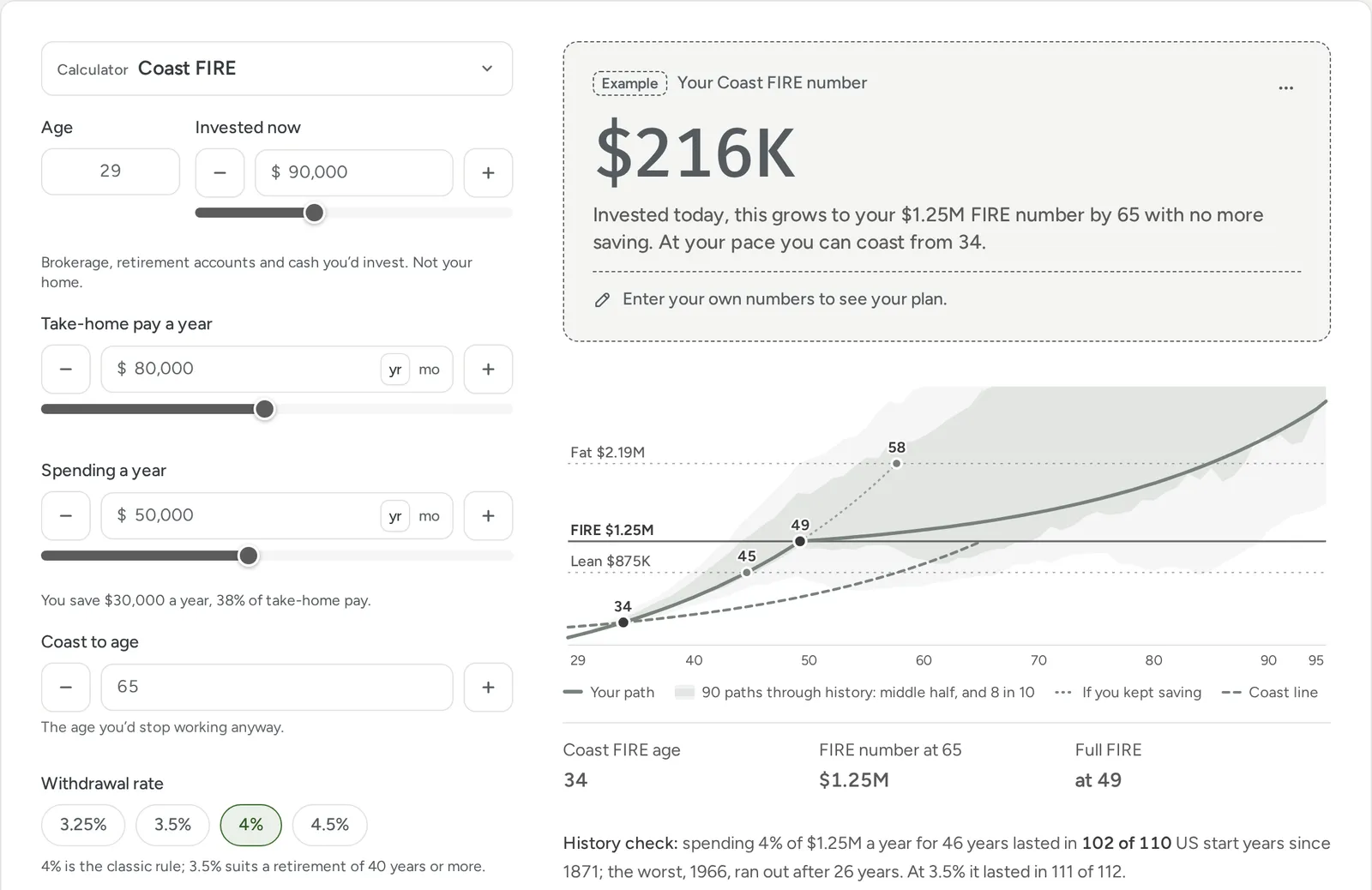
Here's the Coast FIRE calculator's own example, someone of 29 with $90,000 invested, taking home $80,000 and spending $50,000:
- FIRE number for $50,000 a year at 4%$1,250,000
- Divide by 1.05 to the 36th power, about 5.79÷ 5.79
- Coast number at 29$215,822
- Saving $30,000 a year on top of $90,000Coast at 34
There's a subtlety in that last step. You don't have to reach $215,822. While you keep saving, your balance rises and the number you need falls, because each year you wait leaves fewer years to grow. The calculator finds the first age where the two cross. Here that's just before 34, with about $273,000 invested. From then on, with no more saving, $273,000 growing at 5% for 31 years reaches about $1.25 million at 65.
Coast FIRE number by age
The same FIRE number needs very different amounts at different ages. These are for a $1.25 million target at 65, at 5% and at a more cautious 4% after inflation, worked out with the calculator's formula.
| Age now | At 5% real | At 4% real |
|---|---|---|
| 25 | $177,557 | $260,361 |
| 30 | $226,613 | $316,769 |
| 35 | $289,222 | $385,398 |
| 40 | $369,128 | $468,896 |
| 45 | $471,112 | $570,484 |
| 50 | $601,271 | $694,081 |
| 55 | $767,392 | $844,455 |
For another target, scale the row: a $2.5 million FIRE number needs twice these, a $1 million one needs 80% of them. One percentage point of return is a big deal over long stretches: at 25, dropping from 5% to 4% raises the Coast number by almost half.
Did coasting actually work in history?
The formula assumes the same return every year. Real markets don't do that, so we took the FIRE calculator's return series, Robert Shiller's US stock, bond and inflation data from 1871 to 2025, and asked a simple question for every possible start year: if you put in exactly the Coast number for an assumed return, invested 80% in stocks and 20% in bonds and rebalanced yearly, did it grow to the target in time?
Show the numbers
| Assumed 5% | Assumed 4% | |
|---|---|---|
| 20 years | 71.3% | 77.2% |
| 25 years | 69.5% | 81.7% |
| 30 years | 73.8% | 89.7% |
| 35 years | 74.4% | 96.7% |
| 40 years | 76.7% | 99.1% |
At an assumed 5%, about three in four start years got there, whatever the length. That makes sense: the mix averaged 6.4% a year after inflation over the whole record, so 5% is a bit below average, but plenty of 20- and 30-year stretches did worse. At 4%, long coasts almost always worked, because over 35 or 40 years the bad decades are usually made up for.
Falling short didn't mean ending up with nothing. For the 36-year coast in the example, 92 of 120 start years reached the target at 5%; among the 28 that didn't, the typical one got to about 83% of it, and the worst, starting in 1886, reached 60%. The middle start year ended a third above the target.
The usual cautions apply. Start years overlap heavily, so 120 of them hold only a few independent 36-year stretches. The US market was one of the best of the last century. And none of this counts fees.
What Coast FIRE doesn't cover
- You still have to pay for today. Coasting means your job covers all of your current spending, every year until 65. If you lose that income, the plan doesn't pause; you'd be drawing on money that was meant to grow.
- Your spending at 65 has to match the plan. The target is built from today's spending in today's dollars. If you expect to spend more in retirement, or less, change the spending, not the formula.
- Coast isn't the same as Barista FIRE. With Coast FIRE your investments are left alone. With Barista FIRE you leave full-time work and start drawing on them, with part-time pay covering the gap. Coast usually comes first, because it needs a smaller balance.
- A pension or Social Security changes the target. Money that starts later reduces what your investments have to pay. The calculator lets you add income that starts at a given age under More options.
Find your own Coast number
The Coast FIRE calculator needs your age, what you have invested, what you take home and what you spend. It shows your Coast number today, the age you reach it if you keep saving at your current pace, the dashed line of the falling target on a chart of your path, and how the same plan went through every stretch of US history since 1871. You can change the return, the withdrawal rate and the age you coast to. It all runs in your browser and nothing is sent anywhere.
If you're nowhere near it yet, that's normal. The point of the number is to tell you when you can ease off, and for most people that day comes years before full FIRE.
Sources
- Robert J. Shiller. Online Data for Irrational Exuberance: US stock prices, dividends, 10-year Treasury yields and CPI since 1871 (data to January 2026). The history check and the 6.4% average are our calculation from it, with the FIRE calculator's return series.
- The Coast FIRE formula is the standard one used by FIRE calculators, for example WalletBurst's Coast FIRE calculator.
- Anarkulova, Cederburg, O'Doherty and Sias (2025). The Safe Withdrawal Rate: Evidence from a Broad Sample of Developed Markets. On how US returns compare with other developed markets.
Share this post
Keep reading
Money· Nov 14, 2026· 12 min
How Much Do You Need to Retire Early? Your FIRE Number
Your FIRE number is 25 times a year's spending at 4%. We tested that rule on every US start year since 1871, including 50-year early retirements.Money· Oct 24, 2026· 18 min· Updated Nov 2026
Lease vs Buy a Car: Which Really Costs Less Over 6 Years?
On a $40,000 car, two 3-year leases cost $50,524 over 6 years; buying and keeping it cost $37,124 after resale value. How each payment works, worked out.Money· Oct 11, 2026· 12 min· Updated Nov 2026
How Much Have People Saved for Retirement by Age? (2025 Data)
Median and mean 401(k) and IRA balances by age from the Fed's 2025 survey, the 45% of families with no account at all, and why the median is the fair number.