Lease vs Buy a Car: Which Really Costs Less Over 6 Years?
On a $40,000 car, two 3-year leases cost $50,524 over 6 years; buying and keeping it cost $37,124 after resale value. How each payment works, worked out.
Money··17 min read
Over six years, buying a car and keeping it usually costs less than leasing, because you stop paying when the loan ends and you still own something worth selling. In our worked example, a $40,000 car leased twice for 36 months costs $50,524. The same car bought with a 60-month loan at 7.5% costs $37,124 once you take off the roughly $15,100 it's still worth at the end. That's $13,401 in favor of buying. Leasing gives you the smaller payment ($668 a month against $787) and less cash at signing, and it only comes out ahead if you'd have sold the car after about three years anyway.
Below: how a lease payment is actually built (with the money factor to APR conversion), the same car worked through both ways, what changes the answer, and where rates and prices stand in October 2026. This is general education with example numbers, not personal financial advice.
How a lease payment is built
A lease charges you for the part of the car you use up, plus interest on the money tied up in it. A consumer car lease in the US has to show you this sum: the federal leasing rule, Regulation M, requires a "mathematical progression of how the scheduled periodic payment is derived" on the contract (12 CFR 1013.4(f)). These are the parts you'll see.
- Capitalized cost. The price of the car in the lease, plus anything you finance into it. Money you pay up front to lower it is a capitalized cost reduction.
- Residual value. What the leasing company says the car will be worth at the end. It's set as a percentage of the price.
- Depreciation fee. The capitalized cost minus the residual, spread over the months. This is the car you use up.
- Finance fee (the "rent charge"). The capitalized cost plus the residual, times the money factor.
- Tax. In our example, sales tax on each payment. How leases are taxed varies by state.
Money factor to APR: multiply by 2,400
The money factor is the lease's interest rate written as a small decimal, such as 0.00250. To turn it into an APR you can compare with a loan, multiply it by 2,400: 0.00250 × 2,400 = 6.0%.
The 2,400 isn't magic. Over a lease you owe the capitalized cost at the start and the residual at the end, so the average balance is roughly (capitalized cost + residual) ÷ 2. A month's interest on that at an APR is the average balance × APR ÷ 12. Put the two together and the monthly finance fee is (capitalized cost + residual) × APR ÷ 24. So the money factor is the APR ÷ 24, and with the APR as a percentage, that's ÷ 2,400. It's an approximation of a true APR, but a close one.
| Money factor | ≈ APR |
|---|---|
| 0.00150 | 3.6% |
| 0.00180 | 4.3% |
| 0.00210 | 5.0% |
| 0.00250 | 6.0% |
| 0.00300 | 7.2% |
| 0.00350 | 8.4% |
The money factor is negotiable. The Consumer Financial Protection Bureau lists the "rental charge or money factor" among the lease terms people commonly negotiate, along with the price of the car, the residual, the mileage limit and the purchase option (CFPB).
A worked lease: $40,000 car, 36 months
Here's an example lease. The numbers are made up for illustration, not a real quote.
- Price (capitalized cost): $40,000, with no money down
- Term: 36 months
- Residual: 58%, which is $23,200
- Money factor: 0.00250 (6.0% APR)
- Sales tax: 7% on each payment
- Acquisition fee: $800, paid at signing
- Disposition fee: $400, paid when you hand the car back
- Mileage: 12,000 a year, and you drive exactly that
- Depreciation fee. $40,000 − $23,200 = $16,800 used up. $16,800 ÷ 36 = $466.67 a month.
- Finance fee. ($40,000 + $23,200) × 0.00250 = $63,200 × 0.00250 = $158.00 a month.
- Before tax. $466.67 + $158.00 = $624.67.
- Tax. $624.67 × 7% = $43.72, so the payment is $668.39 a month.
- Due at signing. The first payment plus the acquisition fee: $668.39 + $800 = $1,468.39.
- Whole lease. $1,468.39 at signing + 35 more payments of $668.39 ($23,393.65) + the $400 disposition fee = $25,262.04.
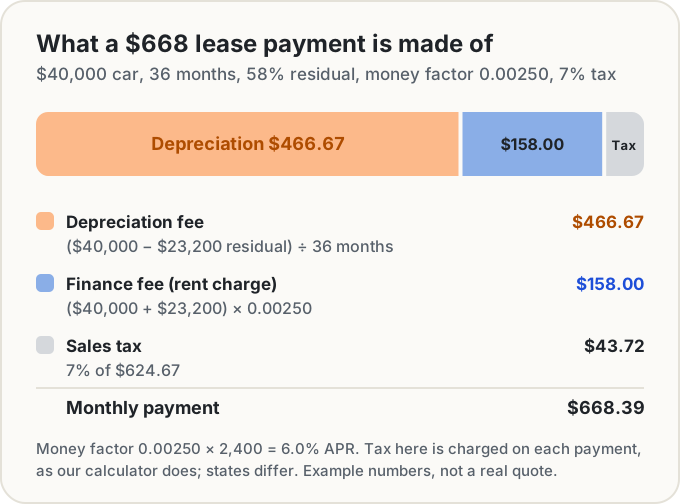
Notice what that finance fee adds up to: $158 × 36 = $5,688 in interest for the use of a car you hand back. And at the end you own nothing, so to keep driving you start a second lease.
The same car, bought with a loan
Now buy the same $40,000 car. We used a 7.5% APR because commercial banks averaged 7.54% on 60-month new-car loans in August 2026 (Federal Reserve G.19 release, October 7, 2026).
- Down payment: $4,000 (10%)
- Sales tax: 7% of the price, $2,800, financed
- Fees: $500, financed
- Loan: 60 months at 7.5%
- Amount financed. $40,000 − $4,000 + $2,800 + $500 = $39,300.
- Monthly payment. The standard loan formula, P × r ÷ (1 − (1 + r)^−n) with r = 7.5% ÷ 12 = 0.625% and n = 60, gives $787.49 a month.
- Total paid. $787.49 × 60 = $47,249, so $7,949 of interest. That's more interest than the lease's $5,688, but you're borrowing the whole car, not just the part you use.
- The down payment's lost return. Cash in the car can't earn anything elsewhere. At 4% a year, the $4,000 gives up $160 a year, $960 over six years.
- What the car is worth. Our calculator assumes a car loses 15% of its value each year, so after six years it's worth $40,000 × 0.85⁶ = $15,086. The loan is paid off, so all of that is yours.
- Net cost after six years. $47,249 + $4,000 + $960 − $15,086 = $37,124.
Step 5 is easy to skip, and skipping it is what makes leasing look cheap. The car you own at the end is real money: sell it, trade it in or keep driving it payment-free.
A fair comparison: six years each way
To compare like with like, both options need to cover the same years of driving. Over six years that means two back-to-back 36-month leases against buying once and keeping the car.
- Lease twice. $25,262 × 2 = $50,524. We've assumed the second lease costs the same as the first. In real life prices tend to rise, which would make leasing look worse.
- Buy and keep. $37,124, net of the $15,086 car.
Buying saves $13,401. The year-by-year picture shows when it pulls ahead.
| After year | Buy (net of the car's value) | Lease | Car's value less loan owed |
|---|---|---|---|
| 1 | $12,179 | $8,421 | $1,431 |
| 2 | $19,636 | $16,841 | $3,584 |
| 3 | $25,765 | $25,262 | $7,065 |
| 4 | $30,636 | $33,683 | $11,803 |
| 5 | $34,301 | $42,104 | $17,748 |
| 6 | $37,124 | $50,524 | $15,086 |
The lease is cheaper for the first three years, because the loan payment is bigger and the new car loses value fastest at the start. The lines cross at about 3 years and 2 months. After year 5 the owner pays nothing but running costs, while the leaser keeps paying $668 a month. Stretch the comparison to eight years and buying wins by $25,736.
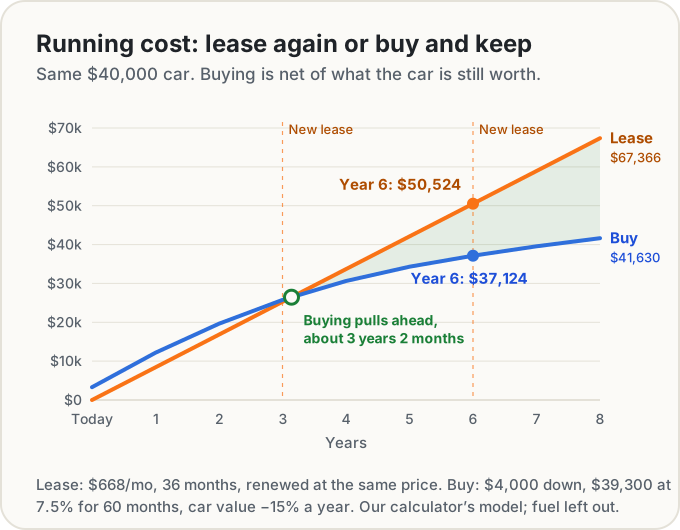
You can load this exact example in our Car Buy vs Lease Calculator and change any number. It puts the lease and the loan side by side, counts what the car is still worth, and shows the year buying pulls ahead.
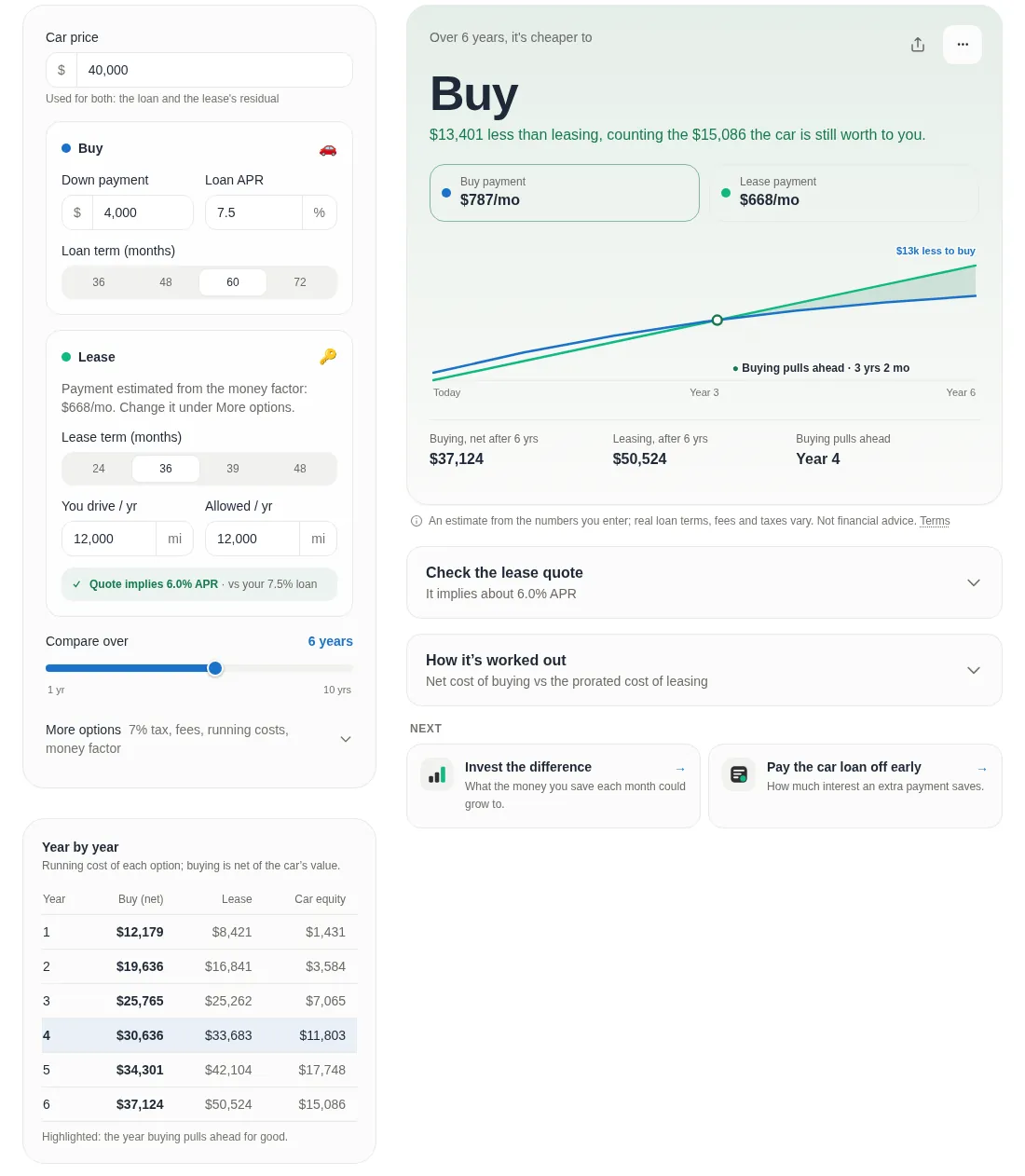
We set fuel and maintenance to zero, because the calculator adds the same amount to both sides. An owned car does cost more to keep up in years 4 to 6, once it's older and needs tires and brakes. If that's an extra $1,000 a year for those three years, buying still wins by about $10,400.
What changes the answer
A few inputs do most of the work. Each bar below changes one thing from the worked example and keeps everything else the same.
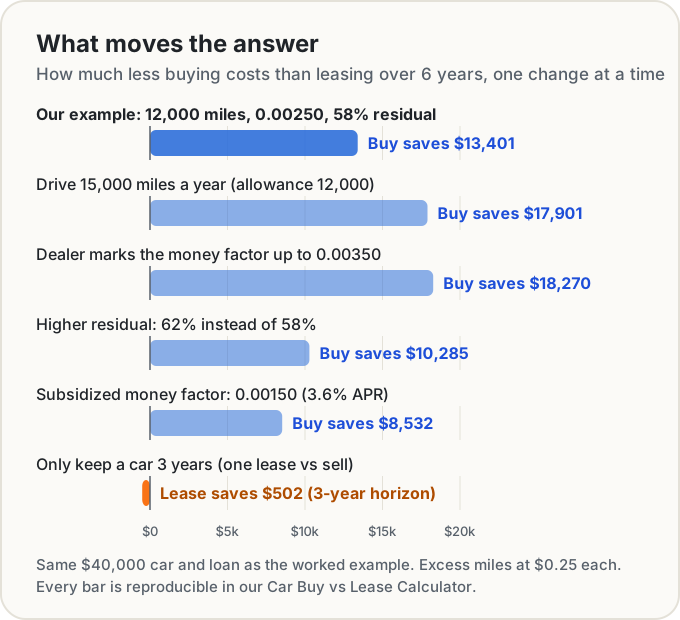
How long you keep a car matters most: at three years leasing wins by $502, at four buying wins by $3,047. After that, 3,000 miles a year over the allowance adds $2,250 to every lease at 25 cents a mile, and each 0.001 of money factor moves the payment by about $68 a month.
When leasing wins
You change cars every two or three years anyway. If you'd sell at year 3, you pay for the steepest depreciation either way. Over three years our example comes out about even, and leasing saves you selling the car.
The deal is subsidized. When a carmaker's finance arm offers a low money factor or a generous residual to move a model, some of the car's cost is being paid by someone else. Check the APR it implies (money factor × 2,400) against the loan rate you could get.
You use the car for business. If you lease a car you use for work, you can deduct the business share of each lease payment, under the actual-expenses method, with a small "inclusion amount" adjustment on pricier cars. Or you can use the standard mileage rate, but then you have to use it for the whole lease (IRS Publication 463, 2025 edition). Owning has its own depreciation rules, so the tax side can favor either. That's a question for whoever does your taxes.
You want predictable costs. The payment covers the steepest years of depreciation at a price fixed up front, while the car is new. If the car is worth less than the residual at the end, that's the leasing company's problem: you hand it back.
When buying wins
You keep cars five years or more. This is the big one. Every month after the loan ends is a month without a car payment.
You drive a lot. The CFPB notes that most leases cap you at 10,000 to 15,000 miles a year (CFPB), and the contract has to say what each extra mile costs (12 CFR 1013.4(h)). Buying has no limit.
Your car takes a beating. When you lease, "you're responsible for excess wear and damage and any missing equipment" (FTC). Dents and scuffs beyond the lease's wear standard get charged when you hand the car back. On a car you own, they just lower its resale value a bit.
Your plans might change. Ending a lease early is expensive. The lease has to carry a notice that says it plainly: "You may have to pay a substantial charge if you end this lease early. The charge may be up to several thousand dollars" (12 CFR 1013.4(g)). A car you own you can sell whenever you like.
You can use the new car loan interest deduction. For 2025 to 2028, you can deduct up to $10,000 a year of interest on a loan for a new car for personal use, if its final assembly was in the US and the loan started after December 31, 2024. It phases out above $100,000 of modified adjusted gross income ($200,000 for joint filers), and "lease payments do not qualify" (IRS). In our example, the first year's interest is about $2,720. It doesn't change the numbers above, which are before tax.
Gap insurance
If a car is written off or stolen, insurance pays what it's worth, which can be less than you still owe. Gap coverage pays the difference (CFPB). With a lease, carrying it "is generally required" (Insurance Information Institute), and "gap coverage is usually rolled into your lease payments" (Insurance Information Institute), so check your contract before paying for it twice. With a loan it's optional. You're most likely to need it with a small down payment, because a new car loses value faster than you pay down the loan at first. In our example the car is only worth $1,431 more than the loan after a year.
EVs: the lease deal that ended
Until fall 2025, leasing an electric car could come with a federal discount. Only the owner of a car can claim a clean vehicle credit, and for a leased car that's the leasing company, not you (IRS FAQ, Q18). Leasing companies could claim the commercial clean vehicle credit instead, worth up to $7,500 on a car (IRS), and any discount you got from it came through the lease price.
That's over. The 2025 tax law (Public Law 119-21) ended the new clean vehicle credit, the used one and the commercial one for any vehicle acquired after September 30, 2025 (IRS). "Acquired" means a binding written contract and a payment, so a lease written in 2026 can't carry a federal credit. An EV lease deal today is the carmaker's or the dealer's own money. EV leasing can still make sense if you worry about how fast EVs lose value, since a fixed residual moves that risk to the leasing company. Run the numbers the same way as for any other car.
Car prices and loan rates in October 2026
- Average price paid for a new vehicle: $50,562 in September 2026, with average incentives of $3,359 (6.6%). EVs averaged $55,879 (Kelley Blue Book, Cox Automotive, October 13, 2026).
- New-car loan rates at banks: 7.54% for 60 months and 7.17% for 72 months, August 2026 (Federal Reserve G.19, October 7, 2026).
- Carmakers' finance companies: 6.3% on new-car loans averaging 67 months and $41,705, June 2026 (same G.19 release).
Our $40,000 example is below the average, so scale it up if you're shopping near it. The pattern holds: the longer you keep the car, the further ahead buying gets.
Check a dealer's lease quote
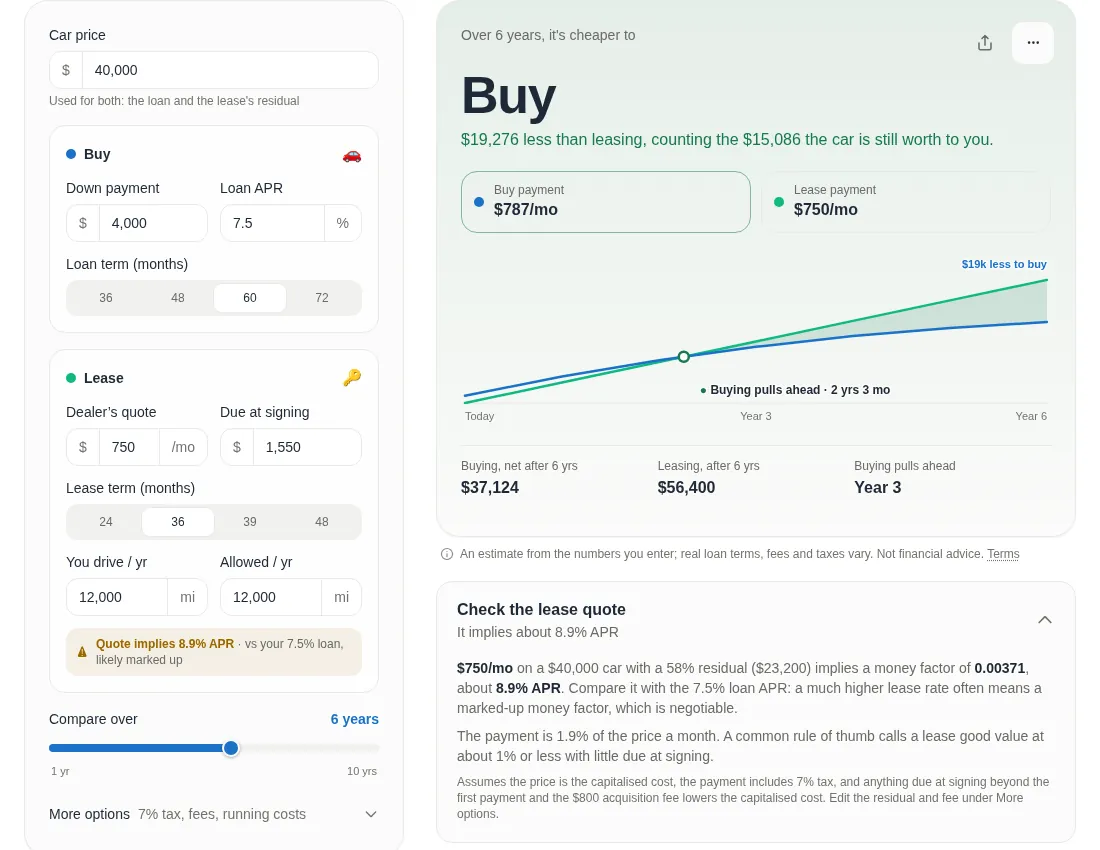
Dealers usually quote a monthly payment and an amount due at signing, not a money factor. You can work backwards. Suppose a dealer quotes $750 a month with $1,550 due for the same $40,000 car with the same 58% residual. Take the tax back out ($750 ÷ 1.07 = $700.93), subtract the depreciation fee ($466.67) to get a finance fee of $234.26, and divide by $63,200. The money factor is 0.00371, about 8.9% APR, against the 6.0% we started with. The extra $82 a month comes to about $2,950 over the lease, so it's worth asking the dealer to show the money factor.
The calculator's quote check does this for you (this quote, loaded). Switch the lease to "From the dealer's quote" and it shows the APR the payment implies, and flags it when it's more than a point above your loan rate.
Frequently asked questions
Is it better to lease or buy a car?
If you keep cars longer than about three or four years, buying usually costs less. In our example, buying saved $13,401 over six years. Leasing makes more sense if you change cars every two or three years, stay inside the mileage limit and get a low money factor. Put your own quote into the calculator to see where the lines cross for you.
How does a car lease work at the end?
You return the car, pay the disposition fee and pay for any miles over the allowance and any excess wear. If your lease has a purchase option, you can buy the car instead, usually for the residual value written in the contract (CFPB). Buying it out makes sense when the car is worth more than the residual.
What is 0.0025 money factor in APR?
0.0025 × 2,400 = 6.0% APR. Likewise 0.0015 is 3.6%, 0.0018 is 4.32%, 0.0021 is 5.04% and 0.003 is 7.2%.
Is it better to lease or buy a car with cash?
Paying cash removes the loan interest but ties up the money. In our example, paying the whole $43,300 (price, tax and fees) up front and counting a 4% return on that cash, buying came to about $38,600 over six years, still about $11,900 less than leasing twice. With no return on the cash, the gap would be bigger.
Keep going
If you buy, the Loan Prepayment Calculator shows how much interest an extra payment saves. If you lease, the Compound Interest Calculator shows what the lower payment could grow to if you invest the difference. And for whether a car loan is the kind of debt worth taking on, see good debt vs bad debt.
Sources
- Consumer Financial Protection Bureau. Regulation M, 12 CFR 1013.4, Content of disclosures: capitalized cost, residual, rent charge, the payment calculation, early termination notice, excess wear and mileage, purchase option.
- Consumer Financial Protection Bureau. What should I know about leasing versus buying a car? (last reviewed September 12, 2023): mileage limits, negotiable terms, end of lease.
- Consumer Financial Protection Bureau. What is Guaranteed Asset Protection (GAP) insurance? (last reviewed March 8, 2024).
- Federal Trade Commission. Financing or Leasing a Car: wear and damage, early termination.
- Insurance Information Institute. What is gap insurance?
- Board of Governors of the Federal Reserve System. G.19 Consumer Credit, released October 7, 2026: terms of credit for new-car loans.
- Cox Automotive. Kelley Blue Book average transaction price report, September 2026, October 13, 2026.
- Internal Revenue Service. FAQs on the modification of sections 25E, 30D, 45W and others under Public Law 119-21 (FS-2025-05); Credits for new clean vehicles; Commercial clean vehicle credit; Topic A FAQs, Q18 (leased vehicles).
- Internal Revenue Service. Working Families Tax Cuts: tax deductions for working Americans and seniors (FS-2025-03): car loan interest deduction.
- Internal Revenue Service. Publication 463, Travel, Gift, and Car Expenses (2025): leasing a car for business.
Share this post
Keep reading
Money· Oct 10, 2026· 10 min
My Inflation Rate: Why Yours Isn't the Official Number
Your personal inflation rate depends on what you buy. How CPI weights work, a commuter vs a renter priced with BLS data, the 2026 gas spike and your raise.Money· Oct 24, 2026· 18 min
Are Solar Panels Worth It in 2026 Without the Tax Credit?
With the 30% credit gone for 2026 installs, a $21,000 system pays back in about 11 years at the US average power price and under 8 in California.Money· Oct 11, 2026· 11 min
How Much Have People Saved for Retirement by Age? (2025 Data)
Median and mean 401(k) and IRA balances by age from the Fed's 2025 survey, the 45% of families with no account at all, and why the median is the fair number.