Are Solar Panels Worth It in 2026 Without the Tax Credit?
With the 30% credit gone for 2026 installs, a $21,000 system pays back in about 11 years at the US average power price and under 8 in California.
Money··18 min read
For a lot of homes, yes, but it takes longer than it did a year ago. The 30% federal tax credit for homeowners ended for systems installed after December 31, 2025, so in 2026 you pay the whole price. A 7 kW system at last year's median cash price of $3.00 a watt costs $21,000. At the US average electricity price (18.2¢ a kWh, January to August 2026), with your utility crediting exported power at the full rate, it pays for itself in about 11 years, against about 8 with the old credit. At California's 32.6¢ it's 6 to 8 years. Where power costs around 15¢ and exports earn little, it's 15 years or more, over half of the 25 years our calculator counts.
Below: the chart and state table behind those numbers, what happened to the credit, a worked California example you can redo in our calculator, the inputs that move the answer, and when solar isn't worth it.
This is general education, not personal financial or tax advice. Your quotes, your bill and your utility's rules decide your own number.
The 2026 answer in one chart
Payback is the number of years until the bill savings add up to what you paid. One of the biggest drivers is what you pay per kWh, because every kWh your panels make is one you don't buy.
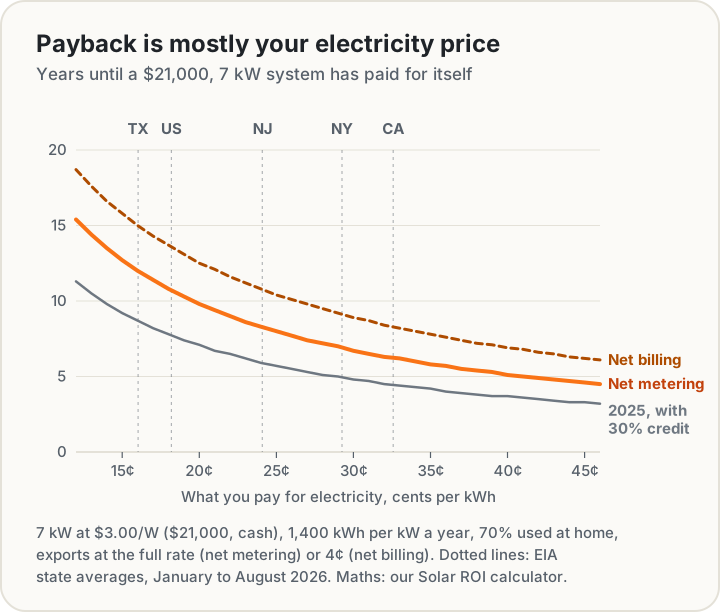
The three lines are the same system under three sets of rules:
- Net metering (solid orange): power you send to the grid earns the same rate you pay for power you take from it.
- Net billing (dashed): power you send back earns a much lower credit, here 4¢. California's three big utilities have worked this way for new solar customers since April 2023.
- 2025, with the 30% credit (grey): what the same system cost a year ago.
Here's the same sum for the ten states in our calculator, with each state's average price from the EIA and the calculator's estimate of what a south-facing kW of panels makes there. Everything else is held the same: 7 kW at $3.00/W, paid in cash, no state incentives. Prices are January to August 2026 averages in cents per kWh, paybacks are in years, and the last column is the same system in 2025 with the 30% credit and net metering.
| State | Price | kWh per kW | Net metering | Exports at 4¢ | 2025, with credit |
|---|---|---|---|---|---|
| California | 32.6¢ | 1,500 | 5.8 | 7.8 | 4.2 |
| Massachusetts | 30.2¢ | 1,200 | 7.7 | 10.2 | 5.5 |
| New York | 29.3¢ | 1,200 | 8.0 | 10.5 | 5.7 |
| New Jersey | 24.1¢ | 1,250 | 9.2 | 11.9 | 6.6 |
| Arizona | 15.4¢ | 1,650 | 10.7 | 13.4 | 7.7 |
| Colorado | 16.8¢ | 1,500 | 10.8 | 13.6 | 7.8 |
| Texas | 16.0¢ | 1,450 | 11.6 | 14.5 | 8.4 |
| Florida | 15.3¢ | 1,400 | 12.5 | 15.5 | 9.0 |
| Georgia | 15.5¢ | 1,350 | 12.8 | 15.9 | 9.3 |
| North Carolina | 14.9¢ | 1,350 | 13.2 | 16.3 | 9.6 |
Arizona has the most sun on the list and lands mid-table, because its power is cheap. Massachusetts has among the least and pays back faster, because its power is expensive. Which export column applies to you depends on your utility, so check before you trust either.
What happened to the 30% tax credit
The Residential Clean Energy Credit (section 25D of the tax code) gave homeowners 30% of the cost of solar panels, batteries and a few other systems back as a tax credit. The 2025 budget law (Public Law 119-21, signed July 4, 2025) rewrote its end date. Section 25D(h) now reads: "The credit allowed under this section shall not apply with respect to any expenditures made after December 31, 2025." Before the change, it was due to stay at 30% until the end of 2032, then drop to 26% and 22%.
The detail that matters is what "expenditures made" means. Under section 25D(e)(8), a cost "shall be treated as made when the original installation of the item is completed". So the date that counts is when the installation is finished, not when you signed or paid. The IRS FAQ on the change (Fact Sheet 2025-05, August 21, 2025) asks whether you can claim the credit for a system installed after 2025 if you paid for it on or before December 31, 2025. The answer is "No."
Who still gets it:
- Installations completed by December 31, 2025. You claim it on your 2025 tax return with Form 5695. The 2025 Form 5695 instructions confirm the cut-off and say that if your tax bill was too small to use the whole credit, the unused part carries forward to 2026.
- Nobody installing in 2026. The end date covers the whole section, so home batteries lost the credit at the same moment as panels.
Leases and the business credit
If a company owns the panels on your roof and you lease them or buy their power, the company claims a business credit instead, section 48E. The 2025 law ended that one later. For solar, section 48E(e)(4) stops the credit for systems placed in service after December 31, 2027, unless construction began by July 4, 2026, and newer projects must also meet rules on components from "prohibited foreign entities". The law added a ban on the business credit for leased home systems, but it covers solar water heaters and small wind turbines, not solar panels that make electricity.
So a leasing company may still get a credit on a 2026 or 2027 install. Whether any of it reaches you depends on the contract, which is a reason to price a lease against a cash quote rather than assume it's cheaper.
A worked example: California in 2026
Here's one home, with every input on show. It's the calculator's California default bill with two changes: EIA's state average rate and a 4¢ export credit.
- Your use. A $260 monthly bill at 32.58¢ a kWh is $260 × 12 ÷ $0.3258 = 9,576 kWh a year.
- System size. The calculator assumes 1,500 kWh per kW a year in California, so you need 9,576 ÷ 1,500 = 6.4 kW. It rounds to the nearest half kW: 6.5 kW, about 17 panels, making 6.5 × 1,500 = 9,750 kWh in year 1.
- Cost. 6,500 W × $3.00 = $19,500, with no federal credit.
- Year-1 savings. The calculator assumes you use 70% of your solar at home. That's 6,825 kWh × $0.3258 = $2,223.59. The other 2,925 kWh go to the grid at 4¢: $117.00. Together: $2,341.
- Simple payback. $19,500 ÷ $2,341 = 8.3 years if nothing changed.
- With time. The calculator lets the price of electricity rise 2.5% a year and the panels lose 0.5% of their output a year. The rising price wins, so savings grow a little each year and payback comes at 7.8 years. After 25 years you're $55,350 ahead.
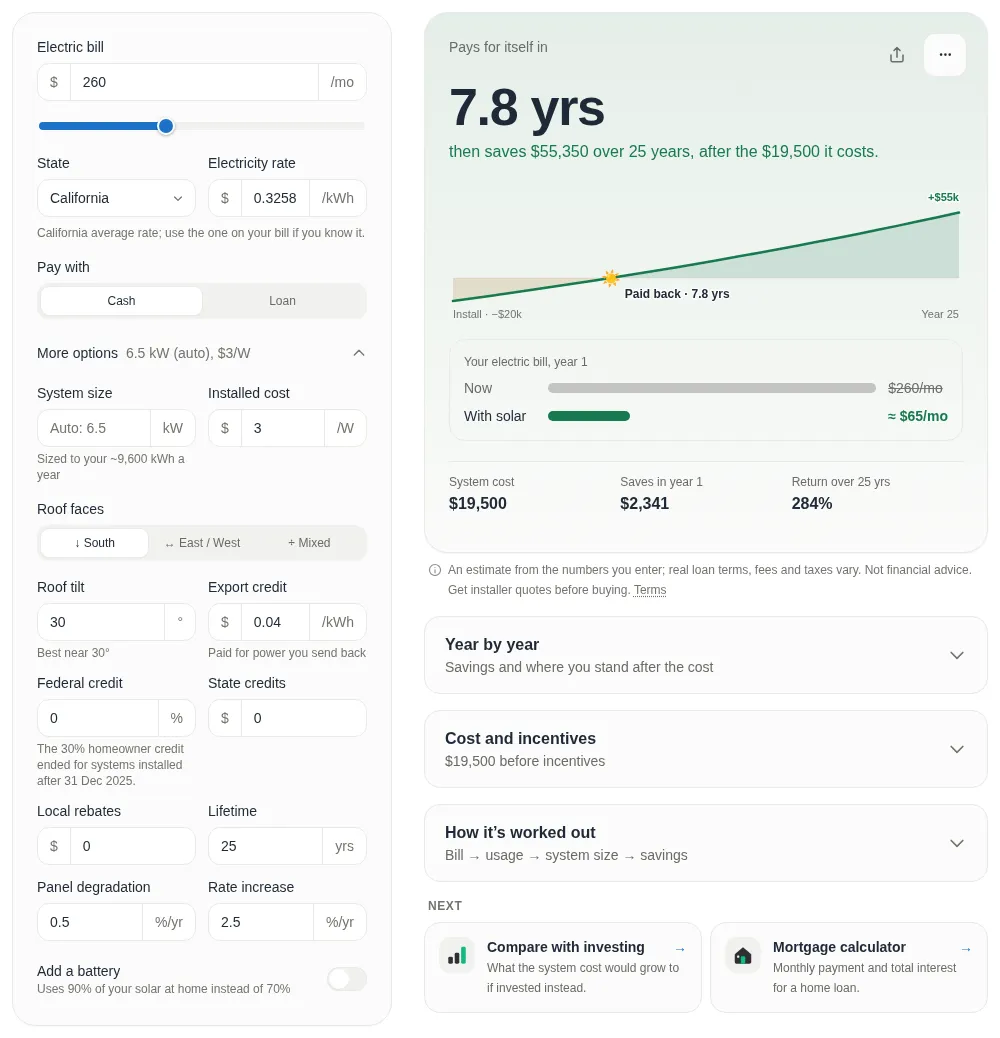
You can open this exact example in the calculator and change any number. Had the same panels been finished in 2025, the credit would have taken $5,850 off the price:
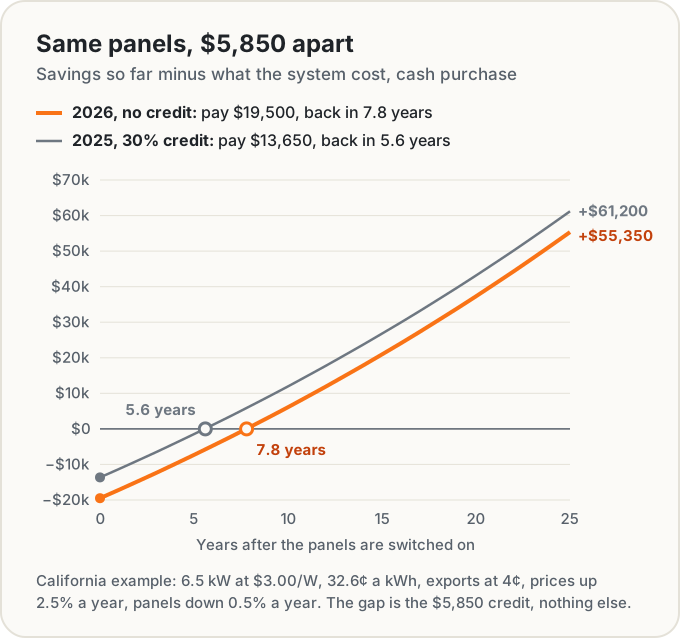
The credit was worth about two years of payback here, and the lines stay exactly $5,850 apart for 25 years. Even without it, $19,500 for those savings works out at about a 13% annual return. To compare that with investing the money instead, see our compound interest calculator and our explainer on compound interest.
The example, like the calculator, leaves out repairs and an inverter replacement, so budget for those over 25 years.
The inputs that decide payback
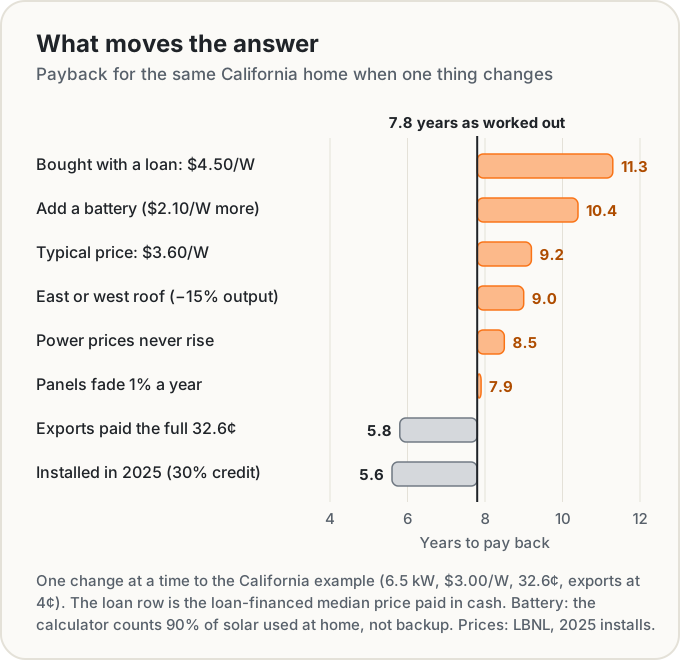
Here's how much each input moves the answer for the California home, one at a time:
Installed cost per watt
Berkeley Lab's U.S. Distributed Solar and Storage Data: 2026 Update (August 2026) covers systems installed in 2025. For homeowner-owned systems, before any incentives, the median prices were:
- $3.00 per watt when paid in cash;
- $3.60 per watt across all buyers;
- $4.50 per watt when bought with a loan. The report says this is "potentially due in part to loan origination fees rolled into the up-front price", and it doesn't include the interest.
That loan gap is the biggest bar on the chart. The same 6.5 kW system at $4.50/W is $29,250, and with a 20-year loan at 7% and nothing down, the calculator's payback stretches to 15.9 years. If a quote comes with "no money down" financing, ask for the cash price too and compare. Our post on good and bad debt has more on that kind of trade.
Prices also vary a lot by company. Among the top 100 installers, the median price ranged from $2.40 to $6.30 per watt. Getting three quotes is the cheapest thing you can do for your payback. The median home system in 2025 was 7.7 kW, which is why the chart above uses 7 kW.
What you pay for electricity
The state averages come from the EIA's Electric Power Monthly, Table 5.6.B (released October 23, 2026; 2026 values are preliminary). The US average for January to August 2026 was 18.19¢ a kWh, up from 17.03¢ in the same months of 2025.
Those averages are total revenue divided by total kWh sold, so they include fixed monthly charges that solar can't touch. California's three big utilities now bill most homes a fixed Base Services Charge ($24.15 a month at SCE and SDG&E for most customers), and lowered the price per kWh at the same time, according to the CPUC. The number that matters for solar is the per-kWh price on your own bill, and the time-of-use rate if you're on one.
Sun and roof direction
How much a kW of panels makes depends on where you live, which way the roof faces and what shades it. The free PVWatts calculator from the National Laboratory of the Rockies (the National Renewable Energy Laboratory until December 2025) estimates it for your address. We ran it for a south-facing roof tilted 20°, with 14.08% system losses:
| City | kWh per kW a year |
|---|---|
| Seattle | 1,087 |
| New York | 1,290 |
| Boston | 1,301 |
| Atlanta | 1,400 |
| Houston | 1,420 |
| Denver | 1,594 |
| Sacramento | 1,616 |
| Los Angeles | 1,676 |
| Phoenix | 1,753 |
Our calculator's state figures are a bit lower than these (1,500 for California, 1,200 for New York), so its paybacks lean conservative. If PVWatts gives you more for your address, set the system size and see. An east or west roof, which the calculator counts as 15% less output, added 1.2 years in the example.
Net metering or net billing
This rule can turn a good deal into a mediocre one. Under net metering, every kWh you export is worth the full retail price. Under net billing, exports earn a lower credit and only the power you use yourself saves the full price.
California is the big example. The CPUC replaced net metering with the Net Billing Tariff in decision D.22-12-056 (December 15, 2022). It covers PG&E, SCE and SDG&E customers who applied to connect on or after April 15, 2023, and it's often called NEM 3.0. Existing solar homes keep their old terms for 20 years from connection, according to the CPUC, and new customers can lock in their export credits for 9 years.
Export credits are set hour by hour from the CPUC's avoided-cost values. SDG&E publishes its export prices for customers who applied in 2026, so here's what they look like over a day:
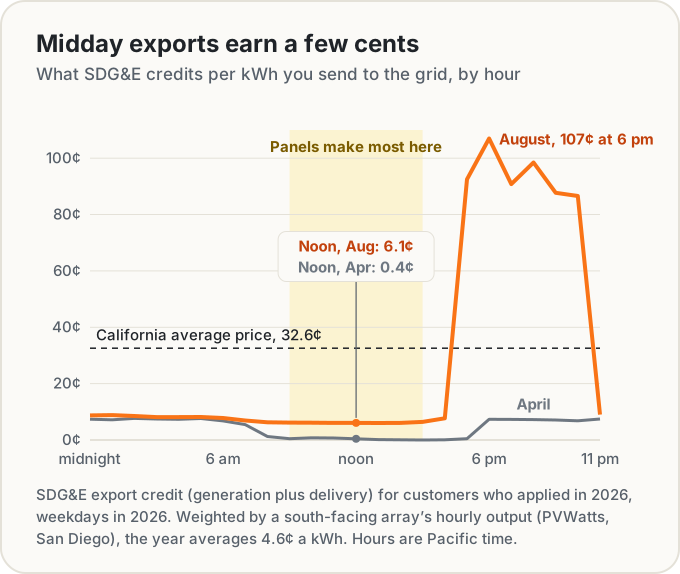
The credit peaks in the early evening and bottoms out around midday, when panels make the most. For a customer who buys power from SDG&E (a community choice provider sets its own generation credit), we weighted every hour of the 2026 export prices by what a south-facing array in San Diego makes in that hour (from PVWatts): the year works out at 4.6¢ a kWh, against an average retail price of 32.6¢. Power you actually export skews even more to midday, so the real figure may be lower.
That's why the worked example uses 4¢, and why the "exports paid the full 32.6¢" bar on the chart above is worth two years. It's also the case for a battery in California: storing the midday surplus and using it in the evening is worth far more than exporting it at midday. The CPUC estimated in 2022 that new solar customers would pay off their systems "in just 9 years or less on average", but the 30% federal credit was available when it said that.
Outside California, rules vary by state and sometimes by utility. Your utility's website or your state's page on DSIRE will say which you're on.
Panel degradation
Panels slowly lose output. A review of nearly 2,000 measured rates from field studies found a median loss of 0.5% a year (Jordan and Kurtz, NREL). At that rate, panels make about 89% of their first-year output in year 25. It matters less than you'd think: doubling it to 1% a year moved the example's payback by 0.1 year, because the early years count most.
State and local incentives
With the federal credit gone, state rebates, state tax credits, property-tax exemptions and utility rebates matter more. They change often, so we haven't listed any. DSIRE, run by the N.C. Clean Energy Technology Center at NC State University, lists them by ZIP code. Enter what you find under "State credits" and "Local rebates" in the calculator.
When solar isn't worth it
- Your roof is shaded. Shade from trees or a taller building next door cuts output, and no state average knows about it. Ask installers for a shading report: if their production estimate is well below your area's PVWatts number, payback grows to match.
- You'll move before it pays back. At 11 years of payback, someone who moves in 5 is betting that the buyer will pay for the panels. If you lease, the buyer has to take the lease over, or you pay it off.
- Your power is cheap and exports earn little. Below about 15¢ a kWh with a low export credit, payback runs past 15 years, more than half the panels' life, before any repairs.
- Your roof needs replacing soon. Panels have to come off and go back on when the roof is redone, which costs money. If the roof is near the end of its life, replace it first.
- You'd pay with an expensive loan. Loan-financed systems cost a median $1.50 a watt more than cash-paid ones in 2025, before interest. A cash quote, or waiting until you can pay cash, can be worth years.
The opposite also holds: high prices, full net metering, a clear south roof and staying put make solar pay even without the credit.
Run your own numbers
The Solar Panel ROI Calculator sizes a system from your bill and state and shows the payback year, the savings curve and a year-by-year table, for cash or a loan. The federal credit starts at 0% for 2026, and everything else is yours to change. Then get real quotes and put their numbers in.
Frequently asked questions
Is the solar tax credit still available in 2026?
Not for homeowners. The 30% Residential Clean Energy Credit doesn't apply to systems whose installation was completed after December 31, 2025, even if you paid earlier. Systems finished in 2025 are claimed on the 2025 tax return, and any unused credit carries forward to 2026. Leasing companies may still claim a business credit for systems placed in service by the end of 2027.
Is solar worth it without the tax credit?
Often, where power is expensive: about 6 to 8 years at California's average price and about 11 at the US average with net metering, for a 7 kW system at $3.00 a watt. Below about 15¢ a kWh it's 12 to 16 years or more.
Is solar worth it without net metering?
It can be, but it pays back more slowly. In the table above, moving exports from the full rate to 4¢ adds 2 to 3 years everywhere. Under net billing, sizing the system to what you use during the day, or adding a battery, keeps more of the solar at the full price.
Is solar worth it without a battery?
In the calculator, a battery at 2025's median extra cost ($2.10 a watt more for a paired system) lengthened the California example's payback from 7.8 to 10.4 years. The calculator only counts the extra solar you use at home, not backup power in an outage, and not the higher evening export credits under California's net billing, so for some homes a battery is worth more than that.
Should I lease or buy solar panels?
When you buy, you keep all the savings. With a lease or power purchase deal you pay the company instead, usually with little or nothing up front, and the company may still get a business tax credit that a homeowner can't. Add up the lease's payments over its term and compare them with a cash quote for the same system.
Sources
- 26 U.S.C. § 25D, Residential Clean Energy Credit, as amended by Pub. L. 119-21 (July 4, 2025): subsection (h), termination; (e)(8), when an expenditure is made; (d), qualifying property.
- 26 U.S.C. § 48E, Clean Electricity Investment Credit: (e)(4), wind and solar termination, and its effective-date note; (i), leased residential property; (b)(6), prohibited foreign entities.
- Internal Revenue Service. FAQs for modification of sections 25C, 25D … under Public Law 119-21, FS-2025-05 (August 21, 2025), and Instructions for Form 5695 (2025).
- Barbose, G., Darghouth, N., O'Shaughnessy, E., Forrester, S. U.S. Distributed Solar and Storage Data: 2026 Update. Lawrence Berkeley National Laboratory, August 2026. Installed prices, installer spread and system size for 2025 installs.
- U.S. Energy Information Administration. Electric Power Monthly, Table 5.6.B, data through August 2026, released October 23, 2026; glossary: average revenue per kilowatthour.
- National Laboratory of the Rockies. PVWatts Calculator: yearly output for nine cities (API version 8.5, run October 24, 2026) and hourly output for San Diego (website version 8.7.4, run October 25, 2026), all for 1 kW on a south-facing roof at 20° with 14.08% losses.
- California Public Utilities Commission. Net Billing Tariff (D.22-12-056); press release, December 15, 2022; FAQ on the decision; Base Services Charge update (December 2025).
- San Diego Gas & Electric. Solar Billing Plan export pricing, 2026 export rates for customers who applied in 2026 (NBT26).
- Jordan, D. C., & Kurtz, S. R. Photovoltaic Degradation Rates: An Analytical Review. Progress in Photovoltaics: Research and Applications, 21(1), 12-29 (2013; online 2011). OSTI 1045052.
- N.C. Clean Energy Technology Center. DSIRE, the Database of State Incentives for Renewables & Efficiency.
Share this post
Keep reading
Money· Oct 24, 2026· 17 min
Lease vs Buy a Car: Which Really Costs Less Over 6 Years?
On a $40,000 car, two 3-year leases cost $50,524 over 6 years; buying and keeping it cost $37,124 after resale value. How each payment works, worked out.Money· Oct 10, 2026· 10 min
My Inflation Rate: Why Yours Isn't the Official Number
Your personal inflation rate depends on what you buy. How CPI weights work, a commuter vs a renter priced with BLS data, the 2026 gas spike and your raise.Money· Oct 11, 2026· 11 min
How Much Have People Saved for Retirement by Age? (2025 Data)
Median and mean 401(k) and IRA balances by age from the Fed's 2025 survey, the 45% of families with no account at all, and why the median is the fair number.