What Colours Go With Navy (and Why They Work)
Navy goes with almost anything because it acts like a neutral. The pairings that work best, the ones that need care, and what colour studies really show.
Style··10 min read
Almost everything goes with navy, because in clothes it behaves like a neutral: a dark, quiet blue that sits behind other colours instead of competing with them. The safest partners are the light ones, white, light blue, grey, cream and beige, because they give a clear light-and-dark contrast. Navy is also a great base for one accent colour: rust, mustard, yellow, coral, pink or lavender.
The colours to handle with a little care are the other dark ones: black, charcoal, brown, forest green, plum and burgundy. They aren't banned. They just sit so close to navy in lightness that the outfit can read as one dark block unless something lighter breaks it up.
That ranking isn't a guess. It comes from the engine behind our Outfit of the Day tool, and the rest of this post shows how it scores each pairing, which parts rest on lab studies and which are plain stylist convention.
Why navy works like a neutral
The navy in your wardrobe is a very muted blue. Measured in OKLCH, the perceptual colour space the CSS colour standard uses, a typical navy fabric colour (#1F2A44) has a lightness of 0.29 on a 0 to 1 scale and a chroma (colourfulness) of just 0.05. For comparison, the CSS keyword navy (#000080) is far more saturated, at a chroma of about 0.19, so it's a poor stand-in for real navy cloth.
Low chroma is what makes a colour read as calm. Our engine counts any blue in the navy-to-denim range with a chroma under 0.085 as a neutral, alongside black, white, greys and the beiges and browns. Treating navy as a neutral is a stylist convention, though, not a lab finding. We found no study that tests it directly, so the tool labels it "less sure".
Two things that do have lab evidence behind them:
- Light against dark is liked. In Schloss and Palmer's 2011 study of colour pairs, preference rose with lightness contrast. Navy is dark, so nearly anything lighter gives you that contrast for free.
- Similar hues look harmonious. The same study, and Ou and Luo's 2006 colour harmony model, both found that pairs close in hue are rated as going together. That's why navy with light blue or denim scores so well.
Both studies used flat colour patches on a screen, not clothes on people, so treat them as a strong hint rather than a law of fashion.
Every common colour, ranked with navy
We asked the engine's pairingsFor() function to score a navy top worn with trousers in each of 32 common garment colours. The score blends three parts of the full outfit score that depend only on the two colours: colour harmony (half the Ou and Luo model, half the scheme rules stylists use), light-against-dark contrast, and whether there's one clear statement piece. It runs from 0 to 1.
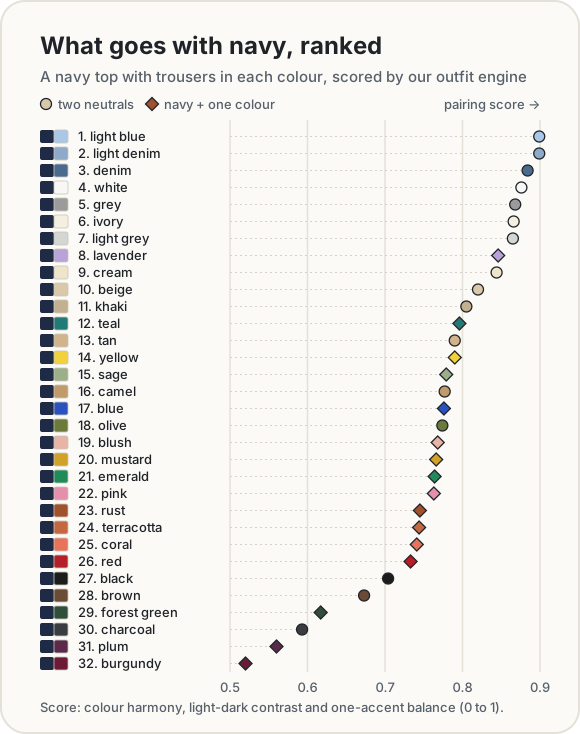
The top of the list is no surprise: blues, whites and greys. The middle is where it gets fun, with lavender, teal, yellow and sage all scoring above camel. And the bottom is all dark colours, for the same reason: as a pair of large pieces, they have almost no lightness contrast with navy.
Light partners: the easy wins
If you're standing in front of the wardrobe asking what colour shirt goes with navy trousers, the answer is any light one. White, light blue, light grey, cream and pale pink all work, and so does lavender, which surprised us by landing eighth.
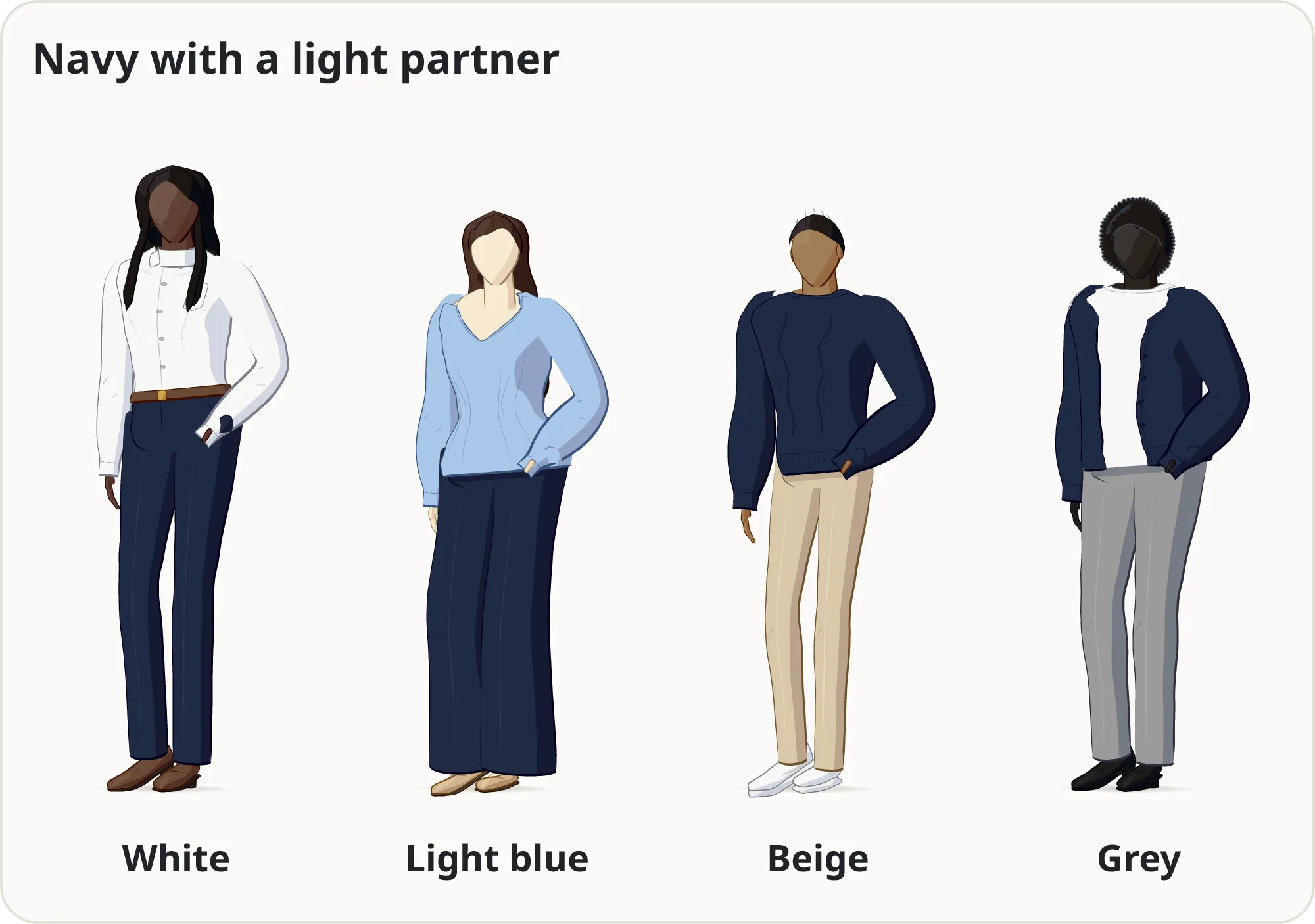
For the navy-and-white look, the tool's explanation reads: "The white shirt against the navy trousers gives a clear light-and-dark contrast, which people tend to like." That one is tagged as research, because it's the lightness contrast finding from Schloss and Palmer.
Beige is a nice example of why the engine blends evidence with convention. On the Ou and Luo model alone, navy with beige scores about −0.04 (across everyday clothing colours it runs from about −1 to +1.3), well below navy with white at +0.46 or navy with light blue at +0.56. Navy with beige is a stock stylist pairing, though, and the convention half of the score credits it as two neutrals, so it still ranks tenth overall.
Navy with one accent colour
Navy is the easiest base there is for a single bright or warm colour. The rule the engine applies is "one statement piece at a time": one coloured piece, with everything else calm. It's stylist convention rather than a tested finding, but it's a sensible one, and navy makes it easy to follow.
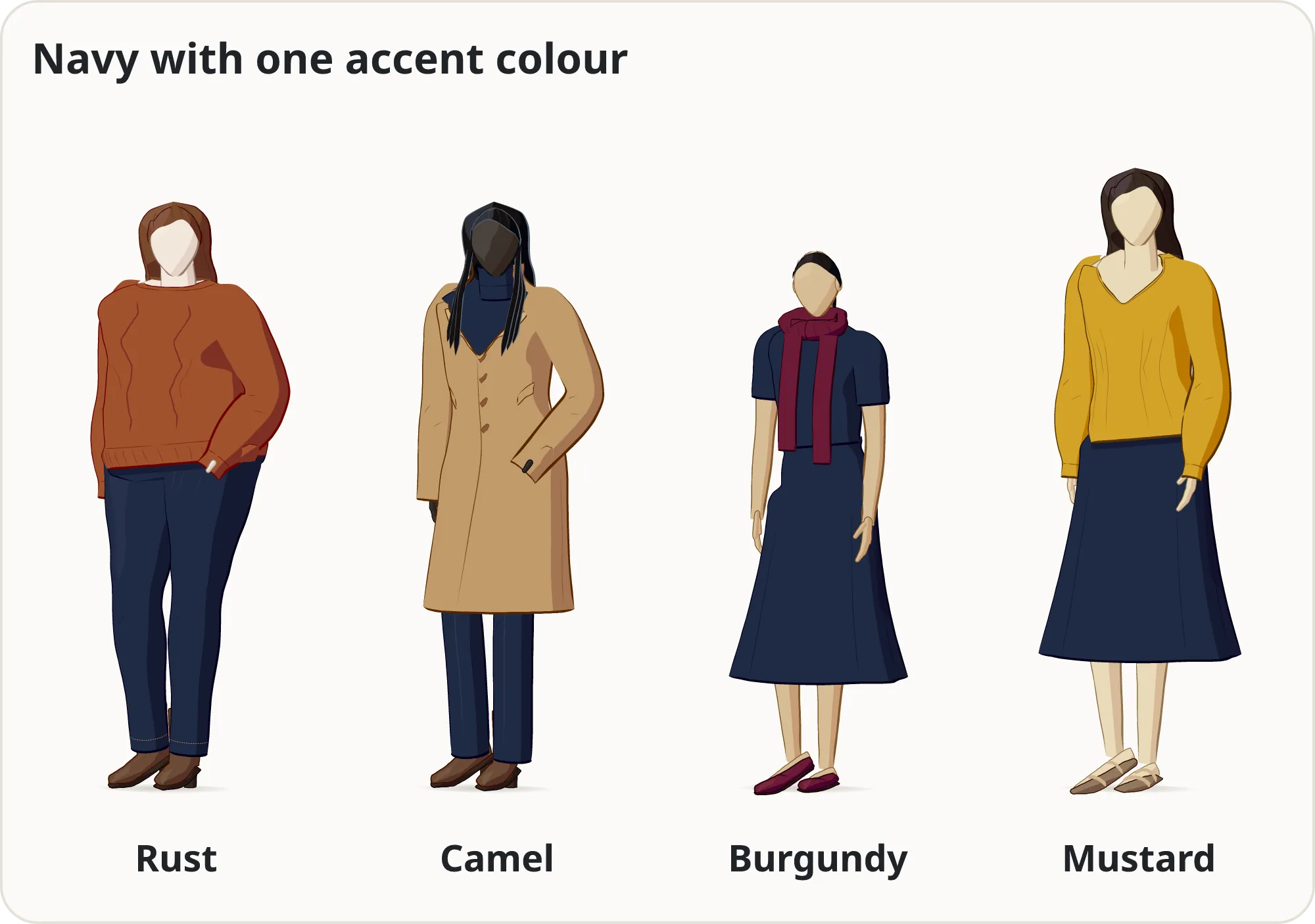
- Rust and terracotta. The autumn favourite. The engine's reason: "The rust sweater is the one colour; everything else is calm, so it stands out without competing."
- Camel. Technically another neutral (an earth tone), so navy and camel count as "two neutrals". A camel coat over all-navy is about as safe as a smart outfit gets.
- Mustard and yellow. Bright, cheerful and high in contrast. Yellow ranked 14th of 32, above camel.
- Burgundy. This one needs care. Burgundy is nearly as dark as navy (lightness 0.36 against 0.29), which is why it ranks last as a pair of trousers with a navy top. As a smaller piece, a scarf, shoes or a bag, it works. The engine also flags something easy to miss: "To people with red-green colour blindness, the navy dress and the burgundy flats may look alike." That check uses a published colour vision deficiency model (Machado and colleagues, 2009).
The complementary myth
You'll often read that navy and orange "go together because they're complementary colours". On the artist's colour wheel they are roughly opposite. But the lab studies don't support the idea that opposites are harmonious. The Ou and Luo model has no term that rewards opposite hues, and it gives navy with rust about −0.57, one of the lowest scores among these pairs. Schloss and Palmer found that pairs with very different hues were generally rated neither harmonious nor preferred.
So why does navy and rust look so good? Because navy is quiet enough to act as a backdrop, there's a clear step from dark to mid-light, and only one piece is doing the talking. Complementary pairs are bold on purpose, and the tool says exactly that ("a deliberately bold pairing") rather than calling them harmonious.
Dark on dark: all navy, and navy with black
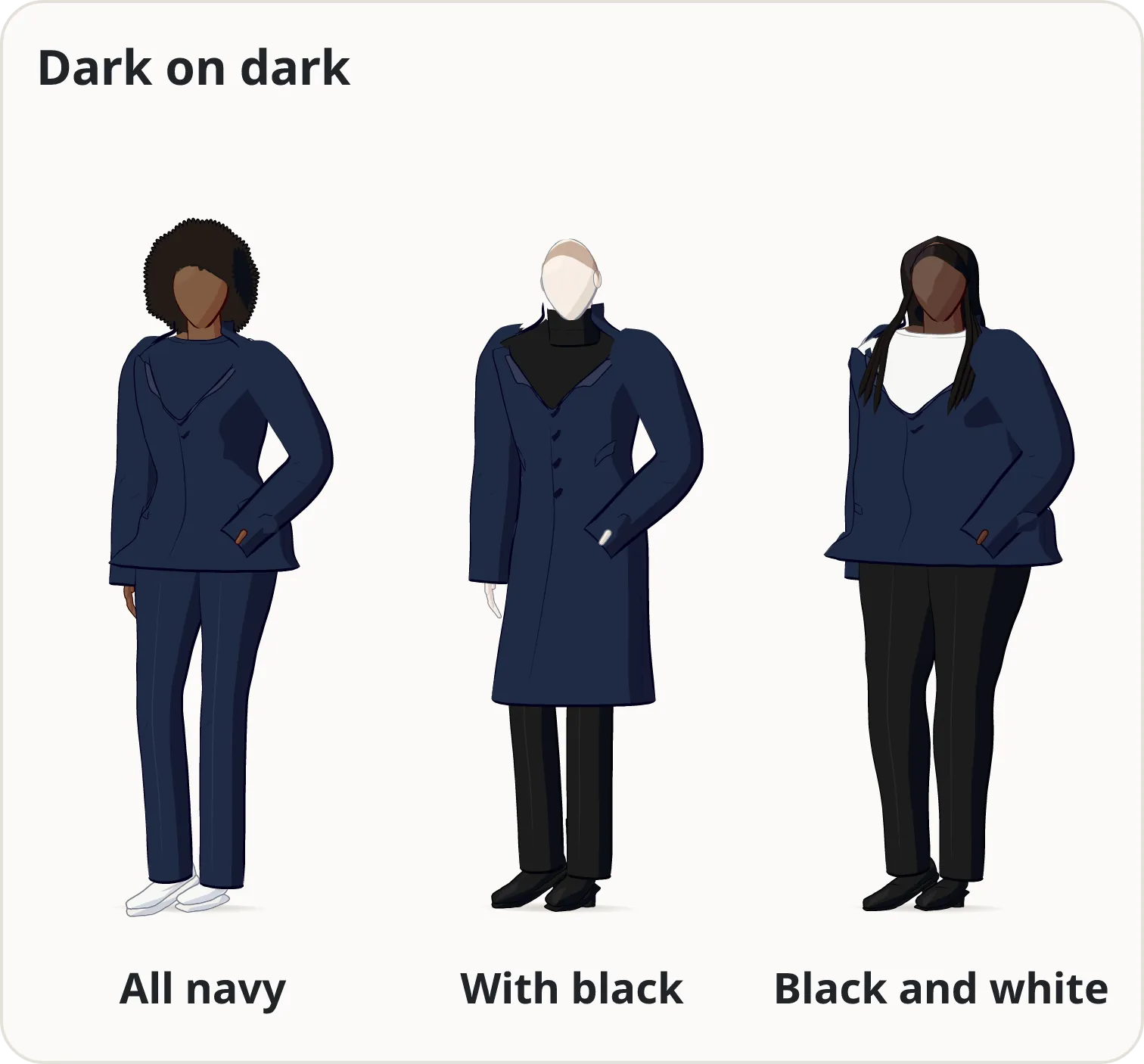
All navy works well. The engine calls it "one deliberate, tonal look", and it scored the head-to-toe navy outfit above at 0.81, level with navy trousers and a white shirt. Two things keep it interesting: mix textures (a wool blazer over a cotton tee) or shades, and give it one light point, such as white sneakers.
Navy with black is where people get nervous, and the old rule says never. We found no study that tests it either way, so it's a matter of taste. The engine treats it as a tonal dark look and scores it modestly: the navy coat over all black above came out lowest of the eleven looks in this post, at 0.73. Add one light piece, such as a white T-shirt under a navy blazer with black trousers, and it climbs to 0.76. The trick is making it look chosen: clearly different textures, or a clear gap between the navy and the black.
Shoes and accessories with navy
- Brown and tan leather are the classic partners for navy trousers, suits and dresses. At smarter occasions, the engine checks that the belt and shoes are the same leather colour. That's convention, but it's an easy one to follow.
- White sneakers go with almost any navy, and they're the quickest way to lighten an all-navy or navy-and-black outfit.
- Burgundy, rust or mustard shoes or a bag are a good way to try an accent without committing to a whole coloured top.
- One metal across a watch, jewellery and buckles keeps things tidy. Again, convention.
Try it with your own navy piece
In Outfit of the Day, every piece of the look has a lock. Lock the navy piece, press Shuffle, and the engine builds a new outfit around it, with a short explanation of why each part works and a label for how strong the evidence is. Here we started from navy trousers with a white shirt and brown loafers, locked the trousers and shuffled once.
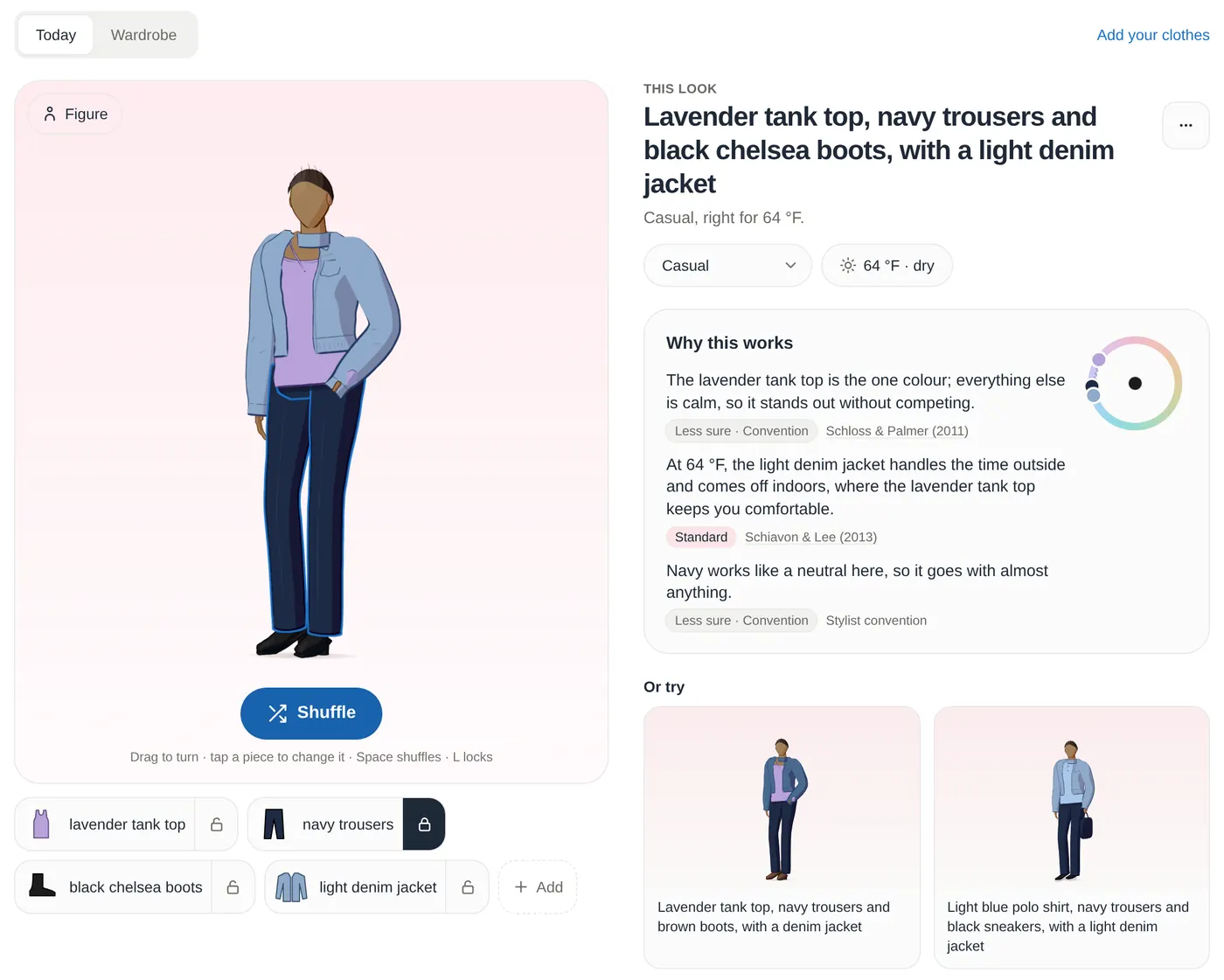
The figures in this post are drawn by the same engine, on a range of bodies and skin tones. Skin tone is only part of the drawing: it never enters the colour score, and the tool doesn't sort people into "seasons". We found no peer-reviewed evidence that seasonal colour analysis predicts what others find attractive.
What's evidence and what's convention
| Claim | How sure |
|---|---|
| Light against dark is liked | Lab study (Schloss and Palmer, 2011) |
| Similar hues look like they go together | Lab studies (Ou and Luo, 2006; Schloss and Palmer, 2011) |
| Opposite hues are harmonious | Not supported by those studies; a design theory |
| Navy acts like a neutral | Stylist convention |
| One statement piece at a time | Stylist convention |
| Never wear navy with black | Folk rule; we found no study |
| Matching belt and shoes | Stylist convention |
The short version
- Navy is a muted, dark blue, so it acts like a neutral and pairs with almost anything.
- The safest partners are light: light blue, white, greys, ivory and cream.
- For colour, add one accent: rust, mustard, yellow, lavender, pink or teal.
- Dark partners (black, charcoal, burgundy, plum) work best as small pieces or with something light in between.
- Complementary colours are a bold choice, not a harmony rule.
Sources
- Ou, L.-C. and Luo, M. R. (2006). A colour harmony model for two-colour combinations. Color Research & Application 31(3):191 to 204.
- Schloss, K. B. and Palmer, S. E. (2011). Aesthetic response to color combinations: preference, harmony, and similarity. Attention, Perception & Psychophysics 73(2):551 to 571.
- Ottosson, B. (2020). A perceptual color space for image processing (OKLab and OKLCH).
- W3C. CSS Color Module Level 4 (OKLCH and the named colour
navy). - Machado, G. M., Oliveira, M. M. and Fernandes, L. A. F. (2009). A physiologically-based model for simulation of color vision deficiency. IEEE Transactions on Visualization and Computer Graphics 15(6):1291 to 1298.
- Itten, J. (1961). The Art of Color. Reinhold (the artist's colour wheel and complementary schemes).
- Scores, rankings and explanations: the Outfit of the Day engine (
pairingsFor()andscoreOutfit()), run on 9 October 2026 for a casual occasion with no weather set.
Keep reading
Computing · Oct 9, 2026 · 9 min
How to Compress an Image to 100 KB (or 50 KB, 20 KB)
Job portals and visa forms want photos under 100 KB, 50 KB or 20 KB. What makes a file small, a worked example with real numbers, and the mistakes to avoid.
Computing · Oct 9, 2026 · 12 min
Cron Syntax Explained, With Examples You'll Actually Use
Read any cron expression field by field, copy 14 everyday schedules (every 5 minutes, weekdays at 9), and avoid the traps that make jobs run at the wrong time.
Computing · Oct 9, 2026 · 10 min
How Long Should a Password Be? What NIST Says Now
NIST now asks for at least 15 characters, with no symbol rules and no forced changes. What the standard says, the maths of length, and passphrases.
Computing · Oct 9, 2026 · 9 min
How to Compress an Image to 100 KB (or 50 KB, 20 KB)
Job portals and visa forms want photos under 100 KB, 50 KB or 20 KB. What makes a file small, a worked example with real numbers, and the mistakes to avoid.
Computing · Oct 9, 2026 · 12 min
Cron Syntax Explained, With Examples You'll Actually Use
Read any cron expression field by field, copy 14 everyday schedules (every 5 minutes, weekdays at 9), and avoid the traps that make jobs run at the wrong time.
Computing · Oct 9, 2026 · 10 min
How Long Should a Password Be? What NIST Says Now
NIST now asks for at least 15 characters, with no symbol rules and no forced changes. What the standard says, the maths of length, and passphrases.