What Is a Good VO2 Max for My Age? Lab Norms by Age and Sex
A good VO2 max is above the median for your age and sex: 42.4 for men in their 30s, 30.2 for women. Lab-tested percentiles, and how far off watches can be.
Health & science··10 min read
A good VO2 max is one above the median for your age and sex, and the top quarter counts as high fitness. In lab tests of healthy US adults, the median is 48.0 mL/kg/min for men in their 20s and 37.6 for women, falling to 37.8 and 26.7 in your 40s and 24.4 and 18.3 in your 70s (FRIEND registry, Kaminsky et al. 2015). So a man of 42 with a VO2 max of 41 is a little above average for his age; a woman of 42 with 30 is too.
Two things make the number harder to read than it looks. Most charts online don't say where their cut-offs come from, and most people's number comes from a watch, which can be off by a lot more than the gap between "average" and "good". Below are the lab norms, what the number is linked to, how far off a watch can be, and how to estimate yours without a lab.
This is general information, not medical advice. Ask a doctor before a hard fitness test if you have a heart condition or haven't exercised in a while.
VO2 max by age: the lab norms
VO2 max is the most oxygen your body can take in and use per minute at all-out effort, divided by your weight. It's the standard measure of cardiorespiratory fitness: how well your heart, lungs, blood and muscles work together.
These percentiles come from the FRIEND registry, which pools treadmill tests with a gas-analysis mask from labs across the US, in adults screened as apparently healthy. The editors of ACSM's exercise testing guidelines chose these reports as their reference standards. A percentile tells you the share of people your sex and age who scored lower than you.
| Age | Men 25th | Men 50th | Men 75th | Women 25th | Women 50th | Women 75th |
|---|---|---|---|---|---|---|
| 20 to 29 | 40.1 | 48.0 | 55.2 | 30.5 | 37.6 | 44.7 |
| 30 to 39 | 35.9 | 42.4 | 49.2 | 25.3 | 30.2 | 36.1 |
| 40 to 49 | 31.9 | 37.8 | 45.0 | 22.1 | 26.7 | 32.4 |
| 50 to 59 | 27.1 | 32.6 | 39.7 | 19.9 | 23.4 | 27.6 |
| 60 to 69 | 23.7 | 28.2 | 34.5 | 17.2 | 20.0 | 23.8 |
| 70 to 79 | 20.4 | 24.4 | 30.4 | 15.6 | 18.3 | 20.8 |
All values in mL/kg/min, treadmill tests (Kaminsky et al. 2015, Table 3).
Show the numbers
| Age | Women | Men |
|---|---|---|
| 20 to 29 | 37.6 | 48.0 |
| 30 to 39 | 30.2 | 42.4 |
| 40 to 49 | 26.7 | 37.8 |
| 50 to 59 | 23.4 | 32.6 |
| 60 to 69 | 20.0 | 28.2 |
| 70 to 79 | 18.3 | 24.4 |
Why do other charts give different numbers? Each one comes from a different group of people and a different test. A 2022 update of the same registry, with more labs, came out 1.5 to 4.6 mL/kg/min lower for treadmill tests (Kaminsky et al. 2022), so the same score would rank a little higher there. Tables from fitter populations, such as Norway's HUNT study, rank you lower. Cycle tests give lower numbers than treadmill tests in the same registry. And the tables inside fitness apps often don't say which population they used at all. If you compare, compare with a table built from the same kind of test as yours.
What "good" is linked to
The groups most people use come from a study of 122,007 adults who had a treadmill test at Cleveland Clinic and were followed for a median of 8.4 years (Mandsager et al. 2018). They sorted people by fitness for their age and sex: low (under the 25th percentile), below average (25th to 49th), above average (50th to 74th), high (75th to 97.6th) and elite (97.7th and up).
After adjusting for age, sex and other risks, the low group's death rate was about 5 times the elite group's. Being below average rather than above average carried a risk (1.41 times) about the same as smoking or diabetes did in the same study. The authors saw no level above which more fitness stopped helping.
That's an association in one health system's patients, measured from treadmill time rather than a gas mask. It can't tell you how long you'll live, or how many years a higher VO2 max would add. But it's why "above the median for your age" is a reasonable target, and "top quarter" a good one.
How accurate is your watch's VO2 max?
Good enough to follow a trend, too loose to rank you. Two treadmill studies of recent Apple Watches found the watch missed the lab's VO2 max by 6.9 mL/kg/min on average, about 13% (Lambe et al. 2025), and 6.8 with the Series 10 (Lambe et al. 2026). In both, the watch mostly read low for their fairly fit volunteers; a 2024 study found watches tend to read high for people with low fitness (Caserman et al.). Across 14 studies of watches that estimate from exercise, 19 in 20 lab results fell within about 9.8 mL/kg/min either side of the watch (Molina-Garcia et al. 2022).
14%of people were placed in the right FRIEND percentile band by the watch. A third were one band off, and half were two or more bands off.
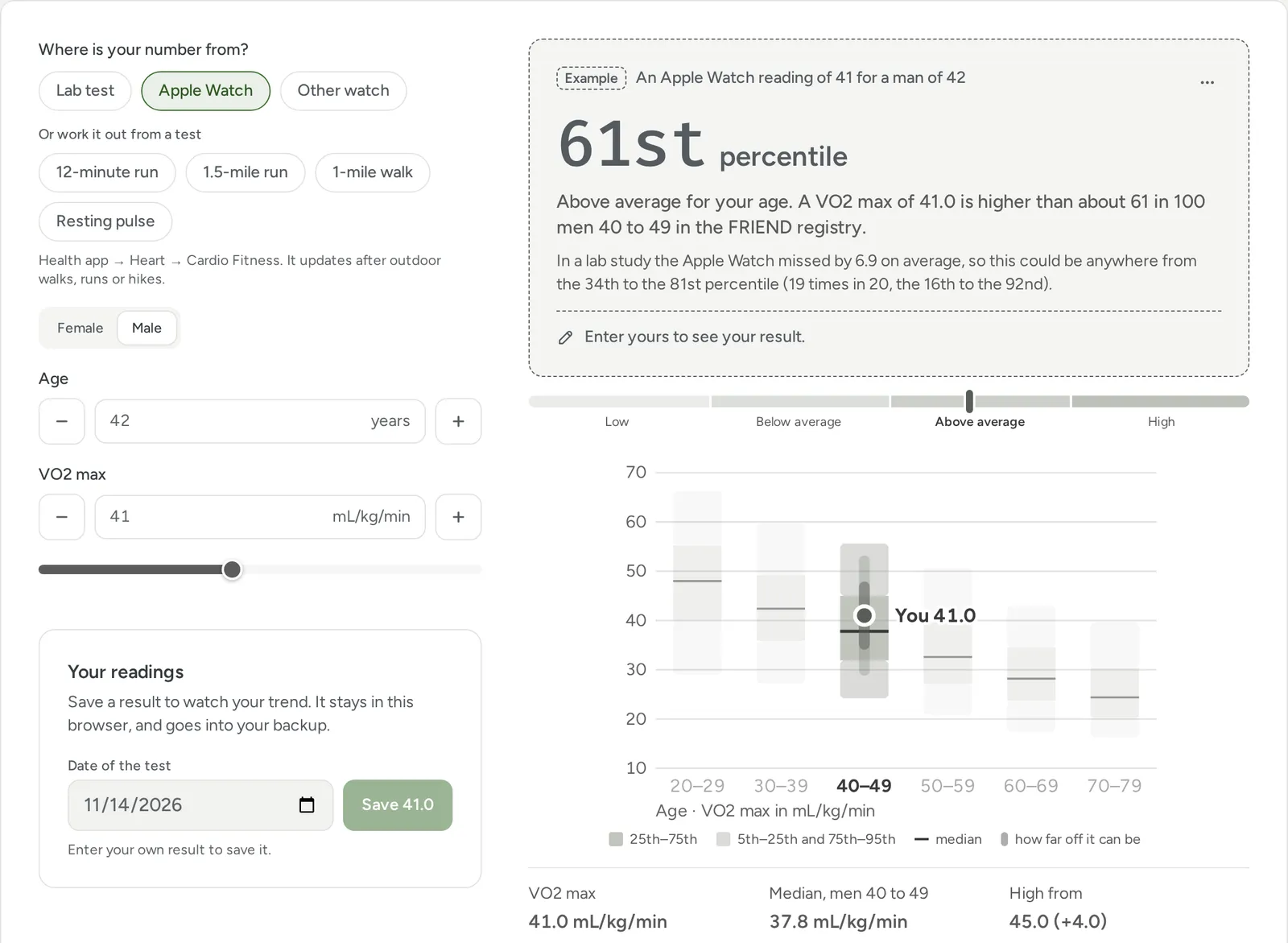
Here's what that error does to a single reading. Take the VO2 max calculator's example: a man of 42 whose watch says 41. On the FRIEND norms that's the 61st percentile, above average. But a typical miss of 6.9 either way puts the true number somewhere from about 34 to 48, which spans the 34th to the 81st percentile: anywhere from below average to high. That's why the calculator shows a range for watch readings rather than one verdict.
The trend is more useful than any one number. If your watch's estimate climbs over a few months of training, your fitness probably has too.
How to estimate VO2 max without a lab
Field tests turn a timed effort into an estimate with a published equation. They're all estimates too, but they're free, and you can repeat them in the same conditions.
- Cooper 12-minute run: run as far as you can in 12 minutes on a flat track. VO2 max = (metres − 504.9) ÷ 44.73 (Cooper 1968).
- 1.5-mile run (2.4 km, six laps of a 400 m track): VO2 max = 3.5 + 483 ÷ your time in minutes (ACSM's guidelines).
- Rockport one-mile walk: walk a mile (1.6 km) as fast as you can, then take your pulse straight away. The equation also uses your age, sex and weight (Kline et al. 1987). Good if running isn't an option.
- Resting heart rate ratio: 15.3 × maximum heart rate ÷ resting heart rate (Uth et al. 2004), with maximum heart rate estimated as 208 − 0.7 × age if you don't know yours (Tanaka et al. 2001). The roughest of the four.
- Run as far as you can in 12 minutes2,400 m1.49 miles
- Subtract 504.9, divide by 44.7342.4mL/kg/min, his VO2 max
- Compare with men aged 40 to 49 (median 37.8)66thpercentile: above average for his age
Warm up properly before either run, and pace the 12 minutes so you're not walking the last four. If you redo the test after a few weeks, use the same track and similar weather, so the change you see is you.
Check yours
The VO2 max calculator takes a lab result, an Apple Watch or other watch reading, or any of the four field tests, and places it on the FRIEND percentiles for your age and sex. For watch readings it shows the range the published error covers, and it can keep a log of readings in your browser so you can watch the trend. Nothing you enter is uploaded.
Fitness is one part of how you're ageing. Grip strength is another simple one to check, and we've written up what's normal for grip strength by age. If you have recent blood test results, there's also a way to turn them into a biological age.
Sources
- Kaminsky LA, Arena R, Myers J (2015). Reference standards for cardiorespiratory fitness measured with cardiopulmonary exercise testing: data from FRIEND. Mayo Clinic Proceedings 90(11):1515–1523, Table 3.
- Kaminsky LA et al. (2022). Updated reference standards for cardiorespiratory fitness. Mayo Clinic Proceedings 97(2):285–293 (abstract: treadmill standards 1.5 to 4.6 mL/kg/min lower).
- Mandsager K et al. (2018). Association of cardiorespiratory fitness with long-term mortality among adults undergoing exercise treadmill testing. JAMA Network Open 1(6):e183605.
- Lambe et al. (2025). Investigating the accuracy of Apple Watch VO2 max measurements. PLoS ONE. Lambe et al. (2026). Accuracy of VO2 max estimates from Apple Watch Series 10. Mayo Clinic Proceedings: Digital Health.
- Caserman P et al. (2024). Assessing the accuracy of smartwatch-based estimation of maximum oxygen uptake using the Apple Watch Series 7. JMIR Biomedical Engineering.
- Molina-Garcia P et al. (2022). Validity of estimating the maximal oxygen consumption by consumer wearables: a systematic review with meta-analysis. Sports Medicine.
- Field-test equations: Cooper 1968; ACSM's Guidelines for Exercise Testing and Prescription, 6th ed. (2000); Kline et al. 1987; Uth et al. 2004; Tanaka, Monahan and Seals 2001.
Apple Watch is a trademark of Apple Inc. Binary Decimal is not affiliated with or endorsed by Apple.
Share this post
Keep reading
Health & science· Nov 14, 2026· 8 min
Grip Strength by Age: What's Normal for Men and Women
Median grip strength peaks near 51 kg (112 lb) for men and 31 kg (68 lb) for women in their 30s. Norms by age from UK and US data, and what counts as weak.Health & science· Nov 14, 2026· 9 min
How to Calculate Your Biological Age From a Blood Test
PhenoAge turns nine routine blood results and your age into a biological age. The full Levine formula, a worked example, and which results move it most.Health & science· Oct 11, 2026· 11 min· Updated Nov 2026
How Many Calories Do You Need a Day? TDEE, Explained
Your daily calories are your resting burn times an activity multiplier. Why most calculators guess low for desk workers, why a range helps, and how to check.