How Many Calories Do You Need a Day? TDEE, Explained
Your daily calories are your resting burn times an activity multiplier. Why most calculators guess low for desk workers, why a range helps, and how to check.
Health & science··10 min read
Most adults need somewhere between 1,600 and 3,000 calories a day: roughly 1,600 to 2,400 for women and 2,000 to 3,000 for men, according to the Dietary Guidelines for Americans (Appendix 2). Where you sit in that span depends on your size, your age and, more than anything, how much you move. The name for your personal number is TDEE, your total daily energy expenditure.
You can get a decent estimate in a minute. You can't get an exact one from any formula, and that's the part most calculators skip. This post covers how the estimate is built, why the usual "sedentary" setting is probably too low for you, why a range is more honest than a single number, and how a few weeks of your own data beat every equation.
BMR and TDEE are different numbers
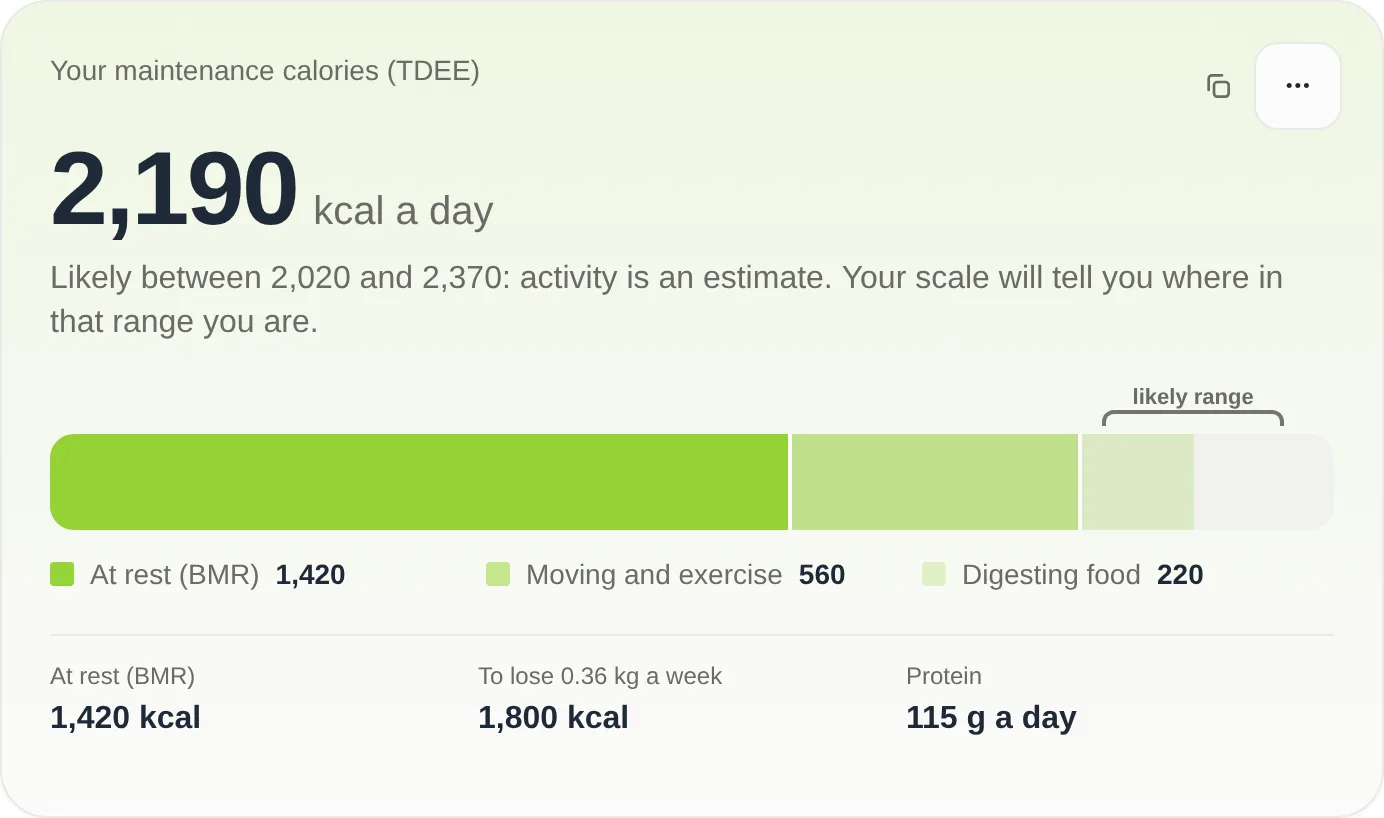
BMR (basal metabolic rate) is what your body burns lying still: heart, lungs, brain, keeping warm. TDEE is BMR plus everything else you do in a day, from walking to the kettle to a gym session, plus the energy it takes to digest what you eat.
For most adults, BMR is the biggest slice. The FAO/WHO/UNU expert report on human energy needs puts it at about 45 to 70% of the day's total (FAO 2004, §5.2). Digesting food takes another 5 to 15% on a mixed diet (Westerterp 2004). Movement is the rest, and it's the slice that varies most from person to person.
Step one: estimate your resting burn
The equation most dietitians reach for is Mifflin-St Jeor, published in 1990 from resting measurements of 498 healthy adults (Mifflin et al., 1990):
- Men: 10 × weight in kg + 6.25 × height in cm − 5 × age + 5
- Women: 10 × weight in kg + 6.25 × height in cm − 5 × age − 161
Take a 35-year-old woman who is 165 cm (5 ft 5 in) and 72 kg (159 lb). That's 720 + 1,031 − 175 − 161, so about 1,415 kcal a day at rest.
Why this one and not the older Harris-Benedict equation from 1919? A systematic review compared the common equations against measured resting energy and found Mifflin-St Jeor got within 10% of the measured value for more people than any other, with the narrowest errors (Frankenfield et al., 2005). Note the "within 10%" part, though. For a real person, even the best equation can be 140 kcal out before you've added any activity. The same review warns that older adults and some ethnic groups were under-represented in the studies, so errors there may be bigger.
If you know your body fat percentage, the Katch-McArdle equation works from lean mass instead, which can suit very muscular people. Our BMR calculator shows all three equations side by side for your numbers, so you can see how much they disagree.
Step two: multiply by how active you are
TDEE is BMR times an activity multiplier, which researchers call the physical activity level, or PAL. The multiplier is where most of the guessing happens, and where many calculators quietly lowball people with desk jobs.
Many online calculators start their scale at 1.2 for "sedentary". The FAO/WHO/UNU report, which pulled together the measured energy use of real people, tells a different story:
- A mean PAL of 1.21 comes from studies of people who were almost completely inactive, such as adults confined to a calorimeter chamber. The report says that figure is too low even for emergency food relief, because people in a crisis aren't completely still (FAO 2004, §5.3).
- Lifestyles that people keep up for long periods run from about 1.40 to 2.40, and "sedentary or light activity" covers 1.40 to 1.69 (Table 5.3 in the same section).
- A pooled analysis of 411 adults in affluent countries, mostly office workers, students and retired people, found a typical PAL of 1.60.
So 1.2 describes a day spent lying down. That's why our TDEE calculator starts its lowest level, "mostly sitting", at 1.40, the bottom of the FAO's sedentary range, and builds the other levels on the same report.
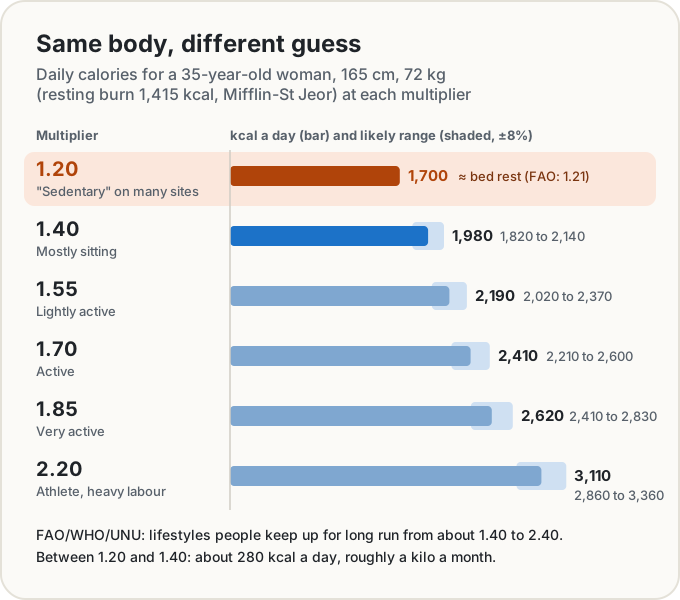
Does 0.2 matter? For our example woman it's about 280 kcal a day. Eat to a 1.2 estimate when you're really at 1.4 and you're in a deficit you didn't plan, worth about a kilo a month at the usual 7,700 kcal per kilogram (Hall, 2008). Planning a deficit on top of that, you'd be eating far less than you meant to.
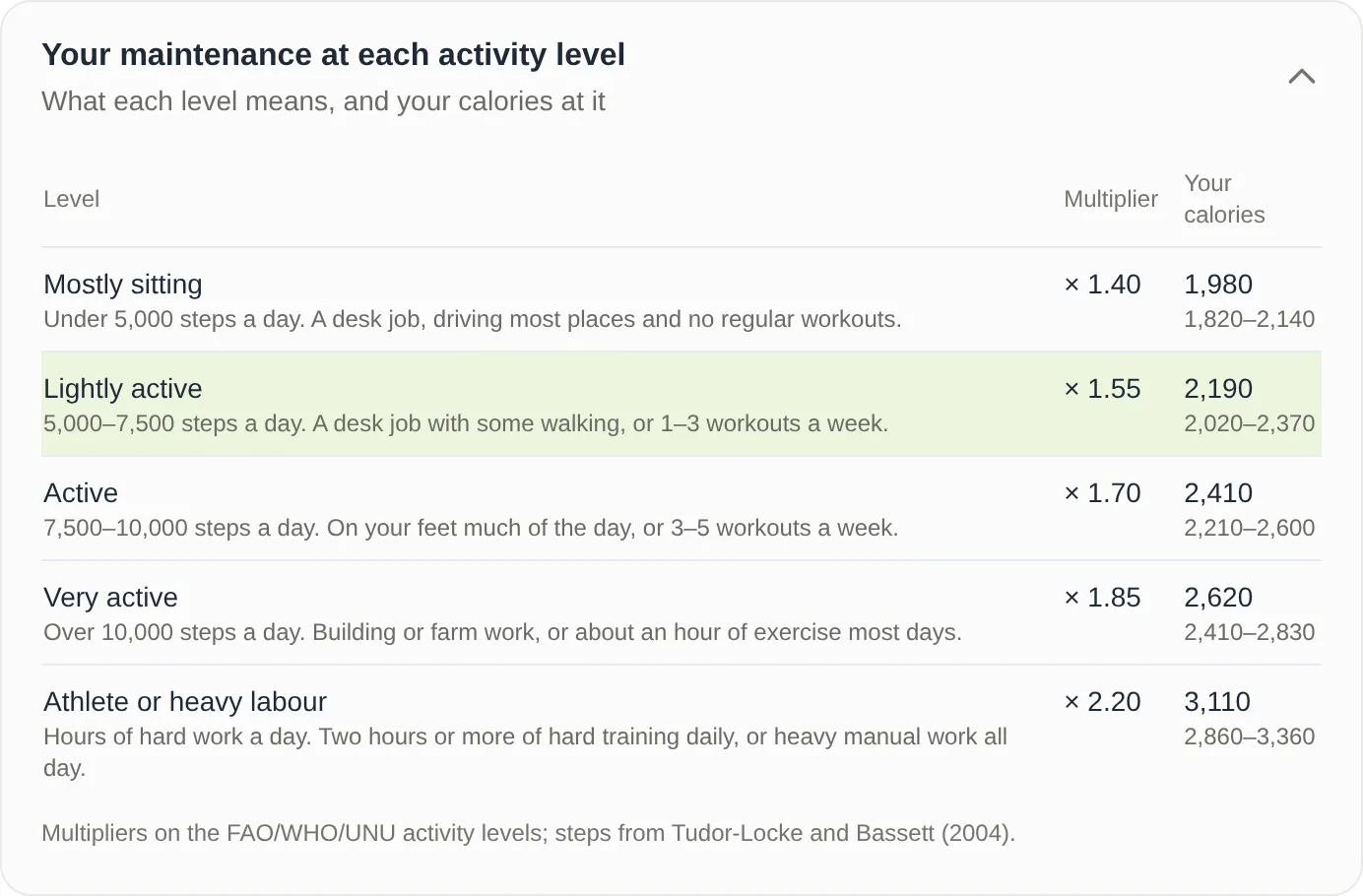
Picking a level is still a judgement call, so the calculator describes each one in steps and habits rather than adjectives. The step counts come from a widely used set of pedometer bands: under 5,000 a day is sedentary, 10,000 and up is active (Tudor-Locke and Bassett, 2004). The FAO adds a handy rule of thumb: an hour a day of moderate to vigorous exercise moves a desk worker from about 1.55 to 1.75.
Why a range beats a single number
Put the two uncertainties together. The resting estimate can be 10% out for a given person. Then the FAO says real requirements vary by roughly 8 to 10% either side of the middle of an activity category (FAO 2004, §5.4). Two people with the same age, size and job can need noticeably different amounts.
A calculator that says "you need 2,194 calories" is claiming precision nobody has. Ours shows the middle of your level and a likely range of ±8% around it, rounded to the nearest 10. For the example woman, lightly active, that's 2,190, likely 2,020 to 2,370. The width of that range, about 350 kcal, is the honest size of the guess.
The useful question isn't "what's my exact number?" It's "where in this range am I?" And only your own body can answer it.
Calories for a goal, kept sensible
To lose weight you eat below your TDEE; to gain, above it. The calorie calculator sets the gap from a pace you choose, measured as a share of your body weight per week, because a kilo a week means something very different at 60 kg and at 130 kg.
- Losing: 0.25 to 1% of body weight a week. A review for lifters dieting down suggests 0.5 to 1% a week to hold on to muscle (Helms et al., 2014), and the NHS suggests 0.5 to 1 kg a week (NHS). The tool never plans more than 1 kg a week.
- Gaining: 0.25 to 0.5% a week, the pace a review suggests for people building muscle, so less of the gain is fat (Iraki et al., 2019).
For the example woman at a steady 0.5% a week, that's 0.36 kg a week, about 400 kcal a day under maintenance, or 1,800 kcal a day.
There's also a floor. The US obesity guideline's diet plans usually prescribe 1,200 to 1,500 kcal a day for women and 1,500 to 1,800 for men, and it keeps very low calorie diets (under 800 kcal) for medical settings with supervision (Jensen et al., 2014). Our calculator never goes below the bottom of those ranges, 1,200 for women and 1,500 for men. If your maintenance is already close to the floor, or your BMI is under 18.5, it doesn't offer a loss plan at all. There are no crash settings, and no supplements or coaching to sell you.
One more thing the simple maths misses: as you lose weight, your maintenance falls too, because a smaller body burns less. That's why the old "3,500 calories a pound" rule over-predicts long-term loss (Hall et al., 2011). The calculator's timeline lets maintenance drop as your weight changes, so its week-by-week line bends rather than running straight down.
If you're pregnant or breastfeeding, under 18, or have had an eating disorder, skip the calculators. A doctor or dietitian is a better start, and the tool says so too.
Let your own results correct the estimate
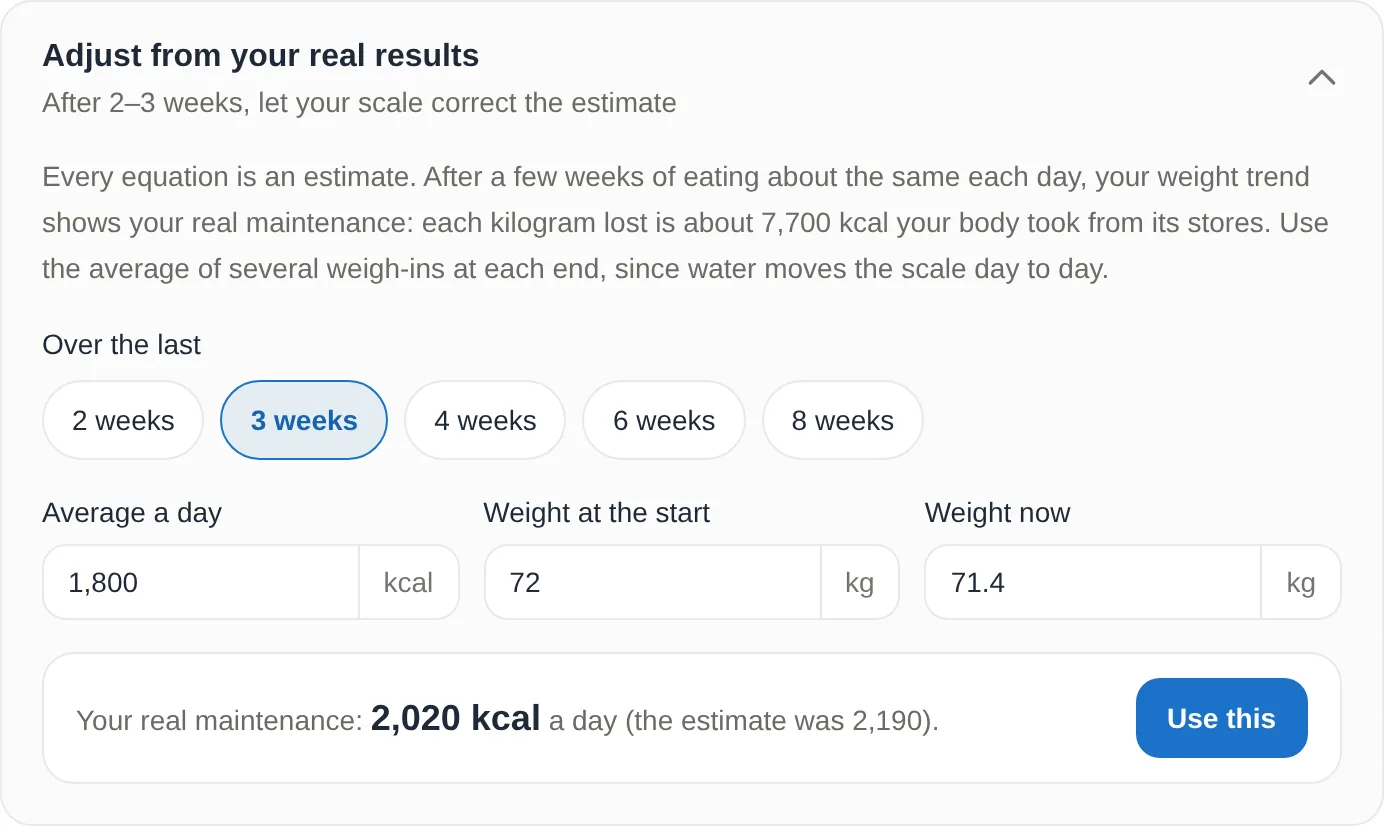
This is the step that turns a guess into a measurement. Eat roughly the same amount each day for two or three weeks, log it as well as you can, and weigh yourself regularly. Then:
your maintenance = average daily intake + (weight lost × 7,700) ÷ days
Say the example woman ate an average of 1,800 kcal a day for 3 weeks and her weight went from 72.0 to 71.4 kg. That's 0.6 kg × 7,700 = 4,620 kcal drawn from her stores over 21 days, or 220 a day. Her real maintenance is about 2,020 kcal, at the low end of her estimated range, not the middle.
A few things make this work better:
- Average your weigh-ins. Scale weight swings from day to day with water and food. A study of 80 adults who weighed themselves daily found weight was, on average, highest on Sunday and Monday and fell through the week (Orsama et al., 2014). Compare the average of a week of weigh-ins at each end, not two single mornings.
- Give it at least two weeks. Shorter than that, water can swamp the signal. The calculator won't work it out from less than 14 days.
- Consistency beats perfection. If your log misses the odd biscuit, that's fine, as long as it misses it the same way every week. The number you get is then your maintenance as you log it, which is exactly what you need to plan with.
Press "Use this" and every other number on the page, from your goal calories to your macros, follows the measured figure instead of the estimate.
Where macros and protein fit
Calories set how much you eat. Macros split it into protein, fat and carbohydrate. The macro calculator starts protein at 1.6 g per kg, the point past which extra protein added no more muscle in a meta-analysis of training studies (Morton et al., 2018), keeps fat at 20 to 35% of calories and lets carbs fill the rest, inside the ranges in the Dietary Guidelines (Appendix 1). If protein is your main question, the protein calculator puts the range for your goal first.
The short version
- Work out your resting burn with Mifflin-St Jeor.
- Multiply by an honest activity level. If you sit most of the day, that's about 1.4, not 1.2.
- Treat the answer as a range, not a target to the calorie.
- After two or three weeks, let your weight trend tell you where in the range you really are.
The TDEE calculator does all four in your browser, with every step of the maths shown under "Your numbers, worked out".
Share this post
Keep reading
Health & science· Oct 9, 2026· 10 min
How Much Protein on Ozempic, Wegovy or Zepbound?
How much protein to eat while losing weight on a GLP-1: the 2025 advisory's 1.2 to 1.6 g/kg, which weight to use, a worked example and 100 g in real food.Health & science· Oct 9, 2026· 12 min
Wegovy vs Zepbound: How Much Weight People Lost in the Trials
The STEP 1 and SURMOUNT-1 trials in numbers: average weight loss, who reached 5 to 20%, side effects, the head-to-head trial and what happened after stopping.Health & science· Oct 7, 2026· 8 min
Tabata vs HIIT: What the Original Study Did and How to Time It
What the 1996 Tabata study actually tested, how gym Tabata differs, and how to time Tabata, 30/30, EMOM, boxing rounds and sprint intervals safely.