How Much Protein on Ozempic, Wegovy or Zepbound?
How much protein to eat while losing weight on a GLP-1: the 2025 advisory's 1.2 to 1.6 g/kg, which weight to use, a worked example and 100 g in real food.
Health & science···10 min read
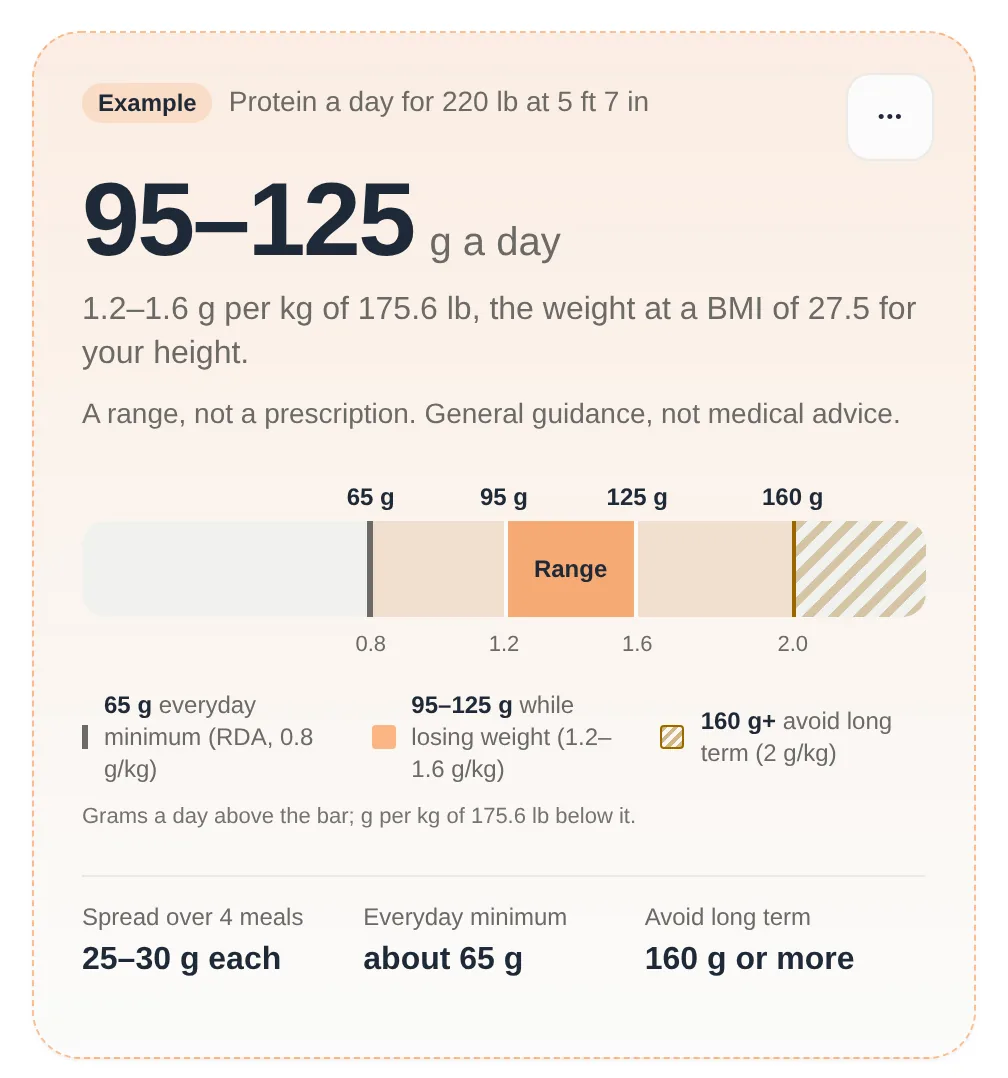
While you're actively losing weight on a GLP-1 such as Ozempic, Wegovy, Zepbound or Mounjaro, the 2025 joint nutrition advisory notes that 1.2 to 1.6 g of protein per kg of body weight a day has been proposed, against the everyday adult minimum (the RDA) of 0.8 g/kg (Mozaffarian et al., 2025). The catch is the word "weight". If you have obesity, multiplying by your full weight can give a number that's too high, so a corrected weight is often used instead. For someone who is 220 lb and 5 ft 7 in, that works out at about 95 to 125 g a day.
That's the short answer. The rest of this post explains where the numbers come from, why muscle is the thing to protect, and how to actually eat that much when the drug has switched off your appetite.
One thing up front: this is general guidance, not medical advice. A doctor or registered dietitian who knows your health can set your own target.
Why muscle matters on these drugs
When weight comes off quickly, it isn't all fat. The advisory sums up the body-composition results from STEP 1, the main semaglutide trial: of an average 13.6 kg lost, 8.3 kg (62%) was fat and 5.3 kg (38%) was lean mass. Muscle is about half of lean mass, so roughly 20% of everything lost was muscle.
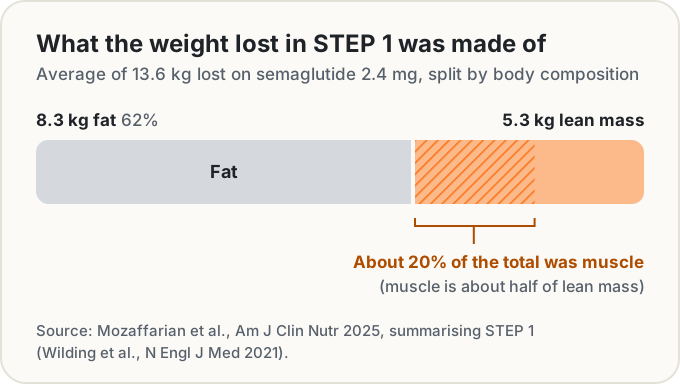
Two things work against you on a GLP-1. You lose weight fast, and you eat a lot less, which usually means less protein too. The advisory's answer has two parts: enough protein, and strength training (more on that below). Muscle is what keeps you strong on the stairs, so it's worth the effort.
Which weight to use
The g/kg figures were never meant to be multiplied by any weight you like. The advisory is frank that for people with obesity, "it is unclear" whether targets should use actual weight, a corrected (adjusted or ideal) weight or fat-free mass. It also says actual weight "can significantly overestimate protein requirements".
A 2024 review the advisory cites (Grosicki et al., 2024) puts it plainly: recommendations based on body weight "may exceed" what fat-free mass needs in people with overweight or obesity. Your muscles set the need, and the full weight counts the fat too.
The same review's fix is the one our Protein on a GLP-1 calculator uses. It works out the weight you'd be at a BMI of 27.5 for your height, and uses that whenever it's lower than your actual weight. If your BMI is already 27.5 or under, it just uses your weight.
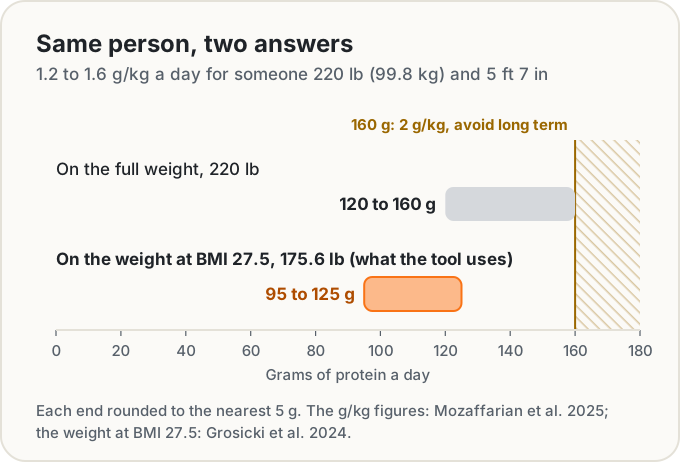
There are two other options in the advisory. If you've had a body-composition scan and know your fat-free mass, 1.5 g per kg of fat-free mass is considered more accurate. And some people just pick a fixed target of 80 to 120 g a day, which is easier to remember.
A worked example: 220 lb at 5 ft 7 in
Here's the calculator's own example, step by step.
- Convert. 220 lb is 99.8 kg. 5 ft 7 in is 1.70 m.
- Check the BMI. 99.8 ÷ 1.70² is a BMI of about 34.5, which is above 27.5, so the corrected weight applies.
- Find the weight at BMI 27.5. 27.5 × 1.70² is 79.6 kg (175.6 lb).
- Multiply. 1.2 × 79.6 is about 96 g and 1.6 × 79.6 is about 127 g. Rounded to the nearest 5 g, that's 95 to 125 g a day.
- Spread it out. Over four meals or snacks, that's about 25 to 30 g each.
For comparison, the everyday minimum (0.8 g/kg) is about 65 g, and 2 g/kg is about 160 g. The advisory says prolonged intake at or above 2 g/kg should be avoided, and that protein beyond what your muscles can use can be turned into fat by the liver. More is not better here.
On the full 220 lb, the same 1.2 to 1.6 g/kg would give 120 to 160 g. That's a much harder number to eat with no appetite, and its top end lands right on that 160 g line.
What 100 g of protein looks like
Numbers on a screen are one thing. Here's what about 100 g looks like as actual food, using the protein values in USDA FoodData Central for plain, generic versions of each food.
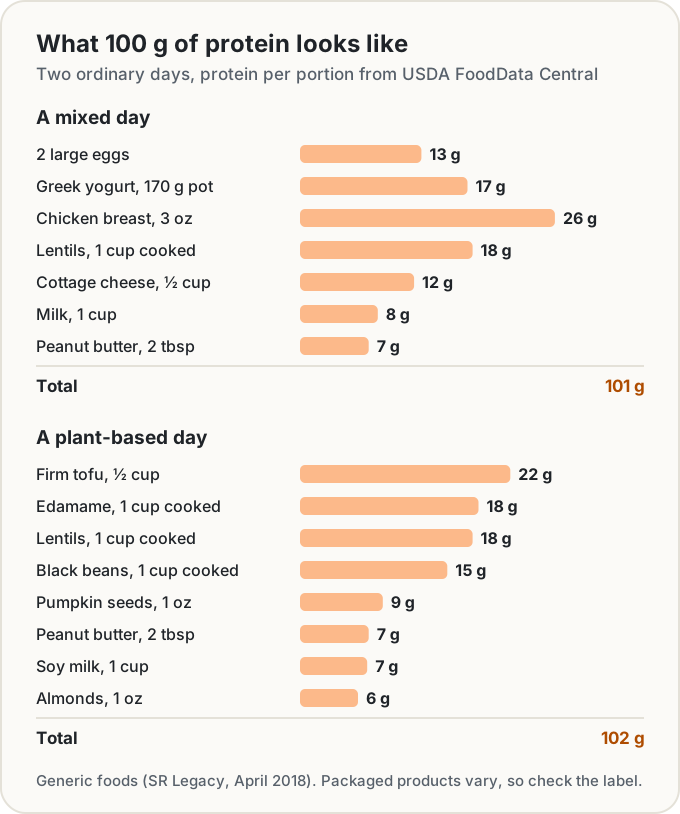
A few things jump out:
- No single meal does the heavy lifting. The biggest item, a palm-sized piece of chicken, is only about a quarter of the day.
- Plant-based works, it just takes more food. The plant day needs eight items to get there, and beans and lentils are filling. If your appetite is tiny, the denser options (tofu, pumpkin seeds) carry more per bite.
- Labels beat averages. These are generic foods. Packaged products vary, so the number on the pack is the one to trust.
The advisory leans towards food first: beans, peas, lentils, dairy, seafood, eggs and lean poultry. It notes that some people do meet their target with shakes, bars or fortified foods, which is a choice for you and your care team. We don't recommend any products and there are no affiliate links here.
Eating enough with no appetite
This is the hard part. A GLP-1 can make a normal dinner feel like a challenge, and protein foods tend to be filling. The advisory's practical tips:
- Protein first. Eat the protein part of the plate before the rest, so it doesn't get left behind when you fill up.
- Small and often. With nausea, a small breakfast and then small meals every 3 to 4 hours, with enough to drink, is easier than three big ones.
- Go for low volume. Fish, eggs, Greek yogurt, cottage cheese, nuts and seeds pack protein into a small amount of food.
Spreading protein out may also help your muscles use it. The Grosicki review describes a study where four servings of 20 g, one every 3 hours, did better for muscle protein building than two 40 g servings 6 hours apart. That's also why the calculator splits your range across 3, 4 or 5 meals instead of handing you one big daily number.
And don't forget fluids. Nausea, vomiting and diarrhoea are common early on, and the advisory warns that the dehydration they cause can lead to acute kidney injury. If you can't keep fluids down, call your care team.
Protein alone won't keep your muscle
This is the part that's easy to miss. The advisory says clinicians should make clear that more protein alone "is likely inadequate" to preserve muscle without structured strength training. Muscle is kept by using it. Protein is the building material, but lifting is the signal to build.
The advisory pairs GLP-1s with strength training at least 3 times a week plus at least 150 minutes of moderate-intensity aerobic exercise a week. The Grosicki review gives a starter shape: at least twice a week, 8 to 10 exercises, 1 to 3 sets of 8 to 12 reps each. If you've never lifted, start lighter than you think and build up.
If you'd like a plan to follow, our GLP-1 strength program is a ready 12-week beginner plan with three 30-minute sessions a week.
Who should ask for their own number
The 1.2 to 1.6 g/kg range is for adults with excess weight who are actively losing it. For some people it's the wrong starting point, and the calculator won't show a number at all if you tick any of these:
- Kidney disease. Protein advice for chronic kidney disease is its own topic, with its own guideline (KDIGO 2024), and a higher-protein diet may be the wrong direction. Your kidney team should set this.
- Pregnancy or breastfeeding. Protein needs change in both (National Academies, Dietary Reference Intakes), and the g/kg figures above weren't written for them.
- Under 18. Teenagers are still growing and their needs are set differently, by the same reference intakes.
- An eating disorder, now or in the past. The advisory says people with a current or past eating disorder should see an obesity medicine specialist and an eating disorders specialist before starting a GLP-1. Hitting a daily number can turn into the wrong kind of focus, so that's a conversation to have with them first.
Work out your own range
If you'd rather not do the arithmetic, the Protein on a GLP-1 calculator takes your weight and height and gives the daily range, the weight it used and why, a per-meal split and both example days. Everything stays in your browser. If you're curious how much weight people actually lost on these drugs in the trials, we went through the numbers in Wegovy vs Zepbound: what the trials found.
Sources
- Mozaffarian, D., et al. (2025). Nutritional priorities to support GLP-1 therapy for obesity: a joint Advisory from the American College of Lifestyle Medicine, the American Society for Nutrition, the Obesity Medicine Association, and The Obesity Society. American Journal of Clinical Nutrition. PMID 40450457 (full text). Sections "Muscle and bone loss", "Preservation of muscle and bone mass" and "Management of GI side effects": the g/kg figures, the weight question, the 2 g/kg caution, STEP 1 body composition, meal tips, fluids, exercise and eating disorders.
- Grosicki, G. J., Dhurandhar, N. V., & Unick, J. L. (2024). Sculpting success: the importance of diet and physical activity to support skeletal muscle health during weight loss with new generation anti-obesity medications. Current Developments in Nutrition, 8(12), 104486. PMC11609469. The weight at BMI 27.5, spreading protein over the day and the strength-training outline.
- Wilding, J. P. H., et al. (2021). Once-weekly semaglutide in adults with overweight or obesity (STEP 1). New England Journal of Medicine, 384(11), 989–1002. doi:10.1056/NEJMoa2032183. The trial behind the lean-mass figures.
- U.S. Department of Agriculture. FoodData Central, SR Legacy (April 2018). Protein per 100 g and portion weights for every food in the example days.
- KDIGO 2024 Clinical Practice Guideline for the Evaluation and Management of Chronic Kidney Disease. kdigo.org.
- Institute of Medicine (2005). Dietary Reference Intakes for Energy, Carbohydrate, Fiber, Fat, Fatty Acids, Cholesterol, Protein, and Amino Acids. National Academies Press.
Wegovy and Ozempic are trademarks of Novo Nordisk A/S. Zepbound and Mounjaro are trademarks of Eli Lilly and Company. Binary Decimal isn't affiliated with or endorsed by either company.
Keep reading
Health & science · Oct 9, 2026 · 12 min
Wegovy vs Zepbound: How Much Weight People Lost in the Trials
The STEP 1 and SURMOUNT-1 trials in numbers: average weight loss, who reached 5 to 20%, side effects, the head-to-head trial and what happened after stopping.
Health & science · Oct 9, 2026 · 12 min
Missed a Wegovy, Ozempic, Zepbound or Mounjaro Dose? Label Rules
How late each label lets you take a missed GLP-1 dose: 4 days for Zepbound and Mounjaro, 5 for Ozempic, 2 days before the next one for Wegovy.
Health & science · Oct 8, 2026 · 7 min
How to Print or Save a Growth Chart for Your Child's Doctor
Height, weight and BMI-for-age percentiles on the WHO and CDC charts, what a percentile does and doesn't mean, and how to print or save one report as a PDF.
Health & science · Oct 9, 2026 · 12 min
Wegovy vs Zepbound: How Much Weight People Lost in the Trials
The STEP 1 and SURMOUNT-1 trials in numbers: average weight loss, who reached 5 to 20%, side effects, the head-to-head trial and what happened after stopping.
Health & science · Oct 9, 2026 · 12 min
Missed a Wegovy, Ozempic, Zepbound or Mounjaro Dose? Label Rules
How late each label lets you take a missed GLP-1 dose: 4 days for Zepbound and Mounjaro, 5 for Ozempic, 2 days before the next one for Wegovy.
Health & science · Oct 8, 2026 · 7 min
How to Print or Save a Growth Chart for Your Child's Doctor
Height, weight and BMI-for-age percentiles on the WHO and CDC charts, what a percentile does and doesn't mean, and how to print or save one report as a PDF.