Wegovy vs Zepbound: How Much Weight People Lost in the Trials
The STEP 1 and SURMOUNT-1 trials in numbers: average weight loss, who reached 5 to 20%, side effects, the head-to-head trial and what happened after stopping.
Health & science··12 min read
In the main trial behind Wegovy (semaglutide 2.4 mg), people lost an average of 14.9% of their body weight over 68 weeks, against 2.4% on placebo. In the main trial behind Zepbound (tirzepatide), the averages after 72 weeks were 15.0%, 19.5% and 20.9% on the 5, 10 and 15 mg doses, against 3.1% on placebo. When the two drugs finally met in one trial, SURMOUNT-5, the averages were 20.2% for tirzepatide and 13.7% for semaglutide.
Those are averages, and they hide a wide spread. They also come from trials where everyone had regular diet and activity counselling, and where most of the weight came back within a year of stopping. This post goes through what the papers actually report, with every number linked to its source, so you can read the headlines with the right amount of salt.
A note on names: Wegovy is Novo Nordisk's brand of semaglutide, and Zepbound is Eli Lilly's brand of tirzepatide. Both names are their makers' trademarks. We use them here only to say which product matches the doses tested. We're not affiliated with either company, and nothing here is medical advice.
The two trials
Both were large, double-blind and placebo-controlled, run in adults with obesity who did not have diabetes. The entry rules were almost the same: a BMI of 30 or more, or 27 or more with at least one weight-related condition such as high blood pressure or abnormal cholesterol.
| STEP 1 (semaglutide) | SURMOUNT-1 (tirzepatide) | |
|---|---|---|
| Published | NEJM, 2021 | NEJM, 2022 |
| People | 1,961, split 2:1 drug to placebo | 2,539, split 1:1:1:1 across three doses and placebo |
| Length | 68 weeks, the first 16 stepping up the dose | 72 weeks, the first 20 stepping up the dose |
| Doses | 2.4 mg once a week | 5, 10 or 15 mg once a week |
| Starting weight | 105.3 kg (232 lb) on average, BMI 37.9 | 104.8 kg (231 lb) on average, BMI 38.0 |
| Who took part | average age 46, 74% women | average age 45, 68% women |
| Support | counselling every 4 weeks: a 500 kcal a day deficit and 150 minutes of activity a week | the same diet and activity advice, plus behaviour-change counselling |
| Funded by | Novo Nordisk | Eli Lilly |
The placebo groups got the same counselling, which is why they lost a little weight too.
Average weight loss
Here are the headline results at the end of each trial:
| Group | Average change | Placebo in the same trial |
|---|---|---|
| Semaglutide 2.4 mg, week 68 | −14.9% (−15.3 kg) | −2.4% (−2.6 kg) |
| Tirzepatide 5 mg, week 72 | −15.0% | −3.1% |
| Tirzepatide 10 mg, week 72 | −19.5% | −3.1% |
| Tirzepatide 15 mg, week 72 | −20.9% | −3.1% |
The chart below shows how people got there. It's redrawn from the published figures: the STEP 1 curve from Figure 1A of the paper and the SURMOUNT-1 curves from Figure 3 of the Zepbound label, reading the average at each clinic visit. These are the plain averages of everyone weighed at each visit, so the end points sit a little below the headline numbers in the table, which also account for the people who missed the final weigh-in.
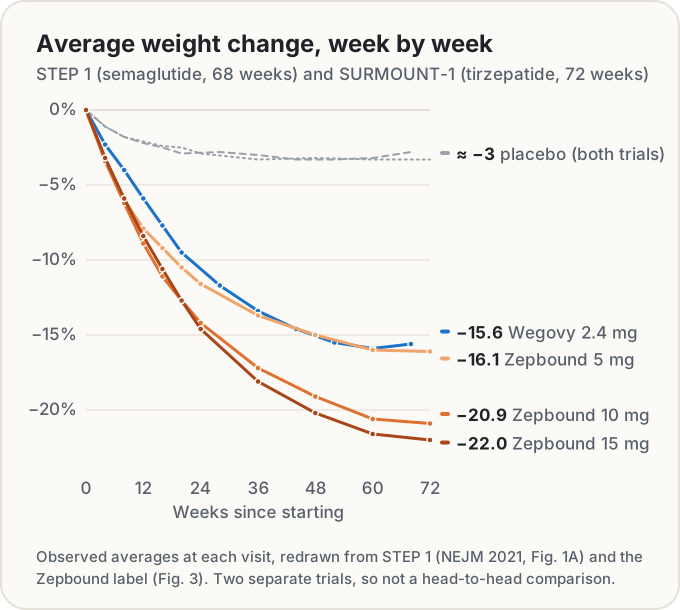
Two things stand out. Weight comes off fastest in the first six months, while the dose is still being raised, and the curves flatten after about a year. In STEP 1 the lowest point was at week 60. And for the first eight weeks the three tirzepatide lines sit on top of each other, because everyone started on the same 2.5 mg dose and stepped up on the same schedule at first.
This chart puts two separate trials side by side. They ran in different years, at different clinics, with different people (48% of SURMOUNT-1's participants were Hispanic or Latino, for example, against 12% in STEP 1). The only fair comparison is the head-to-head trial further down.
Two ways to count an average
Trials now report more than one kind of average, and headlines often quote the bigger one.
- "Regardless of stopping" (called the treatment-policy estimand in STEP 1 and the treatment-regimen estimand in SURMOUNT-1). Everyone who was randomised counts, including people who stopped taking the drug. This is the main result of both trials, and it's the one we use throughout this post and in our GLP-1 weight loss calculator.
- "If taken as intended" (the trial-product or efficacy estimand). This estimates the effect in people who kept taking the drug. It's higher: −16.9% for semaglutide 2.4 mg against −2.4% for placebo, and −16.0%, −21.4% and −22.5% for tirzepatide 5, 10 and 15 mg against −2.4%.
Neither is wrong. They answer different questions. If you see "22.5%" in an article, it's the second kind.
How many people reached 5, 10, 15 and 20%
The average is only one point on a spread. The papers also report how many people lost at least 5, 10, 15 or 20% of their starting weight. The chart uses the figures from the FDA labels, which count everyone who started and fill in missing final weights statistically, the same way for both drugs.
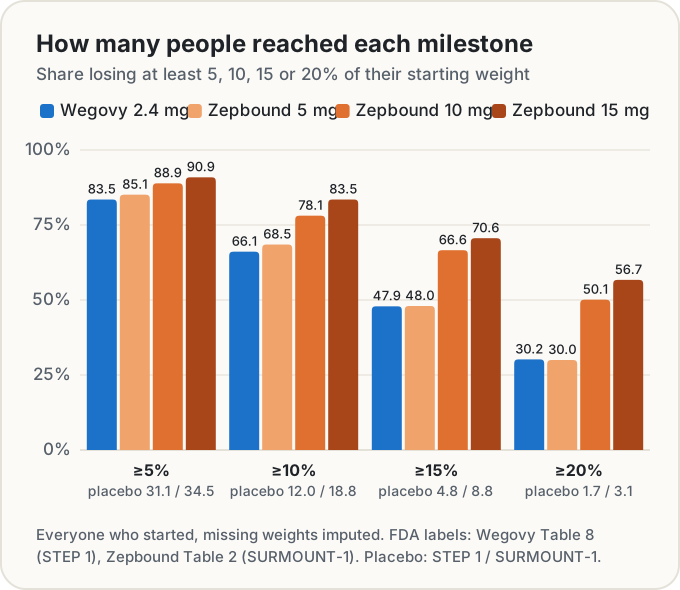
Read it from the other side and the spread is clearer. On semaglutide, about one person in six (16.5%) did not lose 5%, and about half lost less than 15%. Even on the top tirzepatide dose, 9.1% did not lose 5%. At the other end, more than half of the 15 mg group lost 20% or more.
If you read the STEP 1 paper itself you'll see slightly higher shares (86.4%, 69.1%, 50.5% and 32.0%). Those count only the people who were weighed at week 68. The label's figures include everyone who started.
The head-to-head trial: SURMOUNT-5
Comparing numbers across two trials only goes so far. SURMOUNT-5 (NEJM, 2025) put the two drugs against each other: 751 adults with obesity and no diabetes, at 32 sites in the United States and Puerto Rico, randomly assigned to tirzepatide (10 or 15 mg, whichever they tolerated) or semaglutide (1.7 or 2.4 mg) for 72 weeks. Both groups got nutrition and activity counselling. There was no placebo group, and the trial was open-label, meaning people knew which drug they were on. It was funded by Eli Lilly, which makes tirzepatide.
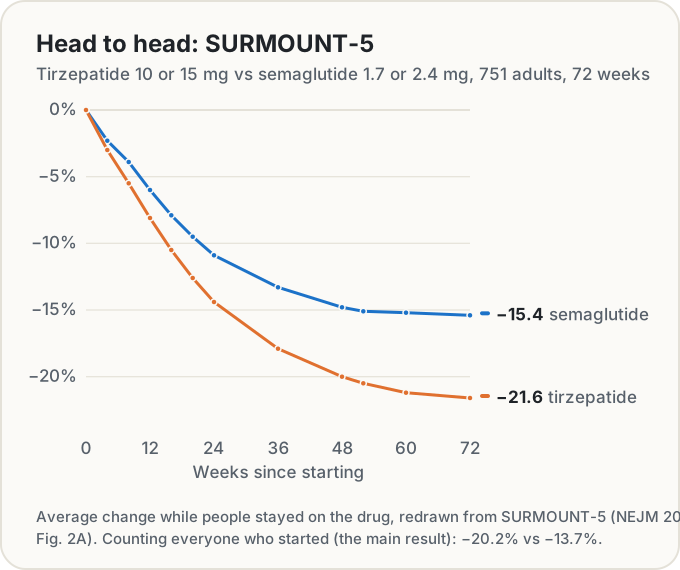
The main result, counting everyone regardless of stopping:
| Tirzepatide | Semaglutide | |
|---|---|---|
| Average weight change at week 72 | −20.2% (−22.8 kg) | −13.7% (−15.0 kg) |
| Waist | −18.4 cm | −13.0 cm |
| Lost at least 10% | 81.6% | 60.5% |
| Lost at least 15% | 64.6% | 40.1% |
| Lost at least 20% | 48.4% | 27.3% |
| Lost at least 25% | 31.6% | 16.1% |
Semaglutide's 13.7% here is lower than its 14.9% in STEP 1. The authors point out that SURMOUNT-5 had more men (35%) than the STEP trials without diabetes (19 to 26%), and that weight loss was about 6% greater in women than in men in both groups.
Side effects and stopping
The most common side effects with both drugs were gastrointestinal: nausea, diarrhoea, vomiting and constipation. Both papers describe them as mostly mild to moderate and most common while the dose was being raised.
In STEP 1, 74.2% of people on semaglutide reported a gastrointestinal problem, against 47.9% on placebo. Nausea affected 44.2% (17.4% on placebo), diarrhoea 31.5% (15.9%), vomiting 24.8% (6.6%) and constipation 23.4% (9.5%). Side effects made 7.0% stop the drug, against 3.1% on placebo. Gallbladder problems, mostly gallstones, were reported by 2.6% against 1.2%.
In SURMOUNT-1, side effects made 4.3%, 7.1% and 6.2% stop tirzepatide on the 5, 10 and 15 mg doses, against 2.6% on placebo. The Zepbound label gives symptom rates for SURMOUNT-1 pooled with SURMOUNT-2 (a trial in people with type 2 diabetes): nausea in 25%, 29% and 28% on 5, 10 and 15 mg, against 8% on placebo.
SURMOUNT-5 gives the fairest side-by-side, because it's one trial:
| Tirzepatide | Semaglutide | |
|---|---|---|
| Nausea | 43.6% | 44.4% |
| Constipation | 27.0% | 28.5% |
| Diarrhoea | 23.5% | 23.4% |
| Vomiting | 15.0% | 21.3% |
| Injection-site reaction | 8.6% | 0.3% |
| Stopped because of side effects | 6.1% | 8.0% |
Both prescribing labels also carry a boxed warning about thyroid C-cell tumours, which both drugs caused in rodents. Whether they do the same in people isn't known, and neither should be used by anyone with a personal or family history of medullary thyroid cancer or MEN 2.
What happened after people stopped
At week 68, STEP 1 stopped both the drug and the counselling. In five countries, 327 participants were then followed for another year with no treatment (Wilding et al., 2022).
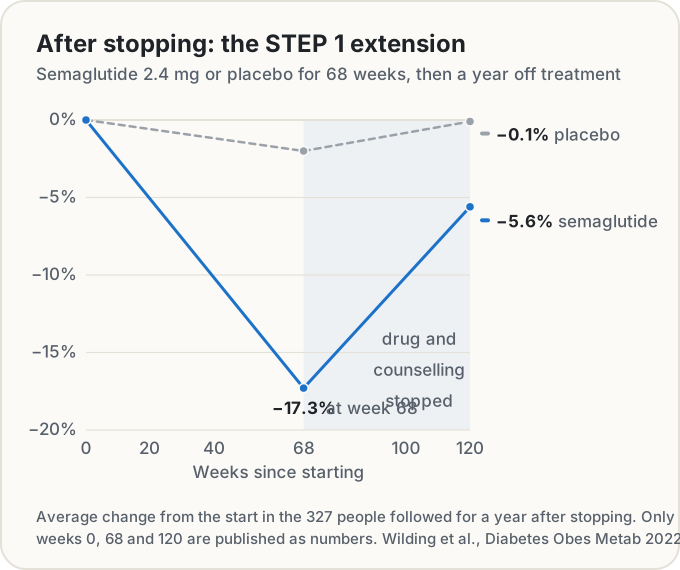
The semaglutide group had lost 17.3% by week 68 (this group is a subset of the trial that finished treatment, so it lost a little more than the trial average). Over the next year they regained 11.6 percentage points, ending 5.6% below where they started. That's about two-thirds of the lost weight back. The improvements in blood pressure, cholesterol and blood sugar mostly went back towards where they began, too. Still, 48.2% of those weighed at week 120 were at least 5% below their starting weight, against 22.6% of the placebo group.
The authors' conclusion is that ongoing treatment is needed to keep the weight off. Keep in mind that the counselling stopped at the same time, so this tells you what happens when everything stops at once.
Caveats, in plain English
- You are not the average. The responder chart is the honest picture: a large range, from people who lost almost nothing to people who lost a quarter of their weight.
- The trials included support. Everyone, placebo groups included, had regular diet and activity counselling and frequent clinic visits. Real life usually has less of that.
- Two trials are not one. STEP 1 and SURMOUNT-1 had different people, sites and years. SURMOUNT-5 is the only direct comparison, and it was open-label and funded by one of the two makers. All three trials were funded by the company whose drug was being tested.
- Weight comes back after stopping, at least in the one trial that measured it for a year.
- Cost and access vary a lot. Both medicines are expensive without insurance, and coverage for weight loss differs by plan and country. Prices change often, so check the manufacturer's current pricing and your own plan rather than any number in an article.
- This is not medical advice. Whether either medicine suits you, and which dose, depends on your health history. Talk to a doctor or other clinician who knows it.
See the trial average on your own weight
Our GLP-1 weight loss calculator applies these trial averages to your starting weight. Pick Wegovy or Zepbound and a dose, and it shows where the trial average would put you, when each milestone would fall, and how many trial participants reached it. One honest limitation: its week-by-week line is a smooth modelled curve fitted to the trial's end point, not the visit-by-visit data in the charts above.
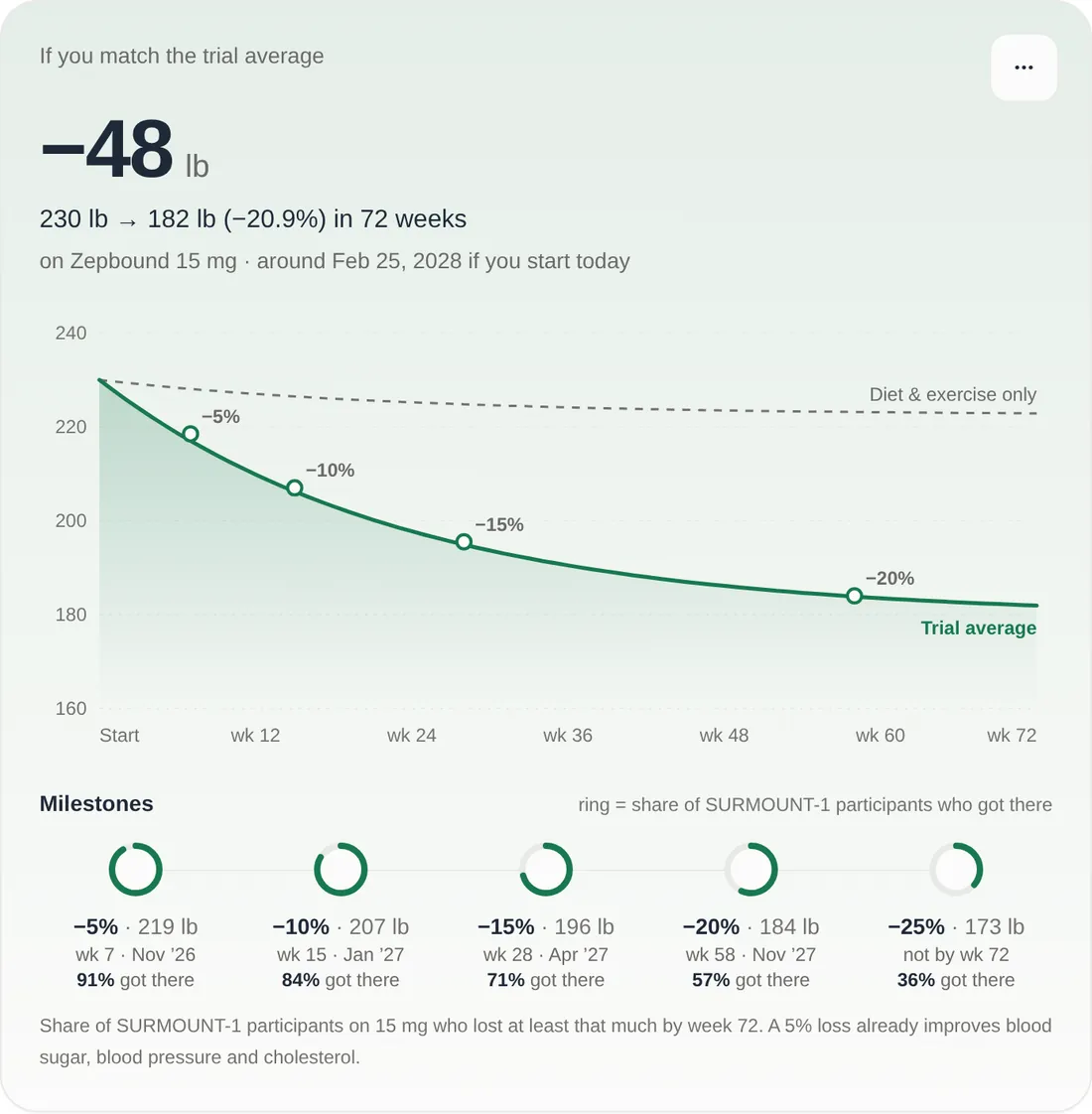
Part of the weight lost on these drugs is muscle, which is why the protein calculator and a strength routine sit next to it. Everything you type stays in your browser.
Sources
- Wilding, J. P. H., et al. (2021). Once-weekly semaglutide in adults with overweight or obesity (STEP 1). New England Journal of Medicine, 384(11), 989–1002. doi:10.1056/NEJMoa2032183 (open copy at UCL Discovery). Table 1, Table 2, Table 3, Figure 1.
- Jastreboff, A. M., et al. (2022). Tirzepatide once weekly for the treatment of obesity (SURMOUNT-1). New England Journal of Medicine, 387(3), 205–216. doi:10.1056/NEJMoa2206038. Abstract.
- Aronne, L. J., et al. (2025). Tirzepatide as compared with semaglutide for the treatment of obesity (SURMOUNT-5). New England Journal of Medicine, 393(1), 26–36. doi:10.1056/NEJMoa2416394 (open copy at Cornell eCommons). Table 2, Table 3, Figure 2A.
- Wilding, J. P. H., et al. (2022). Weight regain and cardiometabolic effects after withdrawal of semaglutide: the STEP 1 trial extension. Diabetes, Obesity and Metabolism, 24(8), 1553–1564. PMC9542252. Abstract, Table S1.
- Wegovy prescribing information, section 14.2, Table 8 (Study 2 is STEP 1), and boxed warning. DailyMed, version of June 2026.
- Zepbound prescribing information, section 14.1, Table 2 and Figure 3 (Study 1 is SURMOUNT-1), section 6.1, Table 1, and boxed warning. DailyMed, version of August 2026.
- ClinicalTrials.gov results for SURMOUNT-1, NCT04184622: the "if taken as intended" percentages.
Keep reading
Health & science · Oct 8, 2026 · 7 min
How to Print or Save a Growth Chart for Your Child's Doctor
Height, weight and BMI-for-age percentiles on the WHO and CDC charts, what a percentile does and doesn't mean, and how to print or save one report as a PDF.
Health & science · Oct 7, 2026 · 8 min
How to Read an AGP Report, Step by Step
A walk through the one-page ambulatory glucose profile (AGP) from a CGM: data check, time in ranges, glucose metrics, the percentile curve and daily views.
Health & science · Oct 7, 2026 · 8 min
Tabata vs HIIT: What the Original Study Did and How to Time It
What the 1996 Tabata study actually tested, how gym Tabata differs, and how to time Tabata, 30/30, EMOM, boxing rounds and sprint intervals safely.
Health & science · Oct 8, 2026 · 7 min
How to Print or Save a Growth Chart for Your Child's Doctor
Height, weight and BMI-for-age percentiles on the WHO and CDC charts, what a percentile does and doesn't mean, and how to print or save one report as a PDF.
Health & science · Oct 7, 2026 · 8 min
How to Read an AGP Report, Step by Step
A walk through the one-page ambulatory glucose profile (AGP) from a CGM: data check, time in ranges, glucose metrics, the percentile curve and daily views.
Health & science · Oct 7, 2026 · 8 min
Tabata vs HIIT: What the Original Study Did and How to Time It
What the 1996 Tabata study actually tested, how gym Tabata differs, and how to time Tabata, 30/30, EMOM, boxing rounds and sprint intervals safely.