How to Meditate for Beginners: Your First 5 Minutes
How to meditate as a beginner: what to do in your first five minutes, why a wandering mind is the practice, how often to sit, and what the evidence says.
Health & science··10 min read
Sit somewhere you can stay awake, pick one place where you can feel your breath (the nose, the chest or the belly) and rest your attention there. When your mind wanders off, notice, and come back. That's the whole technique. Five minutes of it, once a day, is a good start.
The part nobody tells beginners: your mind will wander constantly, and that doesn't mean you're doing it wrong. Noticing that you've drifted is the exercise. This post walks through your first five minutes, how long and how often to sit, how meditating for sleep differs from meditating in the day, and what the research does and doesn't show. The short version of that last part: it helps a bit, it isn't magic, and it isn't right for every moment.
Your first five minutes
This is the order our 5-minute guided meditation follows. You can do the same with any timer.
- Get comfortable, but not too comfortable. A chair is fine: feet on the floor, back upright without being stiff. Lying down works too, if you won't drop off.
- Close your eyes, or don't. If closing them feels odd, rest your gaze on a spot on the floor a little way in front of you.
- Listen for a moment. Sounds close by, sounds further away. You don't have to name them or like them.
- Feel where you're held up. Your feet on the floor, your weight in the chair, your hands wherever they're resting.
- Find the breath in one place. The nose, the chest or the belly, whichever is easiest to feel. Don't change the breath. Just notice it going in and going out.
- Drift, notice, come back. At some point you'll be planning dinner. When you catch it, go back to the next breath, with no fuss.
- End by noticing how you are. Not better or worse. Just how you are.
If watching your breath makes you uneasy, and for some people it does, rest your attention on your hands or on the sounds in the room instead. Any of those works as an anchor.
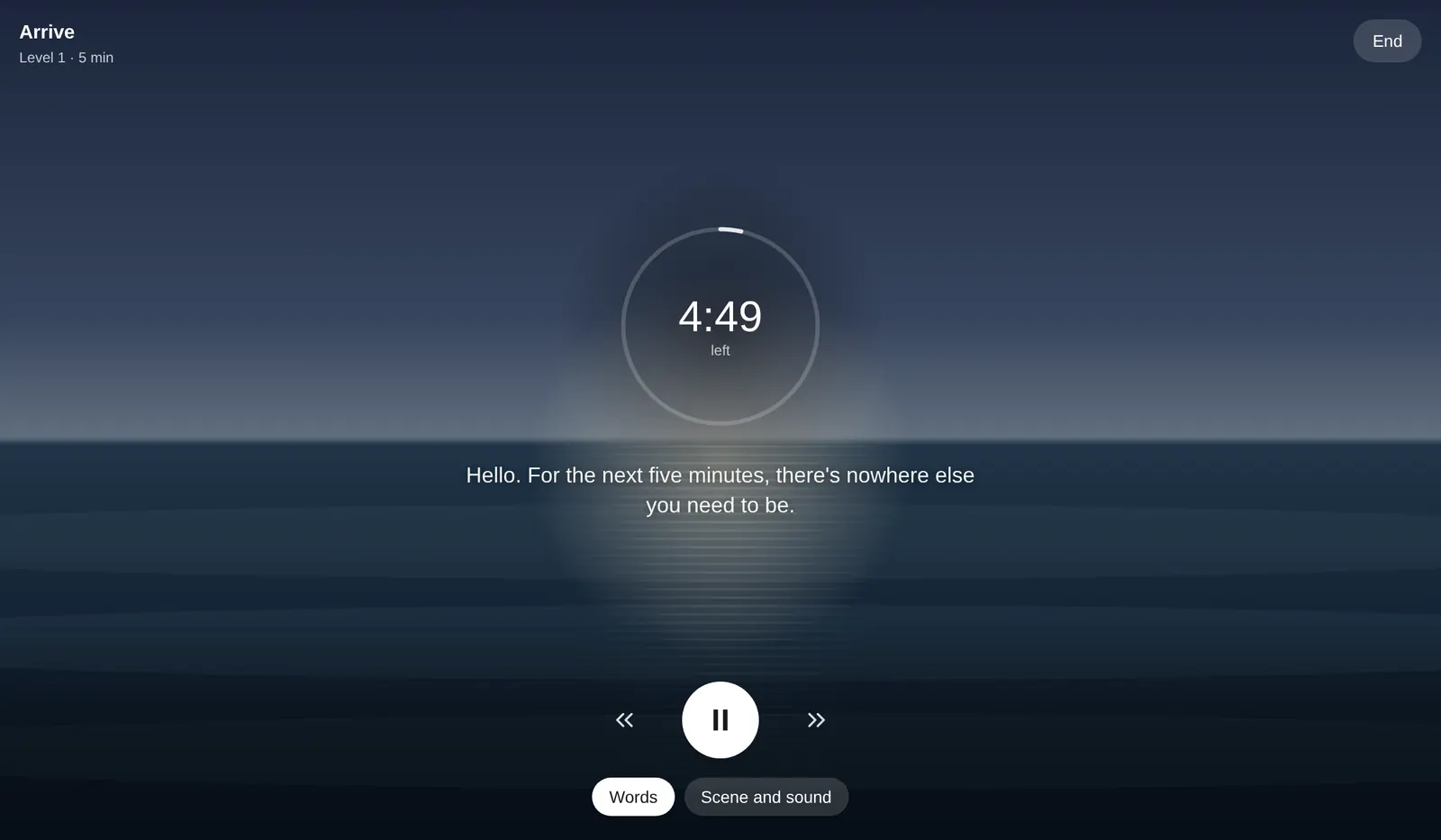
In our five-minute session the voice's lines fill about half the time (157 of the 300 seconds, in the default voice), and the longest stretch of quiet is under half a minute. That balance is on purpose: a beginner does better with some company, but the practice happens in the gaps. The voice is synthesised, by the way: Kokoro, an open speech model, reading a script we wrote in the order the MBSR and MBCT mindfulness courses use.
"My mind won't stop wandering"
Good. That's what it's for.
The kind of meditation in this post is attention training. You pick something to pay attention to, attention slides off it, you notice, and you bring it back. Each return is one repetition, like a single curl at the gym. If you noticed fifty times in three minutes, you practised fifty times. Nobody's mind goes quiet on command, and emptying it was never the goal.
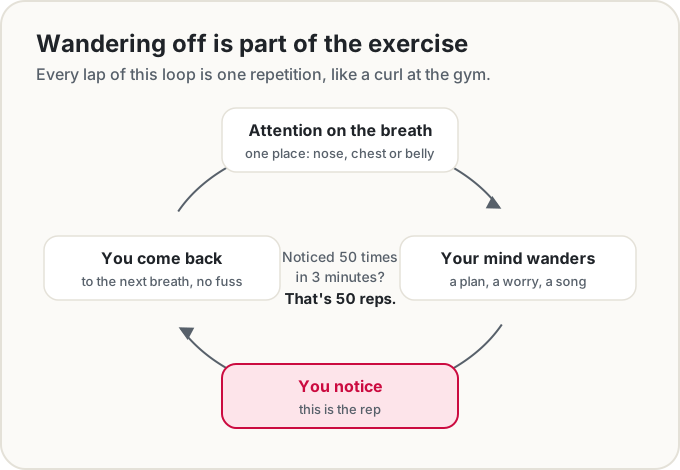
Things that don't count as failing: thinking, itching, fidgeting, being bored, getting lost in a plan for twenty seconds. The only thing the practice asks is that you notice, eventually, and come back.
If you'd like a way to see when you've wandered, try counting. Count each out-breath from one to ten, then start again at one. If you lose count, or find yourself at 17, you've drifted: go back to one. That's level 2 in our tool, Steady, and researchers use the same breath-counting task to measure mindful attention (Levinson et al., 2014).
How long, and how often
Short and daily beats long and occasional. The best evidence for small doses comes from a trial that gave people who had never meditated either a 13-minute guided meditation or a 13-minute podcast every day for eight weeks. After eight weeks the meditators had better attention, working memory and recognition memory, less negative mood, and lower anxiety in a stress test than the podcast group. After four weeks, there was no difference yet (Basso et al., 2019).
Two lessons from that. Doing it most days matters more than doing it for a long time. And give it a couple of months before you decide whether it's working.
A simple first two weeks:
| Days | Session | Length |
|---|---|---|
| 1 to 4 | Arrive: settle in and find the breath | 3 minutes |
| 5 to 10 | Arrive, the longer version | 5 minutes |
| 11 to 14 | Steady: count breaths from one to ten | 10 minutes |
After that come four more levels: a body scan, noting what pulls you away, loving-kindness and open awareness, up to 20 minutes. They're a suggestion, not a ladder. Nothing is locked, there are no streaks to lose, and the tool only keeps a quiet count of your minutes in the past week, in your browser.
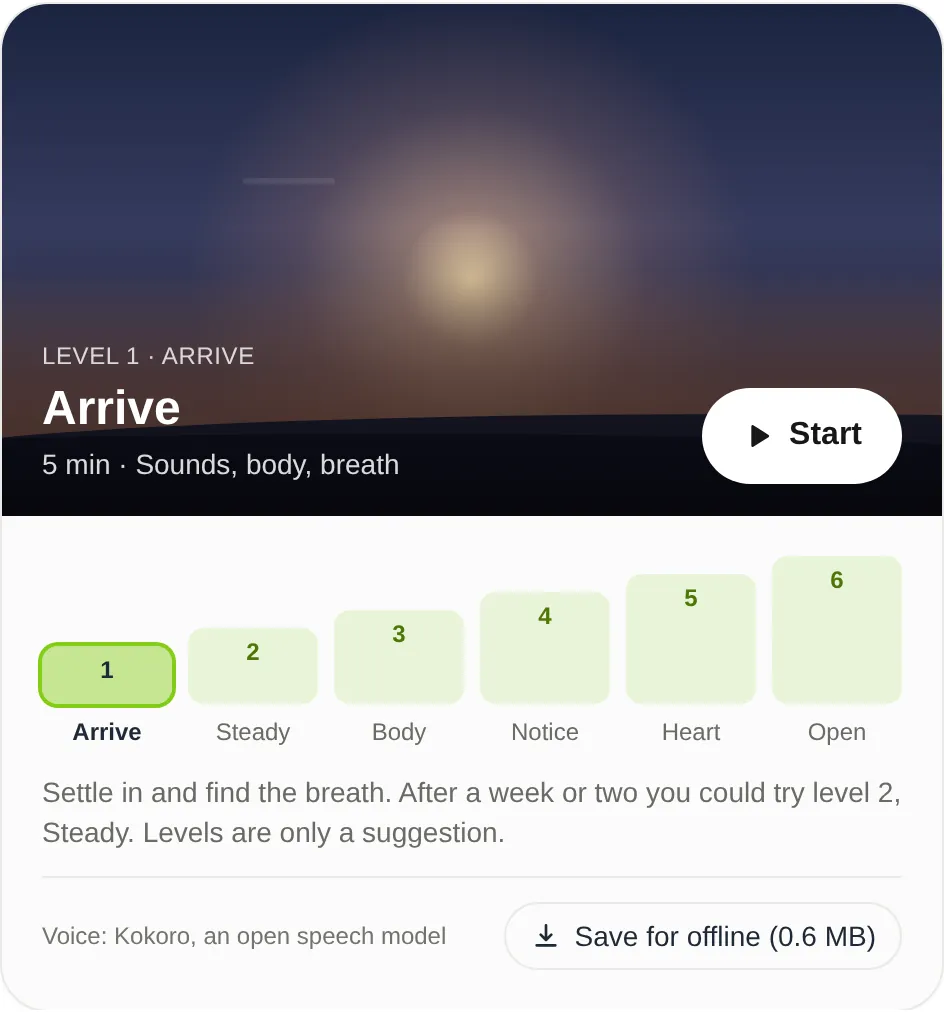
The hard part is remembering, so tie it to something you already do every day. Straight after you make the morning coffee and before you open your messages. In the parked car before you walk into work. On the bus, eyes open, gaze on the floor.
Sleep meditation and daytime meditation are different
In the day, the aim is to stay awake and alert. Sit upright, keep your eyes half open if you need to, and if you keep nodding off, try sitting straighter or practising earlier.
At bedtime it's the opposite: falling asleep halfway is the point. Our sleep meditation is a 20-minute body scan done lying down. The voice moves from your feet to your head, letting each part get heavier, counts slowly down from ten, then stops talking while a soft sound carries on and fades to silence. There's no bell at the end and nothing plays afterwards, and the screen starts dark so the phone can lock itself.
Does it help? Somewhat. A review of 18 trials with 1,654 people found mindfulness meditation improved sleep quality by a moderate amount compared with time-matched activities, but did no better than proven sleep treatments (Rusch et al., 2019). In a smaller trial of 49 older adults who slept badly, six weeks of mindfulness classes improved sleep quality more than six weeks of sleep hygiene classes (Black et al., 2015). So it's a reasonable part of winding down. If you've slept badly for weeks, though, see a doctor, because there are sleep treatments that work at least as well.
If you'd rather keep your eyes open, during the day or at night, the player has six slow scenes to rest them on, plus a dark screen. Most of them drift on cycles of a minute or more, so there's nothing to follow.

One slow breath, if you arrive wound up
The sessions never ask you to change your breath. But if you sit down tense, a few deliberately slow breaths can take the edge off before you start: in for about four seconds, out for about six. That's ten seconds a breath, or six breaths a minute.
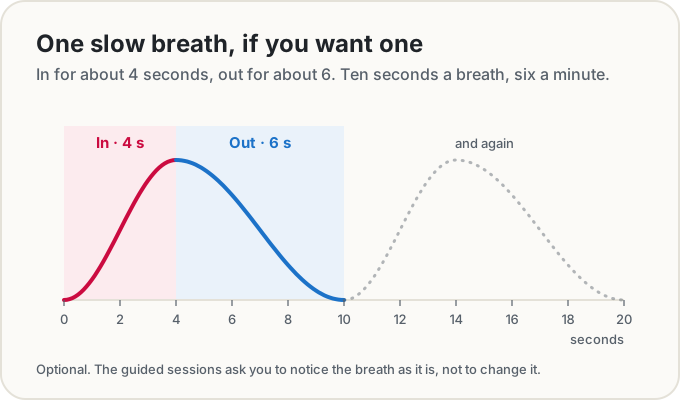
A systematic review of slow breathing, which it defined as under 10 breaths a minute, looked at 15 studies in healthy people and linked it with feeling more relaxed and comfortable, and with less anxiety and anger (Zaccaro et al., 2018). Take three or four, then let the breath go back to doing its own thing, and start noticing it.
What the evidence says, and what it doesn't
The most careful look at meditation programmes is still a 2014 review of 47 trials with 3,515 people, all compared against active controls rather than doing nothing. Mindfulness programmes eased anxiety, depression and pain, with effect sizes of about 0.3 to 0.4 at eight weeks; the authors call that "small to moderate". They found no evidence that meditation did better than any active treatment, such as drugs, exercise or other behavioural therapies. For attention, positive mood, sleep and weight, the evidence was too thin or showed no effect (Goyal et al., 2014).
The US National Center for Complementary and Integrative Health sums up the newer work in the same tone. One 2018 analysis found mindfulness worked about as well as evidence-based therapies for anxiety and depression; a 2021 review found mixed short-term results and no lasting effect in studies that followed people for more than two months (NCCIH).
So here's an honest summary. Meditation is a modest, real help with stress, worry and low mood, about the size you'd hope for from a daily habit. It's not a treatment that replaces therapy or medicine, and the single trial showing better attention after eight weeks is one study, not a settled result.
When it isn't helping, and when to talk to someone
Meditation is usually harmless, but not always. A review of 83 studies with 6,703 people found that about 8% of people who meditated reported an unwanted effect, most often anxiety or depression (Farias et al., 2020). In one careful study of 96 people who took an 8-week mindfulness course, 6 to 14% had bad effects that lasted, often signs of feeling over-aroused or detached (Britton et al., 2021).
If you feel panicky, numb or flooded during a sit, open your eyes, move, look around the room and name a few things you can see, or simply stop. You're always allowed to stop.
Talk to a doctor or therapist rather than meditating harder if:
- low mood or anxiety has gone on for weeks, or is getting in the way of work, sleep or relationships;
- you've slept badly for weeks;
- you live with trauma or PTSD (practise with a professional who knows that ground);
- meditation keeps leaving you worse rather than better.
NCCIH puts it plainly: don't use meditation to replace conventional care, or as a reason to put off seeing a health care provider about a problem. And if you're in crisis or thinking about suicide, talk to someone now: in the US, call or text 988; in the UK and Ireland, call Samaritans on 116 123; elsewhere, findahelpline.com lists free, confidential lines.
If none of that applies, the next step is small. Open the three-minute Arrive session, press Start, and let your mind wander. Then notice.
Share this post
Keep reading
Health & science· Oct 11, 2026· 10 min
How Many Calories Do You Need a Day? TDEE, Explained
Your daily calories are your resting burn times an activity multiplier. Why most calculators guess low for desk workers, why a range helps, and how to check.Health & science· Oct 9, 2026· 10 min
How Much Protein on Ozempic, Wegovy or Zepbound?
How much protein to eat while losing weight on a GLP-1: the 2025 advisory's 1.2 to 1.6 g/kg, which weight to use, a worked example and 100 g in real food.Health & science· Oct 9, 2026· 12 min
Missed a Wegovy, Ozempic, Zepbound or Mounjaro Dose? Label Rules
How late each label lets you take a missed GLP-1 dose: 4 days for Zepbound and Mounjaro, 5 for Ozempic, 2 days before the next one for Wegovy.