What Time Should I Go to Bed? How Sleep Cycles Work
When to go to bed for your alarm: the four sleep stages, why a cycle isn't always 90 minutes, how much sleep each age needs and what the timing evidence says.
Health & science··14 min read
Start from the time you have to get up, count back the sleep you need, then subtract the time it takes you to drop off. For most adults that's 7 to 9 hours (National Sleep Foundation). So with a 7:00 am alarm, 7½ hours of sleep and 10 to 20 minutes to fall asleep, you'd be in bed between 11:10 and 11:20 pm.
You've probably seen the advice to plan in 90-minute sleep cycles so the alarm catches you at the end of one. There's something to it, but less than the calculators suggest. Cycles vary in length from person to person and from one night to the next, and the research on waking "at the right moment" is mixed. The number of hours, and getting up at the same time every day, matter more.
The rest of this post explains what actually happens in a night of sleep, what the evidence does and doesn't support, and how long you should expect to lie there before you nod off. It's general information, not medical advice.
The four stages of sleep
Sleep labs score a night in 30-second slices and give each one a stage. Since 2007, the standard scoring rules have come from the American Academy of Sleep Medicine (AASM). Its task force replaced the 1968 system, merged the old stages 3 and 4 into one stage of deep sleep because it found no evidence for splitting them, and gave the stages new names (Silber et al., 2007). The AASM manual is now on version 3, released in February 2023 (AASM).
There are three stages of non-REM sleep and one of REM, as the US National Institutes of Health describes them (NHLBI; NINDS):
| Stage | What it is |
|---|---|
| N1 | The changeover from awake to asleep. Short and light: breathing and heartbeat slow, muscles relax with the odd twitch. |
| N2 | Properly asleep. You spend more of each cycle here than in any other stage. |
| N3 | Deep or slow-wave sleep. Breathing and heart rate are at their lowest, and you're hard to wake. |
| REM | Rapid eye movement sleep. Brain activity looks close to waking, most dreaming happens here, and your arm and leg muscles go limp so you don't act the dreams out. |
How long is a sleep cycle?
A cycle is one trip down through the non-REM stages and back up into REM. The famous figure is 90 minutes, but it's an average, not a fixed length. The NHLBI says a cycle "starts over every 80 to 100 minutes", with usually four to six cycles a night (NHLBI). Australia's Sleep Health Foundation puts the spread wider, from around 60 to 110 minutes, and adds that the same person's cycles can change unpredictably from night to night (Sleep Health Foundation, 2024).
That spread adds up. Take three people who all fall asleep at 11:30 pm, with cycles of 80, 90 and 100 minutes. All three are normal. Five cycles later, the first one finishes at 6:10 am and the last at 7:50 am.
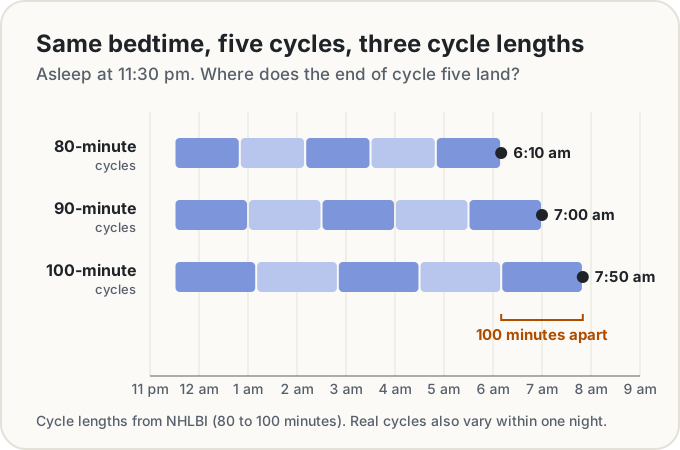
So an alarm set to the minute for "the end of cycle five" is a guess with a wide margin. That's why our Sleep Calculator gives a window rather than a single time, and lets you change the cycle length under More options if 90 minutes doesn't suit you.
How the night changes
Cycles aren't copies of each other either. Deep sleep comes in longer stretches in the first half of the night, while REM periods get longer as the night goes on (NINDS). The first REM period usually arrives about 90 minutes after you fall asleep, and it's a short one. You may also wake briefly between cycles, which is normal (NHLBI).
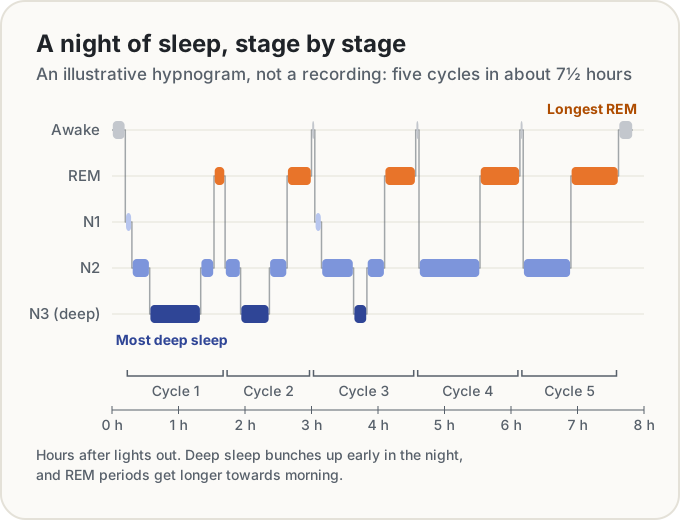
This drawing is illustrative, not anyone's recording. Real hypnograms are messier. The shape also shifts with age: in a meta-analysis of 65 studies covering people from 5 to 102 years old, adults' share of deep sleep and of REM fell with age, while the time it took to fall asleep and the share of light N1 and N2 sleep went up (Ohayon et al., 2004).
Does waking at the end of a cycle help?
This is the claim behind every sleep-cycle calculator, so it deserves a straight answer: partly, sometimes, and the evidence is weaker than the calculators make it sound.
The grogginess you feel right after waking has a name, sleep inertia. A 2019 review describes it as reduced alertness and slower thinking just after you wake, with the worst of it usually gone within 30 minutes, though full recovery can take an hour or more (Hilditch and McHill, 2019).
Here's what the review found for and against the cycle idea:
- For. Several studies found that being woken from deep slow-wave sleep makes inertia worse. In one, people woken from slow-wave sleep showed a 41% drop in performance compared with before their nap, while those woken from stage 2 did about as well as people who'd been awake.
- Against. Other studies found no link at all between the stage you wake from and how well you perform afterwards. In one, most people were woken from slow-wave sleep after a nap on a simulated night shift and showed no drop at all.
- A caveat. Most of this research, on both sides, is on naps rather than a full night's sleep.
- Other factors. Waking after too little sleep, or at the low point of your body clock, also makes inertia worse, whatever stage you were in.
There's also a timing point. Deep sleep is concentrated in the first half of the night, so by a normal morning alarm you're less likely to be in deep sleep to begin with. By morning, the cycle trick is guarding against something that's already less likely.
The Sleep Health Foundation is blunter than we'd be. It calls the sleep calculator idea "unscientific hype" and says it "massively over-generalises" from two real facts (Sleep Health Foundation, 2024). We couldn't find a trial that tested cycle-timed bedtimes against ordinary ones.
So treat whole cycles as a tie-breaker. If you're choosing between 11:00 and 11:20 pm, picking the one that lines up with a cycle costs nothing. If it means cutting your night short to hit a cycle boundary, the extra sleep wins.
How much sleep you need, by age
This part has much firmer ground under it. Three sets of recommendations are widely used, and they agree closely.
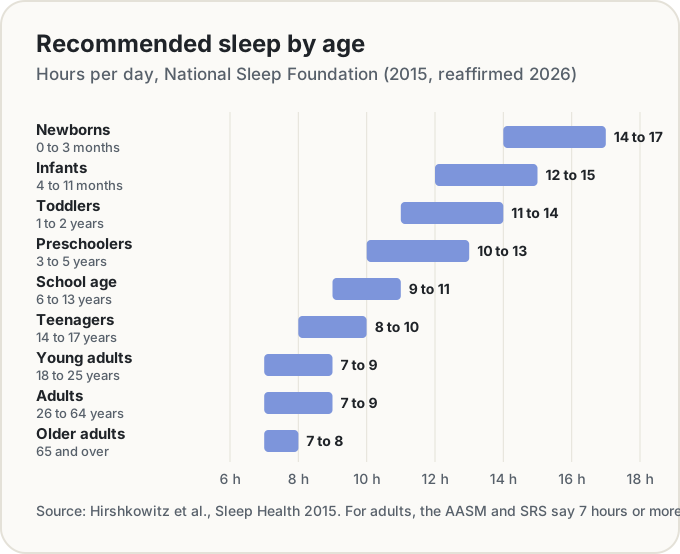
| Age | NSF (2015) | AASM | CDC |
|---|---|---|---|
| Newborns, 0 to 3 months | 14 to 17 h | not covered | 14 to 17 h |
| Infants | 12 to 15 h (4 to 11 months) | 12 to 16 h, naps included (4 to 12 months) | 12 to 16 h, naps included (4 to 12 months) |
| Toddlers, 1 to 2 years | 11 to 14 h | 11 to 14 h, naps included | 11 to 14 h, naps included |
| Preschool, 3 to 5 years | 10 to 13 h | 10 to 13 h, naps included | 10 to 13 h, naps included |
| School age | 9 to 11 h (6 to 13) | 9 to 12 h (6 to 12) | 9 to 12 h (6 to 12) |
| Teenagers | 8 to 10 h (14 to 17) | 8 to 10 h (13 to 18) | 8 to 10 h (13 to 17) |
| Adults | 7 to 9 h (18 to 64) | 7 h or more (18 to 60) | 7 h or more (18 to 60), 7 to 9 h (61 to 64) |
| Older adults, 65 and over | 7 to 8 h | not covered | 7 to 8 h |
Sources: NSF (Hirshkowitz et al., 2015), AASM for adults with the Sleep Research Society (Watson et al., 2015) and for children (Paruthi et al., 2016), and the CDC.
A few things worth knowing about these numbers:
- They're for healthy people. The NSF panel says its ranges are for people without a sleep disorder, and that needs vary from person to person (Hirshkowitz et al., 2015).
- They still hold. In June 2026 the NSF announced a 10-year review of 133 meta-analyses that reaffirmed every one of its 2015 ranges, and found no evidence that women and men need different amounts (NSF, 2026).
- Short sleep is the bigger worry. The AASM and SRS link regularly sleeping under 7 hours with weight gain, diabetes, high blood pressure, heart disease and stroke, depression and a higher risk of death. Sleeping more than 9 hours, they say, may be fine for young adults, people catching up on lost sleep and people who are ill (Watson et al., 2015).
How long should it take to fall asleep?
There isn't one right number, and it creeps up with age (Ohayon et al., 2004). What there is, is a sense of when it becomes a problem. The AASM's insomnia guideline notes that a common complaint among people with insomnia is taking more than 30 minutes, on average, to fall asleep, and it uses "under 30 minutes" as one of the goals of treatment (Schutte-Rodin et al., 2008).
The same guideline has a piece of advice that surprises people: if you can't get to sleep within about 20 minutes, get out of bed and do something relaxing until you feel drowsy, then go back. And don't watch the clock to measure the 20 minutes; the guideline says a rough sense of it is enough.
For a calculator, the practical move is to be honest about your own number. If you usually take 20 to 30 minutes, plan for it. That's why our calculator asks.
The habit that beats the maths: a fixed wake time
If you take one thing from this post, make it this. In 2023 a National Sleep Foundation panel reviewed 63 studies and agreed that keeping regular times for falling asleep and waking up is important for health, safety and performance (Sletten et al., 2023). A systematic review of 41 studies in adults found that later bedtimes and more variable sleep were generally linked to worse health, though the quality of evidence ranged from very low to moderate (Chaput et al., 2020).
An older experiment shows the effect day to day. College students were all asked to sleep at least 7½ hours a night for four weeks, and half of them were also told to keep a regular schedule. The regular group reported bigger and longer-lasting gains in alertness and better sleep efficiency (Manber et al., 1996).
The wake time is the easier one to fix. You can't make yourself fall asleep at 11:15 on the dot, but you can get up at 7:00 every day, including the weekend. Pick a time you can actually keep, count back the hours your age needs, and let the bedtime follow.
The NSF panel did make one allowance: if you've been short of sleep through the week, some catch-up sleep at the weekend may help. It's a patch, not a plan.
Putting it together
Here's the calculator's default example, which is also the 7 am answer from the top of this post.
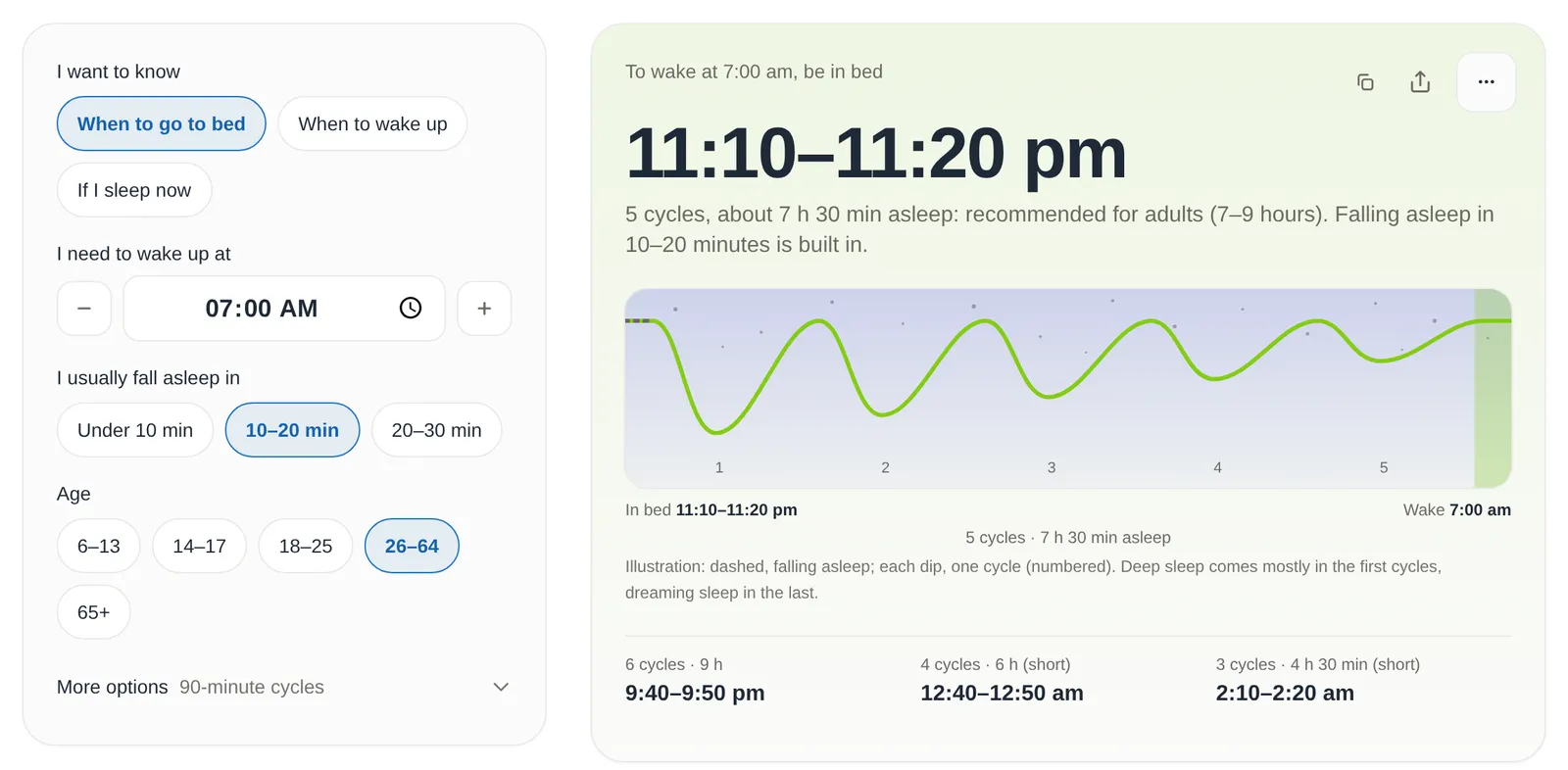
- Wake time. 7:00 am, every day.
- Sleep needed. Five 90-minute cycles is 7½ hours, inside the 7 to 9 for adults.
- Back from the alarm. 7:00 am minus 7½ hours is 11:30 pm, when you need to be asleep.
- Time to fall asleep. 10 to 20 minutes earlier: in bed between 11:10 and 11:20 pm.
If you'd rather aim for 8 hours, go to bed around 10:40 to 10:50 pm instead. It doesn't land on a cycle boundary, and for the reasons above, that's fine. You can try other wake times, ages and falling-asleep speeds in the Sleep Calculator. If your mind is busy at bedtime, our sleep meditation is a slow body scan that fades out as you drift off.
When to talk to someone
A bedtime plan helps with ordinary short sleep. It won't fix a sleep problem. See a doctor if you regularly lie awake for long stretches, wake unrefreshed after enough hours, snore loudly, or struggle to stay awake during the day. Those can have causes that are worth finding and that treatment can help with.
Sources
- Silber, M. H., et al. (2007). The visual scoring of sleep in adults. Journal of Clinical Sleep Medicine, 3(2), 121–131. PMID 17557422. The AASM stages and the merging of stages 3 and 4.
- American Academy of Sleep Medicine. The AASM Manual for the Scoring of Sleep and Associated Events, version 3 (February 2023).
- National Heart, Lung, and Blood Institute. Sleep phases and stages (updated March 2022). Cycles every 80 to 100 minutes, four to six a night.
- National Institute of Neurological Disorders and Stroke. Brain basics: understanding sleep. What happens in each stage and across the night.
- Sleep Health Foundation (2024). The "Sleep Calculator" is just unscientific hype. Cycle lengths of about 60 to 110 minutes.
- Ohayon, M. M., et al. (2004). Meta-analysis of quantitative sleep parameters from childhood to old age in healthy individuals. Sleep, 27(7), 1255–1273. PMID 15586779.
- Hilditch, C. J., & McHill, A. W. (2019). Sleep inertia: current insights. Nature and Science of Sleep, 11, 155–165. PMC6710480.
- Hirshkowitz, M., et al. (2015). National Sleep Foundation's sleep time duration recommendations: methodology and results summary. Sleep Health, 1(1), 40–43. PMID 29073412; and the final report, Sleep Health, 1(4), 233–243. PMID 29073398.
- National Sleep Foundation (June 10, 2026). National Sleep Foundation reaffirms landmark sleep duration recommendations.
- Watson, N. F., et al. (2015). Recommended amount of sleep for a healthy adult: a joint consensus statement of the American Academy of Sleep Medicine and Sleep Research Society. Journal of Clinical Sleep Medicine, 11(6), 591–592. PMC4442216.
- Paruthi, S., et al. (2016). Recommended amount of sleep for pediatric populations: a consensus statement of the American Academy of Sleep Medicine. Journal of Clinical Sleep Medicine, 12(6), 785–786. PMC4877308.
- Centers for Disease Control and Prevention. About sleep (reviewed May 2024).
- Schutte-Rodin, S., et al. (2008). Clinical guideline for the evaluation and management of chronic insomnia in adults. Journal of Clinical Sleep Medicine, 4(5), 487–504. PMC2576317.
- Sletten, T. L., et al. (2023). The importance of sleep regularity: a consensus statement of the National Sleep Foundation sleep timing and variability panel. Sleep Health, 9(6), 801–820. PMID 37684151.
- Chaput, J.-P., et al. (2020). Sleep timing, sleep consistency, and health in adults: a systematic review. Applied Physiology, Nutrition, and Metabolism, 45(10 Suppl. 2), S232–S247. PMID 33054339.
- Manber, R., Bootzin, R. R., Acebo, C., & Carskadon, M. A. (1996). The effects of regularizing sleep-wake schedules on daytime sleepiness. Sleep, 19(5), 432–441. PMID 8843535.
Share this post
Keep reading
Health & science· Oct 10, 2026· 10 min
How to Meditate for Beginners: Your First 5 Minutes
How to meditate as a beginner: what to do in your first five minutes, why a wandering mind is the practice, how often to sit, and what the evidence says.Health & science· Oct 14, 2026· 13 min
How Is Your Due Date Calculated? LMP, Scans and IVF
How a due date is worked out: Naegele's 280-day rule, adjusting for cycle length, when a scan changes the date, IVF transfers and how few babies arrive on it.Health & science· Oct 11, 2026· 10 min
How Many Calories Do You Need a Day? TDEE, Explained
Your daily calories are your resting burn times an activity multiplier. Why most calculators guess low for desk workers, why a range helps, and how to check.