How Is Your Due Date Calculated? LMP, Scans and IVF
How a due date is worked out: Naegele's 280-day rule, adjusting for cycle length, when a scan changes the date, IVF transfers and how few babies arrive on it.
Health & science··13 min read
A due date is 280 days (40 weeks) after the first day of the last menstrual period. That's the convention the American College of Obstetricians and Gynecologists (ACOG) describes (Committee Opinion 700). A last period that started on Sunday 19 July 2026 gives a due date of Sunday 25 April 2027.
Two things change that simple sum in practice. An early ultrasound often replaces it, because it's more accurate, and after IVF the date comes from the embryo transfer instead. And whichever method you use, the date is the middle of a range, not a prediction: in one study of 18,708 births, only 5% arrived on the day (Khambalia et al., 2013).
This post walks through each method and where its numbers come from. It's general information, not medical advice. The date that counts is the one your clinician records, usually after a scan.
Naegele's rule: 280 days from the last period
The 280-day rule is usually credited to the German obstetrician Franz Naegele (1778 to 1851). Counting from the last period sounds odd, since nobody is pregnant on that day, but it's the one date most people can know without a test. Ovulation and conception aren't visible; a period is.
ACOG spells out what the rule assumes: "a regular menstrual cycle of 28 days, with ovulation occurring on the 14th day". It also lists what it doesn't account for: people misremembering the date, cycles of other lengths, and ovulation coming earlier or later than day 14. On the first point, ACOG notes that only about half of women accurately recall their last period (ACOG, 2017).
The pen-and-paper version is: take the first day of the last period, add a year, go back three months and add seven days. Because months differ in length, that shortcut can land a day or so away from a straight 280-day count, which is why calculators, ours included, just count the days.
Even the history is argued over. A 2000 paper suggested the rule had been misinterpreted over the years in a way that makes due dates come out too early (Baskett and Nagele, 2000). A 2016 re-reading of Naegele's own textbooks disagreed: they clearly say to count from the first day of the last period (Loytved and Fleming, 2016).
Is 280 days the right number?
It's a reasonable average with a lot of spread. Some measurements:
- In 125 natural pregnancies where ovulation was pinned down with daily hormone tests, the median from ovulation to birth was 268 days, two days longer than the 266 the rule implies. Even after leaving out preterm births, healthy pregnancies varied in length by 37 days (Jukic et al., 2013).
- A 1990 study of uncomplicated pregnancies with spontaneous labour, in white mothers in private care, found a median of 274 days from assumed ovulation for first births and 269 for later ones (Mittendorf et al., 1990).
Neither study changed the convention, and they don't need to. Everyone using the same rule is what lets a clinic, a lab and a hospital talk about "38 weeks" and mean the same day.
Adjusting for cycle length
If cycles run longer than 28 days, ovulation usually comes later, and so does everything after it. The common fix, and the one our calculator uses, is to move the due date by the difference: a 32-day cycle adds 4 days, a 25-day cycle takes 3 off. For the July example, a 32-day cycle gives 29 April 2027 instead of 25 April.
Why shift the whole difference? Because most of the variation is in the first half of the cycle. Across 612,613 cycles tracked in a fertility app, the phase before ovulation averaged 16.9 days with a 95% interval of 10 to 30 days, while the phase after it averaged 12.4 days with an interval of 7 to 17 (Bull et al., 2019). The second half is the steadier one, so ovulation is better placed by counting back from the next period than forward from the last.
Two caveats. ACOG doesn't set a formula for this adjustment; it just says the 280-day rule doesn't allow for it. And with irregular cycles the adjustment is a rough guess at best. When the last period date is uncertain, ACOG's advice is to date the pregnancy by ultrasound.
When an ultrasound changes the date
ACOG calls an ultrasound in the first trimester, up to and including 13 weeks 6 days, "the most accurate method to establish or confirm gestational age". Measuring the embryo from crown to rump at that stage is accurate to within 5 to 7 days either way, and the earlier the scan, the more accurate it is (ACOG, 2017).
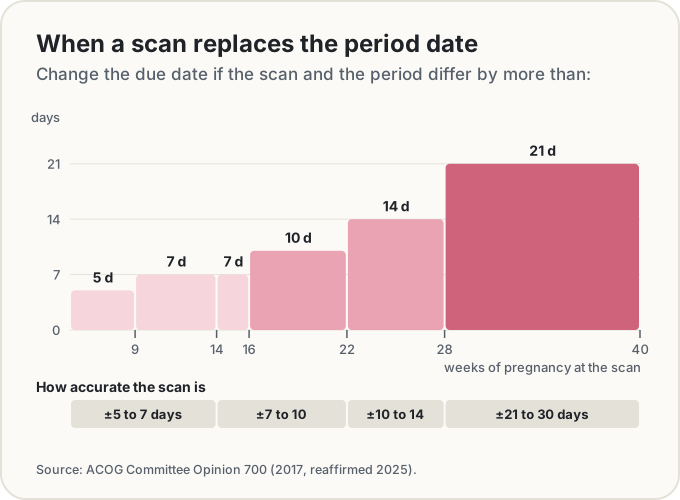
So when the scan and the last period disagree by more than a set number of days, the scan's date wins. The threshold widens as pregnancy goes on, because scans get less precise later in pregnancy:
| Weeks of pregnancy at the scan | Change the due date if they differ by more than | Scan accuracy |
|---|---|---|
| Up to 8 weeks 6 days | 5 days | ±5 to 7 days |
| 9 weeks 0 days to 13 weeks 6 days | 7 days | ±5 to 7 days |
| 14 weeks 0 days to 15 weeks 6 days | 7 days | ±7 to 10 days |
| 16 weeks 0 days to 21 weeks 6 days | 10 days | ±7 to 10 days |
| 22 weeks 0 days to 27 weeks 6 days | 14 days | ±10 to 14 days |
| 28 weeks 0 days and later | 21 days | ±21 to 30 days |
A few details from the same opinion:
- The thresholds are a convention too. ACOG says "no perfect evidence exists" for a single cut-off, and chose these so that everyone uses the same standard.
- First-trimester scans change a lot of dates. In one trial, 40% of women randomised to a first-trimester scan had their due date moved because it differed by more than 5 days, against 10% in the group scanned only in the second trimester.
- A third-trimester scan is the weakest guide. At ±21 to 30 days, there's a risk of mistaking a small baby for a younger one, so ACOG says decisions based on it alone are "especially problematic".
- Before 22 weeks matters. A pregnancy without a scan that confirms or changes the date before 22 weeks 0 days counts as "suboptimally dated".
- One date, then leave it. Once the date is set from the last period, the first accurate scan or both, ACOG says later changes "should be reserved for rare circumstances".
That's why a later growth scan doesn't usually move the date: by then it's tracking the baby's growth, not re-dating the pregnancy.
IVF: counting from the transfer
After IVF the uncertainty about ovulation disappears, because the embryo's age and the day it was placed are both known. ACOG's instruction is to use the gestational age that the fertility treatment gives, worked out from the embryo's age and the transfer date, and it gives two examples: the due date is 263 days after a day-3 embryo transfer and 261 days after a day-5 (blastocyst) transfer (ACOG, 2017).
The arithmetic lines up with the rest of the system. Conception is assumed 14 days after the last period, so 280 days from the period is 266 days from conception. A day-3 embryo is already 3 days past conception when it's transferred, so 266 minus 3 is 263. A day-5 embryo gives 266 minus 5, which is 261. What matters is the embryo's age on transfer day, so the same sums apply to fresh and frozen transfers.
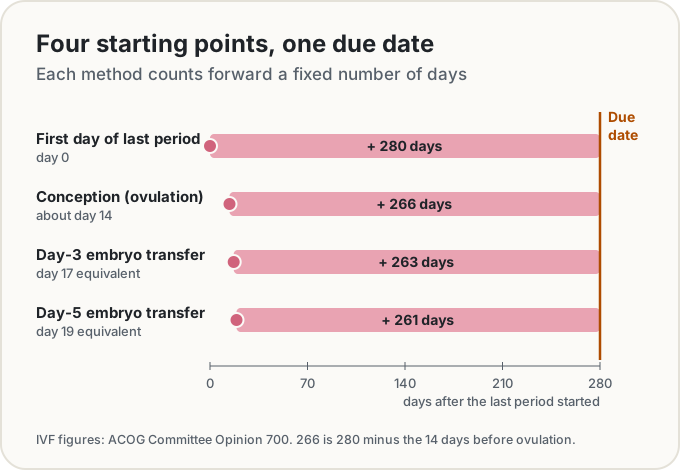
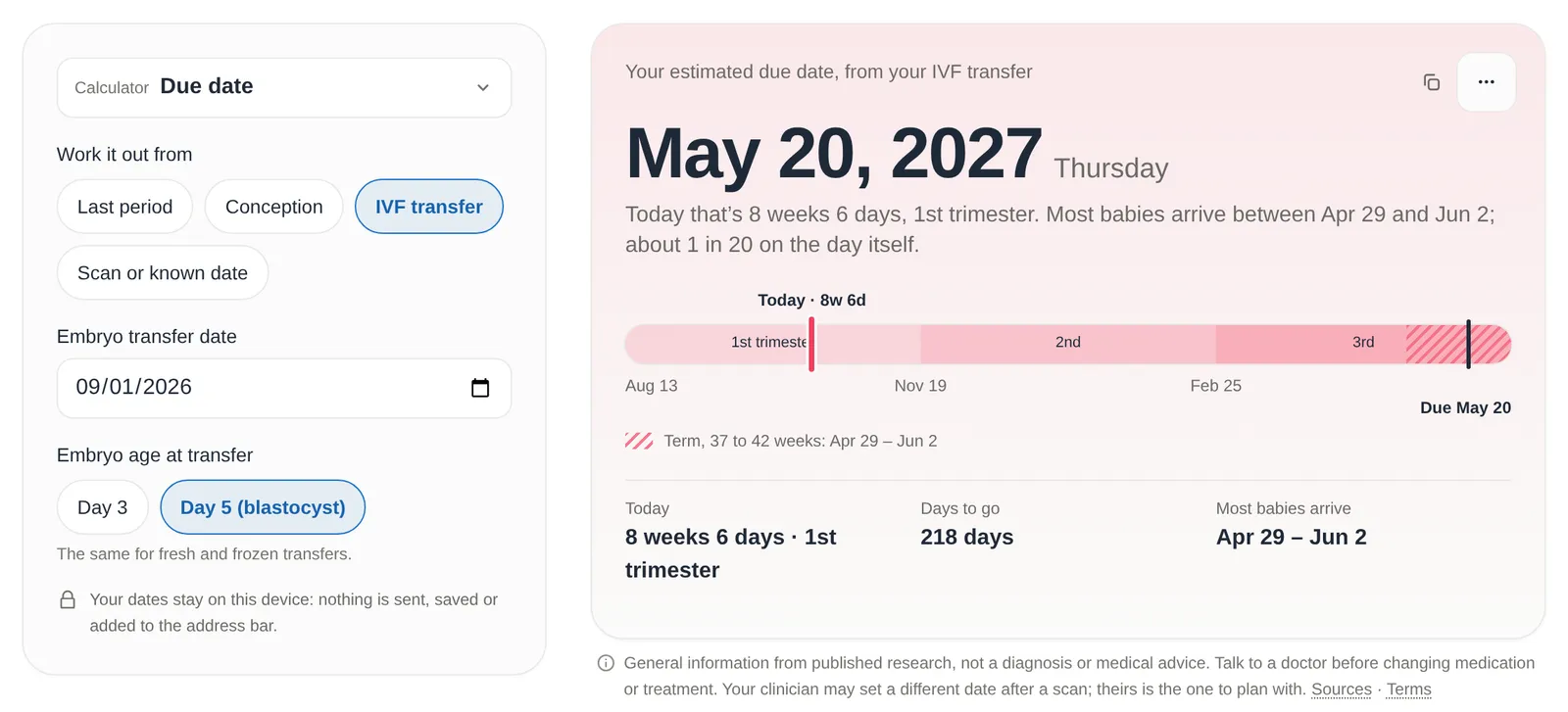
For example, a day-5 transfer on 1 September 2026 gives a due date of 20 May 2027. Pregnancy weeks still count the usual way, so that pregnancy is treated as if the last period had started on 13 August 2026.
Your fertility clinic will give you the date it uses, and that's the one to go by.
How many babies arrive on the due date?
Hardly any. In the Australian study of 18,708 births after labour started on its own, 5% of babies arrived on the estimated date, and about 66% within 7 days of it. That held whether the date came from the last period or from a scan, and whatever week the scan was done in (Khambalia et al., 2013).
A larger UK study of 34,249 pregnancies with "certain" period dates found similar spreads. Within 10 days either side of the due date, 64% of births were captured when the date came from the period alone, and 70% when it came from the scan alone. Scan dating also cut the number of pregnancies counted as postterm by 70% (Mongelli et al., 1996).
So it helps to think of a due date as a week or two either side of a mark, not a day to plan around.
The weeks around it: early, full, late and post term
"Term" used to mean anything from 3 weeks before the due date to 2 weeks after. Research showed that babies' outcomes, especially breathing problems, vary across those 5 weeks, so in 2013 ACOG and the Society for Maternal-Fetal Medicine endorsed four narrower labels (ACOG Committee Opinion 579). Birth before 37 weeks is preterm (WHO).
| Label | Weeks of pregnancy |
|---|---|
| Preterm | before 37 weeks 0 days |
| Early term | 37 weeks 0 days to 38 weeks 6 days |
| Full term | 39 weeks 0 days to 40 weeks 6 days |
| Late term | 41 weeks 0 days to 41 weeks 6 days |
| Postterm | 42 weeks 0 days and later |
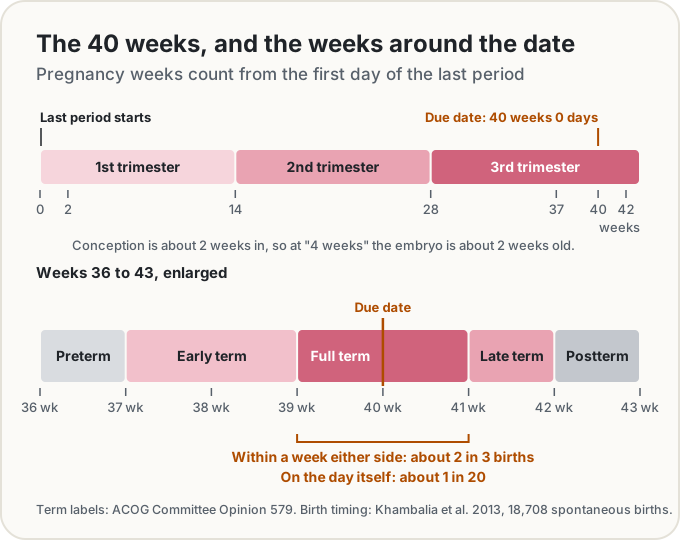
Notice that the due date sits inside "full term", not at its end. Full term runs from a week before the due date to six days after it.
Working back to the conception date
Running the same convention backwards gives a rough conception date: the due date minus 266 days. For a due date of 25 April 2027, that's 2 August 2026.
Treat that as the middle of a window, though. In a study of 221 women trying to conceive, every pregnancy came from sex during the six days ending on the day of ovulation (Wilcox et al., 1995). Add the uncertainty in the due date itself (5 to 7 days either way even from an early scan) and the honest answer spans a week or more. No date calculation can say more precisely when a pregnancy began.
Our conception date calculator shows the most likely day with that six-day window around it.
Try it with your own dates
Here's the Due Date Calculator with the July example from the top of the post:
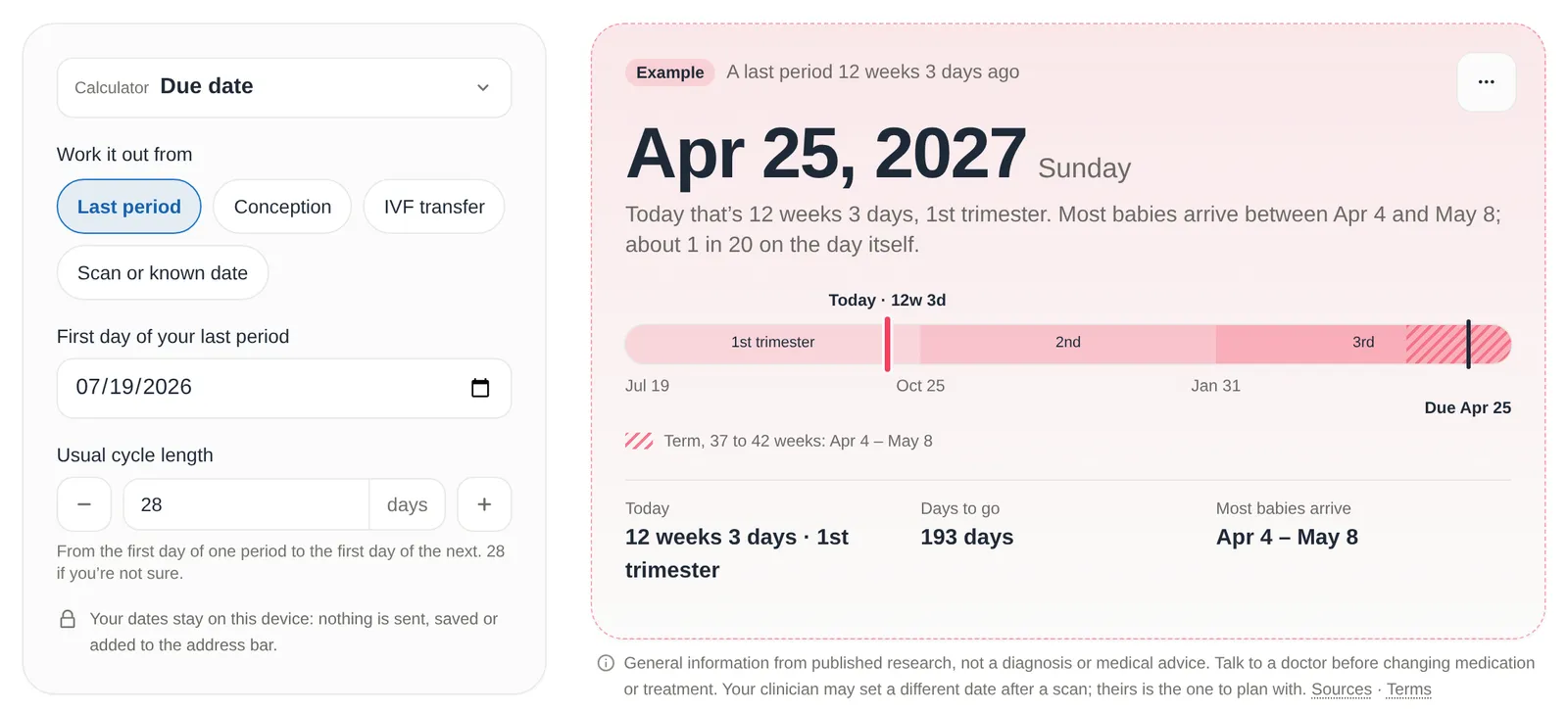
It works from a last period (with your cycle length), a conception date, an IVF transfer or a scan, and shows the term window alongside the date. If you already know your due date, how many weeks pregnant gives today's week and day. The dates you type stay in your browser and aren't put in the address bar.
Whatever a calculator says, your clinician confirms the dating, usually at the first scan, and that's the date to plan with.
Sources
- American College of Obstetricians and Gynecologists (2017, reaffirmed 2025). Committee Opinion No. 700: Methods for estimating the due date. Obstetrics & Gynecology, 129(5), e150–e154. ACOG (full text). The 280-day convention and its assumptions, recall of the last period, scan accuracy, the redating thresholds, suboptimal dating and the IVF figures.
- American College of Obstetricians and Gynecologists (2013, reaffirmed 2025). Committee Opinion No. 579: Definition of term pregnancy. ACOG.
- World Health Organization (2023). Preterm birth fact sheet.
- Khambalia, A. Z., et al. (2013). Predicting date of birth and examining the best time to date a pregnancy. International Journal of Gynecology & Obstetrics, 123(2), 105–109. PMID 23932061.
- Mongelli, M., Wilcox, M., & Gardosi, J. (1996). Estimating the date of confinement: ultrasonographic biometry versus certain menstrual dates. American Journal of Obstetrics and Gynecology, 174(1), 278–281. PMID 8572021.
- Jukic, A. M., et al. (2013). Length of human pregnancy and contributors to its natural variation. Human Reproduction, 28(10), 2848–2855. PMID 23922246.
- Mittendorf, R., et al. (1990). The length of uncomplicated human gestation. Obstetrics & Gynecology, 75(6), 929–932. PMID 2342739.
- Baskett, T. F., & Nagele, F. (2000). Naegele's rule: a reappraisal. BJOG, 107(11), 1433–1435. PMID 11117775.
- Loytved, C. A., & Fleming, V. (2016). Naegele's rule revisited. Sexual & Reproductive Healthcare, 8, 100–101. PMID 27179385.
- Bull, J. R., et al. (2019). Real-world menstrual cycle characteristics of more than 600,000 menstrual cycles. npj Digital Medicine, 2, 83. PMID 31482137.
- Wilcox, A. J., Weinberg, C. R., & Baird, D. D. (1995). Timing of sexual intercourse in relation to ovulation. New England Journal of Medicine, 333(23), 1517–1521. PMID 7477165.
Share this post
Keep reading
Health & science· Oct 14, 2026· 14 min
What Time Should I Go to Bed? How Sleep Cycles Work
When to go to bed for your alarm: the four sleep stages, why a cycle isn't always 90 minutes, how much sleep each age needs and what the timing evidence says.Health & science· Oct 11, 2026· 10 min
How Many Calories Do You Need a Day? TDEE, Explained
Your daily calories are your resting burn times an activity multiplier. Why most calculators guess low for desk workers, why a range helps, and how to check.Health & science· Oct 10, 2026· 10 min
How to Meditate for Beginners: Your First 5 Minutes
How to meditate as a beginner: what to do in your first five minutes, why a wandering mind is the practice, how often to sit, and what the evidence says.