How to Make a Vision Board You'll Actually Look At
A step-by-step guide to a vision board that changes what you do, not just how you feel, using what psychology research says about goals and plans.
Productivity··6 min read
Here's an uncomfortable finding before we start. In a set of experiments published in 2011, psychologists Heather Barry Kappes and Gabriele Oettingen had people fantasize about an ideal future. The dreamers came away with less energy than people who didn't, measured by a drop in their systolic blood pressure. The pleasant picture felt a bit like having already arrived.
It shows up in real life, too. Oettingen and Doris Mayer followed graduating students for two years. The ones who'd spent the most time on rosy fantasies about landing a job sent out fewer applications, got fewer offers, and ended up earning less.
That's not a reason to skip the vision board. It's a reason to make a better one. A board that only shows the happy ending can quietly sap your drive. A board that also shows the path (and the hard bit in the middle) does the opposite.
This guide walks through how to make that second kind.
Step 1: Pick one time horizon
Decide what the board is for before you pick a single photo.
- One year works for concrete things: a trip, a habit, a project you'll finish.
- Three to five years works for who you're becoming: a career shift, a home, a way of living.
Mixing them is how boards turn into clutter. "Run a 10K" and "Live by the sea" can both be true, but they belong to different time scales and pull your attention in different directions. If you want both, make two boards.
Step 2: Choose six to ten areas, not thirty
Look at the parts of your life that matter most right now (health, work, money, relationships, home, travel, your inner life, learning, creativity, community) and pick the ones you'd genuinely trade something for.
Six is a good number. Ten is the most a board can hold before nothing stands out. If you're stuck, our list of 60 vision board ideas is grouped by exactly these areas.
Step 3: Find photos that make you feel it
The test for a photo is simple: does looking at it make you want to do something? Not "is it pretty." Plenty of pretty pictures leave you cold.
Your own photos often win here. The trail you hiked once and keep meaning to finish. Your actual kitchen, with the light at 7am. A picture of you on a day you felt strong. Stock photos are fine when nothing of yours fits. Just be picky.
Step 4: Write short, present-tense captions
One line per photo. Write it as if it's already part of your life.
| Instead of | Try |
|---|---|
| I want to get fit | Move every single day |
| Save more money | Six months of runway |
| Stop being so stressed | Ten quiet minutes each morning |
| Travel more | One road trip every summer |
Notice that the good versions are things you could check. You either moved today or you didn't. That's what turns a board from decoration into a daily nudge.
Step 5: Name the obstacle, and plan for it
This is the step almost every vision board guide skips, and it's the one with the strongest evidence behind it.
Oettingen's research on mental contrasting (later packaged as the WOOP method: Wish, Outcome, Obstacle, Plan) found that people who pair a wish with an honest look at what's in the way follow through more than people who only imagine the wish.
The plan part comes from Peter Gollwitzer's work on implementation intentions: simple "if-then" plans. A 2006 meta-analysis by Gollwitzer and Paschal Sheeran pooled 94 independent tests from 63 reports and found these plans had a medium-to-large effect on actually reaching goals (d = 0.65), across health, study and work goals.
You don't need to put this on the board itself. Keep it on the back, or in a note on your phone. For each item, write one line:
Move every single day. Obstacle: I'm wiped out after work. If it's 6pm and I'm on the couch, then I walk around the block before dinner.
Six months of runway. Obstacle: the money disappears before I save it. If payday hits, then the transfer to savings goes out the same morning.
Two sentences each. That's enough to turn a picture into a plan.
Step 6: Put it where your eyes already go
A board you see once a month is a board you made once. Put it where you'll see it without trying.
Your phone's lock screen is the best real estate there is: you look at it dozens of times a day. A tall, phone-shaped version of the board works far better than a squashed screenshot of a wide one.
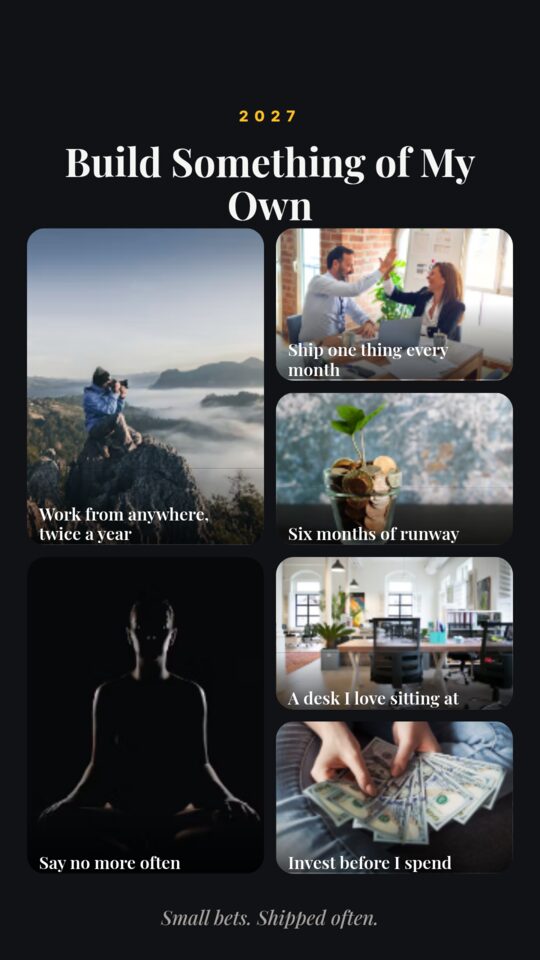
On paper, put it on the wall you face while you work, on the fridge, or next to the bathroom mirror. Anywhere you'll pass it in the morning.
Step 7: Review it every three months
Goals change. That's not failure; that's information. Every quarter, look at each item and ask:
- Did I do anything about this in the last three months?
- Do I still want it?
Swap out anything that's gone stale. A board that reflects who you were in January isn't much use in September.
Digital or paper?
Both, ideally. Make it digitally so it's easy to edit and resize, then print a copy for the wall and save a phone-wallpaper version.
Our free vision board maker is built for exactly that: pick photos from a curated library or upload your own, choose a collage, grid or polaroid layout, then print it, save a PDF, or download a phone wallpaper. No account, and your board stays in your browser.
The short version
- Pick one time horizon.
- Choose six to ten areas.
- Use photos that make you want to act.
- Write short, present-tense, checkable captions.
- Name the obstacle and write an if-then plan.
- Put it on your lock screen and your wall.
- Review it every three months.
The picture is the easy part. The obstacle and the plan are what make it work.
Sources
- Kappes, H. B., & Oettingen, G. (2011). Positive fantasies about idealized futures sap energy. Journal of Experimental Social Psychology, 47(4), 719–729.
- Oettingen, G., & Mayer, D. (2002). The motivating function of thinking about the future: Expectations versus fantasies. Journal of Personality and Social Psychology, 83(5), 1198–1212.
- Oettingen, G. (2014). Rethinking Positive Thinking: Inside the New Science of Motivation. Current.
- Gollwitzer, P. M. (1999). Implementation intentions: Strong effects of simple plans. American Psychologist, 54(7), 493–503.
- Gollwitzer, P. M., & Sheeran, P. (2006). Implementation intentions and goal achievement: A meta-analysis of effects and processes. Advances in Experimental Social Psychology, 38, 69–119.
Share this post
Keep reading
Productivity· Oct 3, 2026· 6 min
Vision Board Ideas for 2027: 60 Captions and 3 Real Examples
Sixty vision board ideas you can steal, grouped by life area, plus three real example boards and the small changes that make a board worth looking at every day.Productivity· Oct 7, 2026· 9 min
Pomodoro vs Flowtime: What the Research on Breaks Says
Classic Pomodoro, Flowtime and a chess-clock break budget compared: what studies on breaks and attention found, and how to pick the one that suits you.Productivity· Oct 10, 2026· 11 min
Do ATS Reject Resumes? The 75% and 6-Second Myths
Do applicant tracking systems really reject 75% of resumes, and do recruiters look for 6 seconds? Where both numbers came from and what the evidence says.