How to Calculate GPA: Semester, Cumulative and Weighted
Multiply each grade's points (A = 4.0, B+ = 3.3) by its credits, add them up and divide by total credits. Worked examples, weighted GPA and finals.
Math··15 min read
To calculate your GPA, turn each letter grade into grade points (A = 4.0, A− = 3.7, B+ = 3.3 and so on), multiply each one by the course's credits, add those products up and divide by your total credits. A semester with a B+ in a 4-credit class, an A− in another 4-credit class, an A and a B in two 3-credit classes and an A in a 1-credit class comes to 53.0 grade points over 15 credits: a 3.53 GPA.
That's the whole method. Below: the grade-point scale and where schools differ, the semester worked through line by line, weighted and unweighted GPA, cumulative GPA (and an averaging mistake that's easy to make), the score you need on a final, and the arithmetic of raising a GPA.
The 4.0 scale, grade by grade
This is the scale you'll see at many US colleges and high schools that give pluses and minuses. Each step between letters is about a third of a point.
| Grade | Points | Grade | Points | Grade | Points |
|---|---|---|---|---|---|
| A+ | 4.0 | B | 3.0 | C− | 1.7 |
| A | 4.0 | B− | 2.7 | D+ | 1.3 |
| A− | 3.7 | C+ | 2.3 | D | 1.0 |
| B+ | 3.3 | C | 2.0 | D− | 0.7 |
| F | 0.0 |
This exact table is what UC Berkeley's registrar publishes, and Berkeley says an A+ "does not receive grade point credit beyond that received for the grade of A" (Berkeley, Grades and Grading). UC San Diego uses the same values (UCSD, Calculate your GPA). But it isn't universal:
- Cornell counts an A+ as 4.3 (Cornell ILR, Academic Grades and Notations).
- MIT uses a 5.0 scale: A = 5, B = 4, C = 3, D = 2, F = 0 (MIT Registrar, Calculating GPA).
- Some schools have no A+ or no D−. Fairfax County Public Schools in Virginia has no A+, and removed the D− for the 2025-26 school year (FCPS, Postsecondary Profile).
Pass/fail grades usually sit outside the GPA entirely. At Berkeley, P and NP grades carry no grade points and their units are left out of the calculation. So the table above is a good default, but your own school's catalogue or registrar page is the one that counts. It takes two minutes to look up.
How to calculate a semester GPA, step by step
Here's a full 15-credit semester:
| Course | Credits | Grade | Points | Points × credits |
|---|---|---|---|---|
| Calculus I | 4 | B+ | 3.3 | 13.2 |
| Chemistry | 4 | A− | 3.7 | 14.8 |
| Writing | 3 | A | 4.0 | 12.0 |
| Psychology | 3 | B | 3.0 | 9.0 |
| Fitness | 1 | A | 4.0 | 4.0 |
| Total | 15 | 53.0 |
- Look up each grade's points on your school's scale.
- Multiply by the course's credits. The result is often called quality points (or grade points). The B+ in a 4-credit class is 3.3 × 4 = 13.2.
- Add up the quality points: 13.2 + 14.8 + 12.0 + 9.0 + 4.0 = 53.0.
- Add up the credits: 4 + 4 + 3 + 3 + 1 = 15.
- Divide: 53.0 ÷ 15 = 3.533, so the GPA is 3.53.
Leave out any class that doesn't carry grade points (a pass/fail class, say), both its grade and its credits. Then keep a few decimal places until the end; UC San Diego's instructions say not to round along the way.
The credits are why you can't just average the letters. Averaging the five grade points gives (3.3 + 3.7 + 4.0 + 3.0 + 4.0) ÷ 5 = 3.60, which treats the 1-credit Fitness class as if it mattered as much as the 4-credit Chemistry class. Drawn as blocks, it's easier to see:
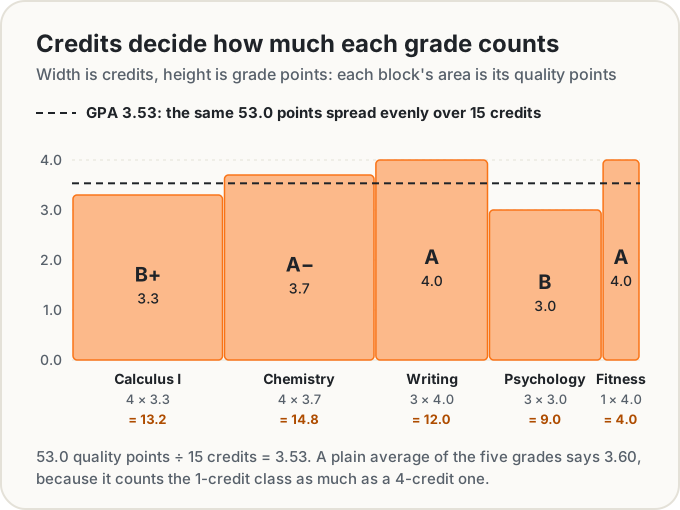
You can type the same five courses into our GPA calculator and it shows each line of the working, plus a strip where each course's width is its credits.
Weighted vs unweighted GPA
An unweighted GPA uses the plain 4.0 scale for every class. A weighted GPA, which is mostly a high school thing, adds a bonus for harder classes so that a B in an AP class isn't counted the same as a B in a regular one.
A common convention is +0.5 for Honors and +1.0 for AP, IB and dual enrollment. Fairfax County Public Schools in Virginia uses exactly those: Honors courses are "weighted with an additional 0.5 quality points", and AP, IB and dual enrollment courses with an additional 1.0. That puts the top of a weighted scale at 5.0. Other districts use different bonuses, cap how many weighted classes count, or don't weight at all, so check your school's handbook.
Here's a high school semester with one AP and one Honors class, each worth 1 credit:
| Course | Grade | Unweighted | Bonus | Weighted |
|---|---|---|---|---|
| AP Biology | B+ | 3.3 | +1.0 | 4.3 |
| Honors English | A− | 3.7 | +0.5 | 4.2 |
| Algebra II | B | 3.0 | 3.0 | |
| US History | A | 4.0 | 4.0 | |
| Spanish II | A− | 3.7 | 3.7 | |
| PE | A | 4.0 | 4.0 | |
| Total | 21.7 | 23.2 |
Unweighted, that's 21.7 ÷ 6 = 3.62. Weighted, it's 23.2 ÷ 6 = 3.87. Notice that the B+ in AP Biology counts for more on the weighted scale (4.3) than the A in US History (4.0).
To try it, open the weighted example in the GPA calculator: it shows the weighted GPA out of 5.0 and the unweighted one underneath. It doesn't add a bonus to an F, which stays at 0 in any class.
Colleges may recalculate your GPA
The weighted GPA on a high school transcript isn't always the number a college uses. A college can recalculate it by its own rules, and the University of California publishes exactly how it does so. For admission, UC's GPA:
- counts only its A-G college-prep courses taken from the summer after 9th grade through the summer after 11th grade;
- ignores pluses and minuses (A = 4, B = 3, C = 2, D = 1);
- adds one extra point per semester of a UC-approved honors-level course, but only for an A, B or C, and at most 8 points in total, with no more than 4 from 10th grade.
So under UC's rules, a semester B+ in AP Biology counts as 3 + 1 = 4, not 4.3. If you're applying, report your GPA exactly as each application asks, and don't be surprised if a college's own figure is different.
Cumulative GPA (and the mistake to avoid)
Your cumulative GPA is your GPA across every semester so far. It uses the same rule as a semester GPA: all your quality points divided by all your credits. Cornell's grading page describes it exactly that way.
The common mistake is to average your semester GPAs. That only works when every semester has the same number of credits, and they rarely do.
Say you'd finished 45 credits with a 3.20 GPA before the semester above. Your old record is worth 3.20 × 45 = 144.0 quality points. Add this semester's 53.0 points and 15 credits:
(144.0 + 53.0) ÷ (45 + 15) = 197.0 ÷ 60 = 3.28
Averaging the two GPAs gives (3.20 + 3.53) ÷ 2 = 3.37, which is wrong: it lets 15 credits pull as hard as 45. Think of it as a balance, where each block's weight is its credits:
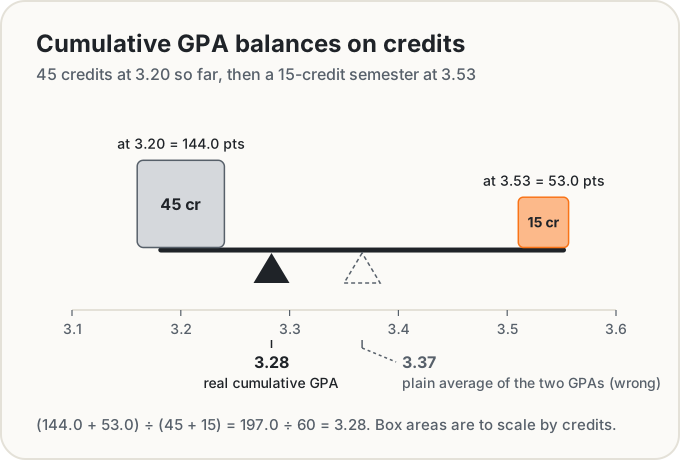
The error gets bigger when the credit loads are lopsided. A 3-credit summer class with an A (4.0) and a 15-credit semester at 2.50 average out to 3.25. The real figure is (12.0 + 37.5) ÷ 18 = 2.75.
One small catch: a GPA on a transcript is usually rounded, so 3.20 × 45 might be a little off from your true points. If your transcript lists total quality points (or grade points) and GPA credits, use those.
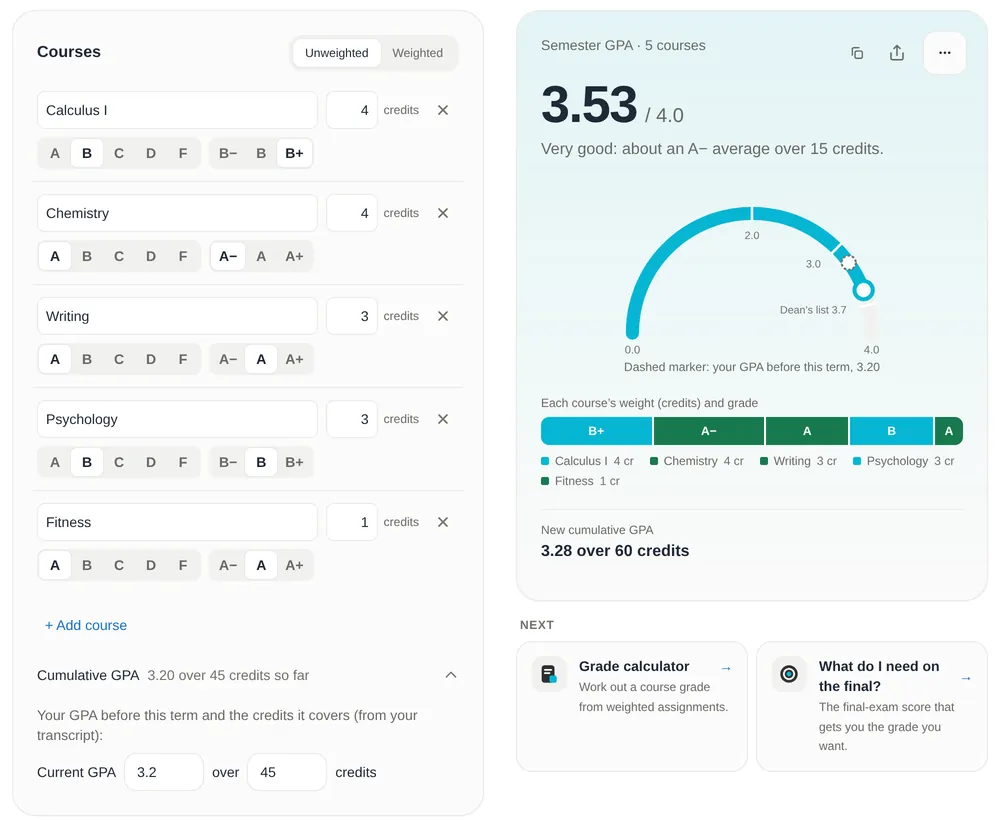
In the GPA calculator, open "Cumulative GPA" and enter your GPA so far and the credits it covers. With the example semester, it shows the 3.53 for the term and 3.28 as the new cumulative GPA, with the sum written out:
What do I need on my final?
If the final is worth a fixed share of your course grade, the score you need is:
Needed on the final = (Target − Current × (1 − Weight)) ÷ Weight
where Current is your grade so far, Target is the course grade you want, and Weight is the final's share as a decimal (30% = 0.30).
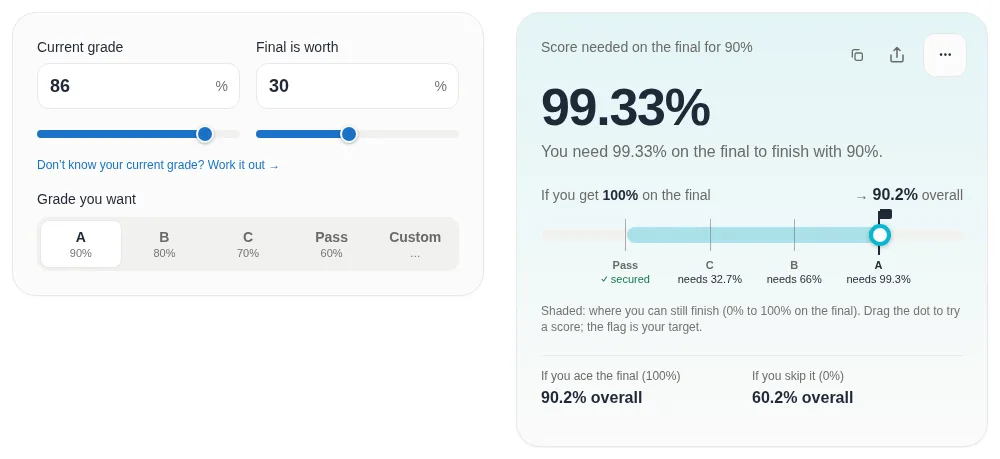
Say you have an 86% going into a final worth 30%, and you want a 90% for an A:
- Everything before the final counts for 1 − 0.30 = 0.70 of the grade.
- Your 86% contributes 86 × 0.70 = 60.2 points.
- The final has to make up the rest: 90 − 60.2 = 29.8 points.
- 29.8 ÷ 0.30 = 99.33% needed on the final.
That's tough, but the same sum for a B (80%) gives (80 − 60.2) ÷ 0.30 = 66%. And you can't fail the course on a 60% pass mark: even a 0 on the final leaves you at 60.2%. A perfect 100% would give 60.2 + 30 = 90.2%.
Two things to check before you trust the answer. First, "current grade" means your weighted grade on everything graded so far, not the average of your test scores; the grade calculator works that out from your assignments and their weights. Second, the letter cut-offs are your school's or your teacher's: 90% is a common line for an A, but Fairfax County, for example, starts an A at 93%. And if your syllabus says you have to pass the final itself to pass the course, that rule sits on top of the arithmetic.
The final grade calculator shows the score you need for an A, B, C and a pass at once, the best and worst overall grade still open to you, and the working:
How to raise your GPA, and why it gets harder
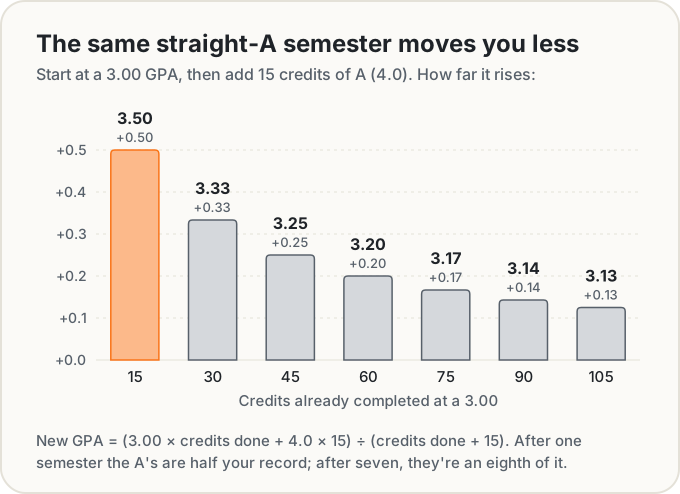
A GPA is an average weighted by credits, so each new grade gets diluted by every credit you've already earned. The more credits behind you, the less one semester can move it.
Take a student with a 3.00 who then earns straight A's over 15 credits. After one earlier semester (15 credits), that lifts them to 3.50. After seven (105 credits), the same perfect semester only reaches 3.13:
You can work out how many credits it takes to reach a target GPA:
Credits needed = Credits done × (Target − Current) ÷ (New average − Target)
where New average is the GPA you expect to earn from here on. Some examples with 60 credits done and a 2.80 GPA:
- To reach 3.00 with straight A's (4.0): 60 × 0.20 ÷ 1.00 = 12 credits, about one semester.
- To reach 3.50 with straight A's: 60 × 0.70 ÷ 0.50 = 84 credits. On a 120-credit degree, there are only 60 left.
- To reach 3.50 with an A− average (3.7): 60 × 0.70 ÷ 0.20 = 210 credits.
The new average has to be above the target, or the target can't be reached at all. That's the honest answer to "can I raise my GPA from 2.8 to 3.5?": early on, yes; late in a degree, usually not by grades alone.
What actually helps, in order of how much it moves the number:
- Do well in the heavy classes. A 4-credit class moves your GPA four times as much as a 1-credit one, in both directions.
- Act early. Every semester you wait adds credits that dilute what comes next.
- Check your school's repeat policy. At Berkeley, when you repeat a course for the first time, only the newer grade counts in the GPA (for up to 12 repeated units), though both stay on the transcript. Policies vary a lot between schools, so read yours before you sign up for a repeat.
- Know that pass/fail won't raise it. A pass carries no grade points, so it protects your GPA from a low grade but can't lift it either.
If the real bottleneck is study time rather than arithmetic, we compared Pomodoro and other break methods and what the research says about each.
Frequently asked questions
How do I calculate GPA from percentage grades?
Turn each percentage into a letter grade using your school's scale, then use the letter's grade points as above. Scales differ: Fairfax County uses 93 to 100 for an A, 90 to 92 for an A− and 87 to 89 for a B+, while plenty of classes use 90% and up for any A. Your syllabus or school handbook has the scale that applies to you.
Do pass/fail classes count toward GPA?
Usually not. At Berkeley, P, NP and similar grades carry no grade points and their units are left out of the GPA, so a pass neither raises nor lowers it. A failing grade in a graded class is different: an F counts as 0.0 with its full credits, and pulls the average down.
Is a weighted or unweighted GPA better?
Neither is better; they answer different questions. The unweighted GPA shows your grades alone. The weighted one also rewards harder classes. Colleges see your transcript and course list either way, and many recalculate a GPA by their own rules, as the UC example above shows.
Can I calculate my GPA with semester GPAs only?
Only if you also know each semester's credits. Multiply each semester GPA by its credits, add those up and divide by the total credits. Averaging the semester GPAs directly is only correct when every semester had the same number of credits.
Work out your own
The GPA calculator handles plus and minus grades, credits, Honors and AP weighting and your cumulative GPA, and shows its working. The final grade calculator tells you what you need on the exam, and the grade calculator gives your course grade so far from weighted assignments. All three run in your browser, and the link to your result holds the numbers you typed, so it only goes where you send it.
Sources
- University of California, Berkeley, Office of the Registrar. Grades and Grading. The grade-point table, A+ counting as an A, pass/fail units left out of the GPA, and the repeat policy.
- University of California San Diego. Calculate Your GPA. Grade points and the steps (multiply by units, add, divide, don't round).
- Cornell University, ILR School. Academic Grades and Notations. A+ as 4.3, and semester and cumulative GPA by credit hours.
- Massachusetts Institute of Technology, Registrar's Office. Calculating Your GPA. The 5.0 scale.
- Fairfax County Public Schools. FCPS Postsecondary Profile, 2025-26. Weighting (Honors +0.5; AP, IB and dual enrollment +1.0) and the percentage scale.
- University of California Admissions. GPA requirement. How UC recalculates a high school GPA for admission.
Share this post
Keep reading
Math· Oct 7, 2026· 7 min
How to Add, Subtract, Multiply and Divide Fractions
Fractions step by step: simplify with the GCF, add unlike denominators with the LCD, multiply, divide with keep-change-flip, and handle mixed numbers.Math· Oct 9, 2026· 13 min
Multiplication Chart Patterns: Times Tables Tricks That Work
A 12×12 multiplication chart holds 78 facts, and only 21 are hard. The patterns that give you the rest, the 7 × 8 trick, and how to practise what's left.Math· Oct 8, 2026· 6 min
GCF vs LCM, Explained with Examples (and When You Need Each)
The greatest common factor and least common multiple, worked three ways (listing, prime factors, Euclid's algorithm), and which one a problem needs.