Multiplication Chart Patterns: Times Tables Tricks That Work
A 12×12 multiplication chart holds 78 facts, and only 21 are hard. The patterns that give you the rest, the 7 × 8 trick, and how to practise what's left.
Math···13 min read
A 12 × 12 multiplication chart has 144 squares, but only 78 different facts, because 7 × 8 and 8 × 7 are the same fact. Cross off the tables that follow a one-line rule (the 1s, 2s, 5s, 10s and 11s) and the square numbers on the diagonal, and you're left with 21 facts. Those 21 are the real work of learning the times tables, and nearly every one of them can be built from something you already know.
That's the short answer to "how do I learn the times tables fast": don't learn 144 things. Learn the shape of the chart, let the patterns take most of it, and spend your practice on the few facts that are left. It works the same for an adult relearning them, a parent helping at home and a teacher planning lessons.
144 squares, 78 facts
Each square on the chart is its row times its column. Read along row 7 and you get the 7 times table; read down column 7 and you get exactly the same numbers. The Common Core puts it plainly: if 6 × 4 = 24 is known, then 4 × 6 = 24 is also known (3.OA.B.5).
So the chart is two copies of one triangle, folded along the diagonal. On a 12 × 12 chart the diagonal holds 12 square numbers (1 × 1 up to 12 × 12) and each side holds 66 pairs, which makes 12 + 66 = 78 facts to know. A 1 to 10 chart has 100 squares and 55 facts.
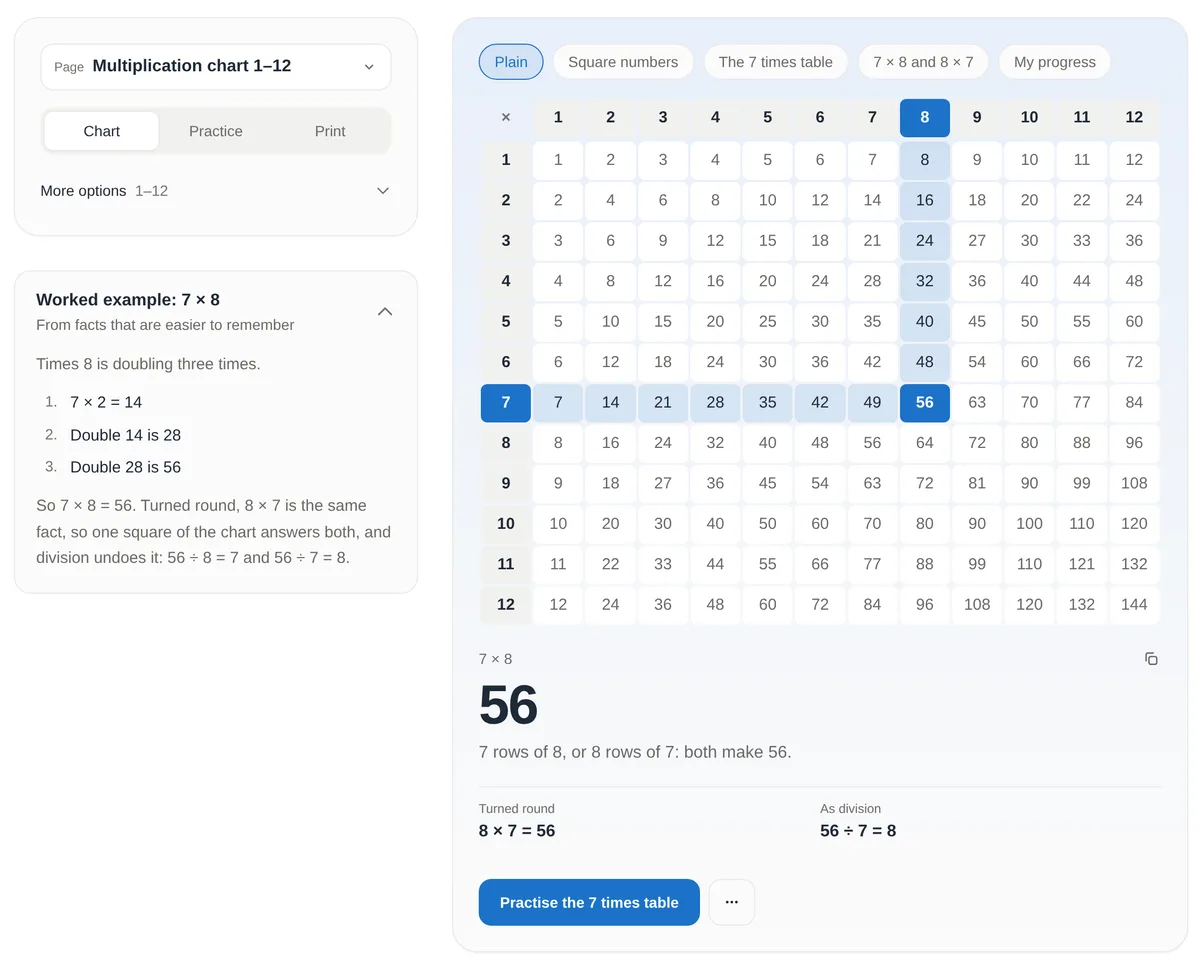
Tap any square on our multiplication chart and its row and column light up, with the answer, the fact turned round, the matching division, and a quick way to work it out.
Cross off the easy ones
Five tables have a rule simple enough that you never need to memorise them one fact at a time:
| Table | The rule | Facts it clears |
|---|---|---|
| 1s | Anything times 1 stays the same | 12 |
| 2s | Double it | 11 |
| 5s | Times 10, then halve | 10 |
| 10s | Every digit moves one place left | 9 |
| 11s | 1 to 9 written twice (11 × 7 = 77); past that, ten lots plus one | 8 |
The counts shrink because each table only clears the facts the tables above it haven't already taken: 2 × 5 is gone by the time you reach the 5s. Together they clear 50 of the 78 facts.
The diagonal goes next. Square numbers (a number times itself) have patterns of their own, covered below, and the five that belong to easy tables are already gone. That's 7 more: 9, 16, 36, 49, 64, 81 and 144.
What's left is 78 − 50 − 7 = 21 facts.
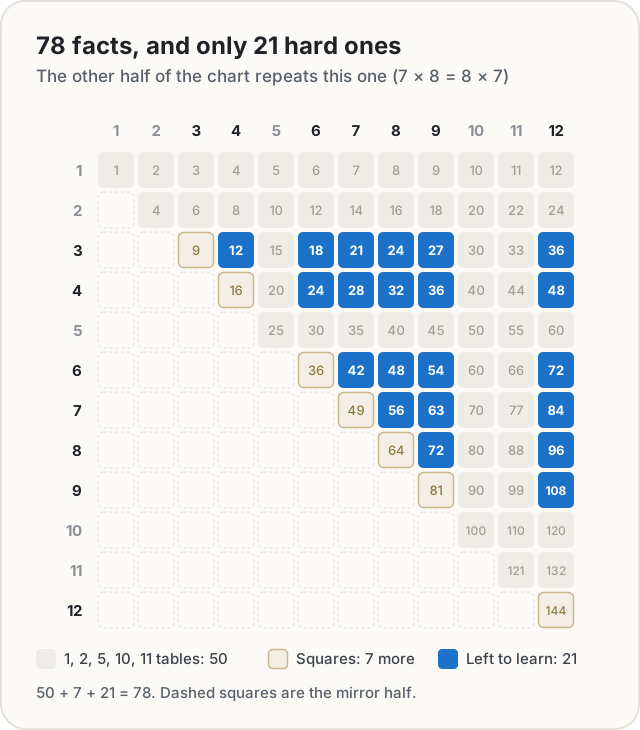
Every one of the 21 comes from the 3, 4, 6, 7, 8, 9 and 12 tables. That lines up with England's multiplication tables check, which puts more questions on the 6, 7, 8, 9 and 12 tables because the Standards and Testing Agency found them the most difficult (MTC assessment framework). If you only want the 1 to 10 chart, the same cross-off leaves 15.
The patterns, table by table
Each table has a pattern that does most of the remembering for you. These are the ones worth knowing.
The 9s: the digits add up to 9
Up to 9 × 10, two things are always true. The tens digit is one less than the number you're multiplying by, and the two digits add up to 9. For 9 × 7, the tens digit is 6, and 6 + 3 = 9, so it's 63.
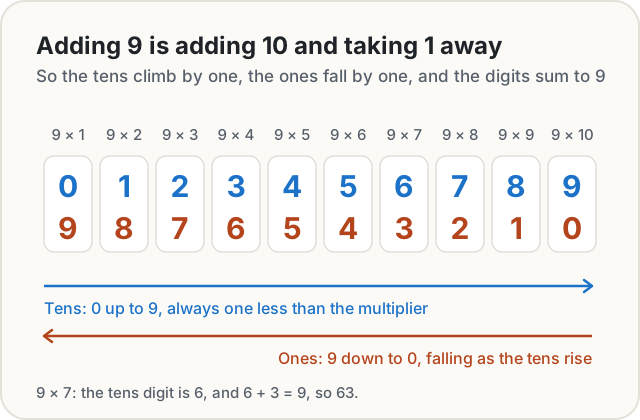
Why it works: adding 9 is adding 10 and taking 1 away, so each step pushes the tens up by one and the ones down by one. It's also why any multiple of 9 has digits that add up to a multiple of 9 (divisibility rule). Past 10, use ten lots take away one lot: 9 × 12 is 120 − 12 = 108.
The finger trick does the same thing with your hands. Hold up all ten fingers and fold down the one for the number you're multiplying by, counting from the left. For 9 × 4, fold the fourth finger: 3 fingers stand to its left and 6 to its right, so 36.
The 5s: always 0 or 5
Every answer in the 5 table ends in 5 (an odd number times 5) or 0 (an even number times 5), and it's always half of ten lots: 5 × 8 is half of 80, so 40. If you can read an analogue clock you already use it, since the minute hand on the 9 means 45 minutes past.
The 4s and 8s: keep doubling
Four is 2 × 2 and eight is 2 × 2 × 2, so times 4 is doubling twice and times 8 is doubling three times. 4 × 7: 14, 28. 8 × 12: 24, 48, 96. England's national curriculum teaches it this way on purpose, connecting the 2, 4 and 8 tables through doubling in year 3 (national curriculum).
The 11s: the digit twice, up to 9
11 × 1 to 11 × 9 is the digit written twice: 11 × 6 = 66. After that, ten lots plus one: 11 × 12 is 120 + 12 = 132.
The 6s: the 5s plus one more
Six lots is five lots and one more lot. 6 × 7 is 35 + 7 = 42; 6 × 8 is 40 + 8 = 48. There's a check built in, too: 6 times an even number ends in that number's own last digit (6 × 4 = 24, 6 × 8 = 48), so if you're torn between 46 and 48 for 6 × 8, the 8 on the end settles it.
7 × 8 = 56: "5, 6, 7, 8"
The classic 7 times table trick is a memory line, not maths. Write 56 = 7 × 8 and the digits run 5, 6, 7, 8 in order. It's worth having, because 7 × 8 sits in two of the five tables the check treats as hardest, and 54 or 58 can sound right when you're unsure. (8 × 7 must end in 6 anyway: the 8 table's last digits go 8, 6, 4, 2, 0 and repeat.)
The squares: the diagonal
The diagonal runs 1, 4, 9, 16, 25, 36, 49, 64, 81, 100, 121, 144. The gaps between them are the odd numbers in order, 3, 5, 7, 9 and so on (square number), so 64 to 81 is a jump of 17.
The squares also hand you their neighbours. Multiply the two numbers either side of 8 and you get one less than 8 × 8: 7 × 9 = 64 − 1 = 63. The same goes for 6 × 8 = 49 − 1 = 48 and 4 × 6 = 25 − 1 = 24. That's three of the 21 hard facts from squares you already know.
Work out the hard facts from the easy ones
This is where the chart earns its keep. You don't have to memorise 7 × 8 cold. You can reach it from 7 × 2, which almost everyone knows, by doubling three times: 7 × 2 is 14, double 14 is 28, double 28 is 56.
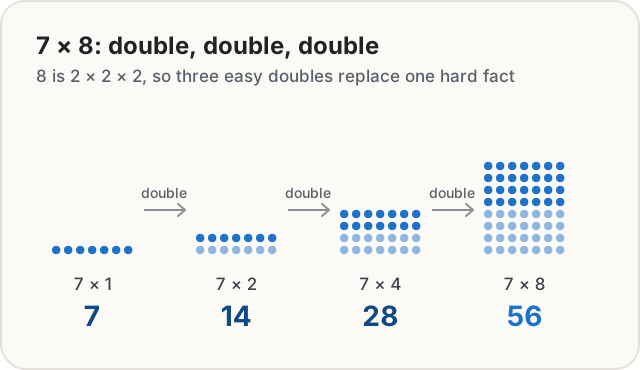
That's the route our chart shows when you open it, and it's a fine way to start. Another works just as well: split 7 into 5 + 2, so 7 × 8 is 5 × 8 = 40 plus 2 × 8 = 16, which makes 56. That second one is the Common Core's own example of the distributive property (3.OA.B.5).
Here are all 21, each with the route the chart gives:
| Fact | Answer | Route |
|---|---|---|
| 3 × 4 | 12 | 3 × 2 = 6, double 6 |
| 3 × 6 | 18 | 6 × 2 = 12, plus 6 |
| 3 × 7 | 21 | 7 × 2 = 14, plus 7 |
| 3 × 8 | 24 | 8 × 2 = 16, plus 8 |
| 3 × 9 | 27 | 9 × 2 = 18, plus 9 |
| 3 × 12 | 36 | 12 × 2 = 24, plus 12 |
| 4 × 6 | 24 | 6 × 2 = 12, double 12 |
| 4 × 7 | 28 | 7 × 2 = 14, double 14 |
| 4 × 8 | 32 | 8 × 2 = 16, double 16 |
| 4 × 9 | 36 | 9 × 2 = 18, double 18 |
| 4 × 12 | 48 | 12 × 2 = 24, double 24 |
| 6 × 7 | 42 | 7 × 5 = 35, plus 7 |
| 6 × 8 | 48 | 8 × 5 = 40, plus 8 |
| 6 × 9 | 54 | 6 × 10 = 60, minus 6 |
| 6 × 12 | 72 | 12 × 5 = 60, plus 12 |
| 7 × 8 | 56 | 7 × 2 = 14, double to 28, double to 56 |
| 7 × 9 | 63 | 7 × 10 = 70, minus 7 |
| 7 × 12 | 84 | 7 × 10 = 70, plus 7 × 2 = 14 |
| 8 × 9 | 72 | 8 × 10 = 80, minus 8 |
| 8 × 12 | 96 | 12 × 2 = 24, double to 48, double to 96 |
| 9 × 12 | 108 | 12 × 10 = 120, minus 12 |
A route is a ladder, not the goal. Both England's curriculum and the Common Core aim for recall: England expects pupils to know their tables up to 12 × 12 by the end of year 4 (national curriculum), and the Common Core asks students to "know from memory all products of two one-digit numbers" by the end of grade 3 (3.OA.C.7). Working a fact out a dozen times is how it turns into a fact you just know.
Practise the misses, not the whole chart
Once the routes make sense, practice should go where you're weakest. Running through the 7 times table from the top spends most of its time on 7 × 2 and 7 × 5, which you never miss.
Our times tables practice works the other way round:
- Missed facts come back. Get one wrong and you see the right answer and a quick route, and the same fact returns 3 questions later.
- Weak facts come up more. Questions are drawn at random, but a fact you just missed is six times as likely as one you know, and known facts still turn up now and then for review.
- "Known" means fast and right, more than once. A fact counts as known after 3 right answers in a row, each within 6 seconds. That's the time England's check allows per question, which the Standards and Testing Agency chose after trialling three time limits with 1,124 pupils, as long enough to recall an answer but not to work it out (MTC assessment framework).
- New facts arrive slowly. Once 6 facts are in progress, new ones come in much less often until some of those are known, so you're never juggling the whole chart at once.
The timer is off unless you switch it on. Speed is measured either way, because a slow right answer doesn't count towards "known", but it doesn't set you back either.
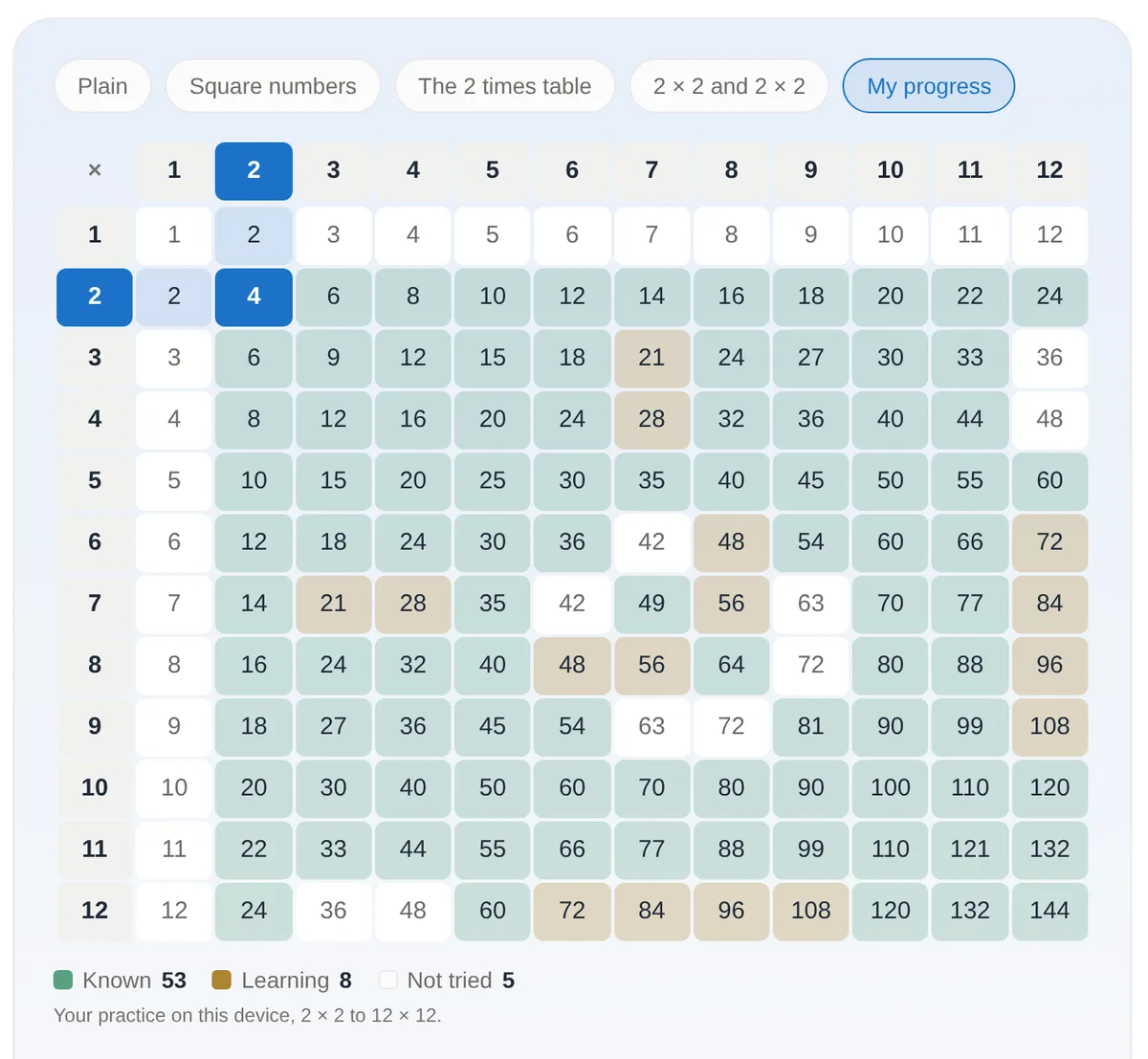
Choose My progress above the chart and it turns into a heat map of everything practised so far, so you can see the 21 shrink. Progress is saved in your browser for each person practising (a nickname is enough), and nothing is sent to us. If you want paper, Print then Facts to learn lists the facts that aren't known yet with a practice sheet of just those.
How long and how often to practise, and whether a timer helps or hurts, is a bigger question with real research behind both sides. We covered it in math fact fluency: timed practice, spacing and worksheets. The short version is little and often, with old facts mixed in.
A plan that fits on a sticky note
- Learn the shape. One triangle, 78 facts, and 7 × 8 is 8 × 7.
- Cross off 57. The 1s, 2s, 5s, 10s and 11s by rule, and the squares.
- Learn the patterns for the 9s, 6s, 4s and 8s, plus "5, 6, 7, 8".
- Give each of the 21 a route you can do in your head, and use it until you don't need it.
- Practise the misses, a few minutes at a time, until each one comes back fast three times running.
If you want to see where you stand first, try a practice check in England's format: 25 questions, 6 seconds each, from the 2 to 12 tables. It's a quick way to find out which of the 21 are still yours to learn.
Sources
- Department for Education (2013). National curriculum in England: mathematics programmes of study. Years 2 to 4, multiplication and division.
- National Governors Association Center for Best Practices & Council of Chief State School Officers (2010). Common Core State Standards for Mathematics, Grade 3: 3.OA.B.5 and 3.OA.C.7.
- Standards and Testing Agency (2018, updated March 2022). Multiplication tables check assessment framework (STA/18/8308/e).
- Wikipedia. Divisibility rule and Square number.
Keep reading
Math · Oct 7, 2026 · 10 min
Math Fact Fluency: Timed Practice, Spacing and Worksheets
What math fact fluency means, what research says about timed practice and math anxiety, and how to use short, mixed worksheets and answer keys well.
Math · Oct 8, 2026 · 6 min
GCF vs LCM, Explained with Examples (and When You Need Each)
The greatest common factor and least common multiple, worked three ways (listing, prime factors, Euclid's algorithm), and which one a problem needs.
Math · Oct 7, 2026 · 7 min
How to Add, Subtract, Multiply and Divide Fractions
Fractions step by step: simplify with the GCF, add unlike denominators with the LCD, multiply, divide with keep-change-flip, and handle mixed numbers.
Math · Oct 7, 2026 · 10 min
Math Fact Fluency: Timed Practice, Spacing and Worksheets
What math fact fluency means, what research says about timed practice and math anxiety, and how to use short, mixed worksheets and answer keys well.
Math · Oct 8, 2026 · 6 min
GCF vs LCM, Explained with Examples (and When You Need Each)
The greatest common factor and least common multiple, worked three ways (listing, prime factors, Euclid's algorithm), and which one a problem needs.
Math · Oct 7, 2026 · 7 min
How to Add, Subtract, Multiply and Divide Fractions
Fractions step by step: simplify with the GCF, add unlike denominators with the LCD, multiply, divide with keep-change-flip, and handle mixed numbers.