Pythagorean Theorem Explained with Real-World Examples
The Pythagorean theorem (a² + b² = c²) explained: how this geometric principle applies to right-angled triangles, with practical examples.
Math···4 min read
Introduction: A Cornerstone of Geometry
The Pythagorean theorem is one of the most famous and fundamental theorems in mathematics, specifically in Euclidean geometry. Attributed to the ancient Greek mathematician Pythagoras, it describes a simple yet powerful relationship between the sides of a right-angled triangle.
A right-angled triangle (or right triangle) is a triangle where one of the angles is exactly 90 degrees. The side opposite the right angle is called the hypotenuse, and it is always the longest side. The other two sides are called the legs.
The Theorem: a² + b² = c²
The theorem states:
In a right-angled triangle, the square of the length of the hypotenuse (c) is equal to the sum of the squares of the lengths of the other two sides (legs a and b).
Mathematically, this is expressed as:
Where:
aandbare the lengths of the legs of the right triangle.cis the length of the hypotenuse.
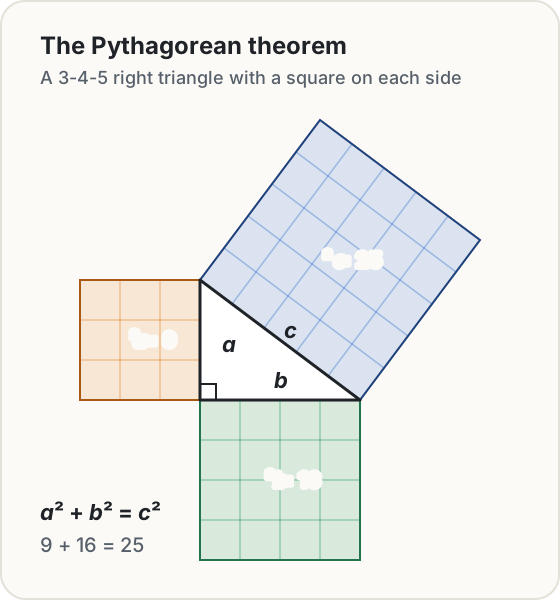
This theorem allows us to find the length of any side of a right triangle if we know the lengths of the other two sides.
Finding the Hypotenuse
If you know the lengths of the two legs (a and b), you can find the hypotenuse (c) by rearranging the formula:
Example: A right triangle has legs of length 3 units and 4 units. Find the length of the hypotenuse.
a = 3,b = 4
The hypotenuse is 5 units long. (This is a classic 3-4-5 right triangle).
Finding a Leg
If you know the length of the hypotenuse (c) and one leg (say, a), you can find the other leg (b):
Example: A right triangle has a hypotenuse of length 13 units and one leg of length 5 units. Find the length of the other leg.
c = 13,a = 5
The other leg is 12 units long. (This is a 5-12-13 right triangle).
Real-World Applications
The Pythagorean theorem isn't just for geometry class; it has numerous practical applications:
-
Navigation: Calculating the shortest distance between two points. If you travel 3 miles east and then 4 miles north, the straight-line distance back to your starting point (the hypotenuse) is 5 miles ()). This is fundamental in GPS calculations and air/sea navigation.
-
Construction and Architecture: Ensuring corners are perfectly square (90 degrees). Builders use the 3-4-5 ratio (or multiples) to check right angles. For example, measuring 3 feet along one wall from a corner and 4 feet along the other, the distance between those two points should be exactly 5 feet if the corner is square.
-
Surveying: Determining the elevation or slope of land. Surveyors use triangulation and the Pythagorean theorem to measure distances and heights that are difficult to access directly.
-
Screen Sizes: TV and computer monitor sizes (e.g., a "55-inch screen") refer to the diagonal length (the hypotenuse). The theorem can relate this diagonal to the screen's width and height.
-
Sports: Calculating the distance a catcher needs to throw from home plate to second base on a baseball diamond (the diagonal of a square).
-
Design: Used in graphic design, game development, and engineering to calculate distances, placements, and trajectories.
Visual Proof (Example)
There are many ways to prove the Pythagorean theorem. One common visual approach involves arranging four identical right triangles around a square:
Imagine four right triangles with legs a and b and hypotenuse c. Arrange them such that their hypotenuses form a large square, and their legs form a smaller tilted square in the center with side length (assuming ).
The area of the large square (side length c) is .
The total area can also be calculated as the sum of the areas of the four triangles plus the area of the inner square:
Area = 4 * (½ * a * b) + (b - a)²
Area = 2ab + (b² - 2ab + a²)
Area = a² + b²
Since both calculations represent the area of the same large square, we have:
(This is just one of many proofs)
Conclusion
The Pythagorean theorem is a testament to the beauty and utility of mathematics. Its simple formula, , provides a fundamental link between the sides of a right triangle, enabling calculations that are essential in fields ranging from construction and navigation to computer graphics and physics. Understanding this theorem opens the door to a deeper appreciation of geometry and its role in describing the world around us.
Share this post
Keep reading
Math· Apr 18, 2025· 4 min· Updated Oct 2026
Understanding Euler's Identity: The Most Beautiful Equation
Explore Euler's Identity, e^(iπ) + 1 = 0, and why this equation linking five fundamental constants is called the most beautiful in math.Math· Apr 11, 2025· 4 min
Order of Operations (PEMDAS/BODMAS): Why It Matters
Understand the order of operations (PEMDAS/BODMAS): the rules for parentheses, exponents, multiplication, division, addition, and subtraction.Math· Apr 4, 2025· 5 min· Updated Oct 2026
The Power of Exponentials: Growth and Decay in Nature and Finance
Explore exponential functions and their profound impact on modeling real-world phenomena, from population growth and radioactive decay to compound interest.