The Power of Exponentials: Growth and Decay in Nature and Finance
Explore exponential functions and their profound impact on modeling real-world phenomena, from population growth and radioactive decay to compound interest.
Math···5 min read
Introduction: Beyond Linear Change
Many things in the world change at a constant rate – this is linear change. For example, if you save $100 each month without interest, your savings grow linearly. However, many other phenomena exhibit a much more dramatic type of change: exponential growth or exponential decay.
Exponential change occurs when the rate of change of a quantity is proportional to the quantity itself. In simpler terms:
- Exponential Growth: The larger the quantity gets, the faster it grows.
- Exponential Decay: The larger the quantity gets, the faster it shrinks (or the smaller it gets, the slower it shrinks).
These processes are modeled mathematically using exponential functions.
What is an Exponential Function?
An exponential function is generally written in the form:
Where:
ais the initial value (the value of the function whenx = 0, since ).amust be non-zero.bis the base, which is a positive constant other than 1. The base determines the rate of growth or decay.xis the exponent, typically representing time or another independent variable.
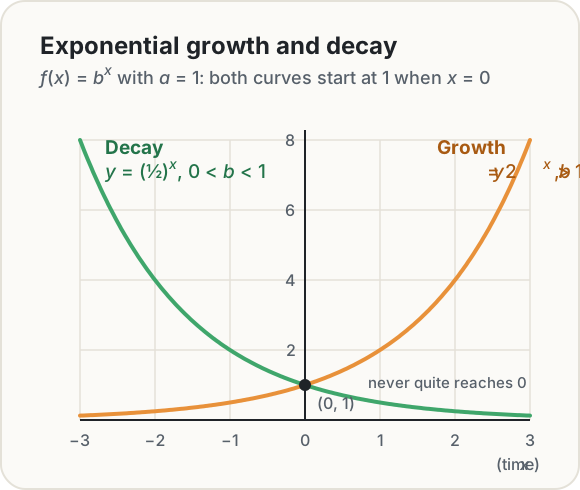
Key Behavior based on the base b:
- If
b > 1, the function represents exponential growth. Asxincreases, the function value increases at an accelerating rate. - If
0 < b < 1, the function represents exponential decay. Asxincreases, the function value approaches zero, decreasing rapidly at first and then more slowly.
Exponential Growth in the Real World
-
Compound Interest: This is a classic example. When interest earned is added to the principal, future interest is calculated on the larger amount. The growth accelerates over time. The compound interest formula is a direct application of the exponential function (see our compound interest post).
-
Population Growth: Under ideal conditions (unlimited resources, no predators), populations of bacteria, animals, or even humans can grow exponentially. Each generation produces offspring, leading to faster and faster population increases.
-
Viral Spread: In the early stages of an epidemic, the number of infected individuals can grow exponentially as each infected person spreads the disease to multiple others.
-
Technology Adoption: The adoption rate of new technologies (like smartphones or internet usage) often follows an S-curve, which has an initial phase of exponential growth.
Example: Bacterial Growth
Suppose a bacterial culture starts with 100 bacteria (a = 100) and doubles (b = 2) every hour (x = hours).
The population after x hours is:
- After 1 hour:
- After 2 hours:
- After 5 hours:
- After 10 hours: Notice how rapidly the population increases.
Exponential Decay in the Real World
-
Radioactive Decay: Radioactive isotopes decay over time, transforming into other elements. The rate of decay is proportional to the amount of the isotope present. This is characterized by the half-life – the time it takes for half of the substance to decay. The base
bin this case would be 0.5, andxwould represent the number of half-lives. -
Depreciation: The value of certain assets, like cars, often decreases exponentially, losing a larger percentage of their value in the early years.
-
Drug Elimination: The concentration of a drug in the bloodstream often decreases exponentially after administration as the body metabolizes and eliminates it.
-
Cooling: According to Newton's Law of Cooling, the rate at which an object cools is proportional to the temperature difference between the object and its surroundings. This leads to an exponential decrease in the temperature difference over time.
Example: Radioactive Decay
Suppose a substance has a half-life of 10 years, and you start with 500 grams (a = 500). We want to find the amount remaining after t years.
First, find the decay factor per year. If it halves in 10 years, the base b raised to the power of 10 should be 0.5: . So, .
The formula becomes:
Alternatively, using half-life directly:
Where t/10 represents the number of half-lives that have passed in t years.
- Amount after 10 years (1 half-life): g
- Amount after 30 years (3 half-lives): g
The Number e (Euler's Number)
A special base often used in exponential functions, particularly for natural processes, is Euler's number, e, which is approximately 2.71828. The function (the natural exponential function) has unique mathematical properties, making it fundamental in calculus and modeling continuous growth or decay.
Conclusion
Exponential functions are incredibly powerful tools for describing and predicting change in the world around us. From the growth of investments and populations to the decay of radioactive materials and the cooling of objects, the principles of exponential growth and decay are fundamental. Understanding these concepts allows us to appreciate the rapid nature of certain changes and make more informed predictions about phenomena in science, finance, and beyond.
Share this post
Keep reading
Math· Apr 18, 2025· 4 min· Updated Oct 2026
Understanding Euler's Identity: The Most Beautiful Equation
Explore Euler's Identity, e^(iπ) + 1 = 0, and why this equation linking five fundamental constants is called the most beautiful in math.Math· Apr 11, 2025· 4 min
Order of Operations (PEMDAS/BODMAS): Why It Matters
Understand the order of operations (PEMDAS/BODMAS): the rules for parentheses, exponents, multiplication, division, addition, and subtraction.Math· Mar 7, 2025· 4 min· Updated Oct 2026
Pythagorean Theorem Explained with Real-World Examples
The Pythagorean theorem (a² + b² = c²) explained: how this geometric principle applies to right-angled triangles, with practical examples.