Understanding Euler's Identity: The Most Beautiful Equation
Explore Euler's Identity, e^(iπ) + 1 = 0, and why this equation linking five fundamental constants is called the most beautiful in math.
Math···4 min read
Introduction: A Mathematical Jewel
In the vast landscape of mathematics, certain equations stand out for their elegance, profundity, and the surprising connections they reveal. Perhaps none is more celebrated in this regard than Euler's Identity:
This seemingly simple equation links five of the most fundamental constants in mathematics in a single, concise statement:
e(Euler's Number): The base of the natural logarithm, approximately 2.71828..., fundamental to calculus and growth processes.i(Imaginary Unit): Defined as , the foundation of complex numbers.π(Pi): The ratio of a circle's circumference to its diameter, approximately 3.14159..., ubiquitous in geometry and trigonometry.1: The multiplicative identity, the basis of counting.0: The additive identity, representing nothingness.
It also involves three fundamental arithmetic operations: exponentiation, multiplication (implicit between i and π), and addition.
The sheer economy and the profound connection between constants from different branches of mathematics (calculus, geometry, algebra) are why many mathematicians, scientists, and enthusiasts consider Euler's Identity to be exceptionally beautiful.
The Foundation: Euler's Formula
Euler's Identity is actually a special case of a more general formula, also discovered by Leonhard Euler, known as Euler's Formula:
Where:
eis Euler's number.iis the imaginary unit.xis a real number representing an angle in radians.cos(x)andsin(x)are the trigonometric functions cosine and sine.
This formula establishes a deep relationship between exponential functions and trigonometry through the use of complex numbers. It can be derived using Taylor series expansions for , , and , but we'll focus on understanding its meaning and application here.
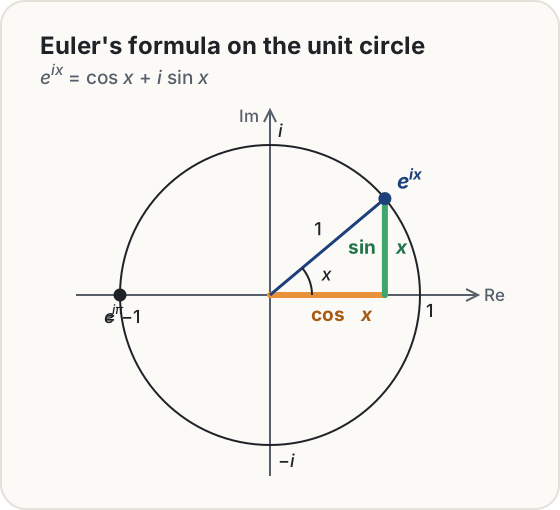
What does mean geometrically?
Euler's formula tells us that represents a point on the unit circle (a circle with radius 1 centered at the origin) in the complex plane. The angle this point makes with the positive real axis is x radians.
- The real part,
cos(x), is the projection onto the horizontal (real) axis. - The imaginary part,
sin(x), is the projection onto the vertical (imaginary) axis.
Deriving Euler's Identity from Euler's Formula
Euler's Identity emerges when we choose a specific value for x in Euler's Formula: .
Let's substitute into Euler's Formula:
Now, we evaluate the trigonometric functions at radians (which is 180 degrees):
Substituting these values back into the equation:
Finally, by simply adding 1 to both sides of the equation, we arrive at Euler's Identity:
Geometrically: Setting in Euler's formula means finding the point on the unit circle in the complex plane that is radians (180 degrees) counterclockwise from the positive real axis. This point is precisely -1 on the real axis.
Why is it Considered Beautiful?
The beauty of Euler's Identity lies in several aspects:
- Simplicity: It connects fundamental constants in a remarkably simple form.
- Surprise: It reveals an unexpected link between
e(related to growth/calculus),π(related to circles/geometry), andi(related to complex numbers). - Universality: These constants appear independently across various mathematical and scientific fields.
- Depth: It arises from the profound Euler's Formula, which connects exponentials and trigonometry via complex numbers.
- Completeness: It involves zero, unity, the foundational constants
e,π,i, and basic operations.
Conclusion
Euler's Identity, , is more than just an equation; it's a profound statement about the interconnectedness of different mathematical concepts. Arising as a special case of Euler's Formula (), it elegantly links the five most important mathematical constants. Its simplicity, depth, and the surprising relationship it unveils are why it resonates so deeply with those who appreciate the structure and elegance of mathematics, truly earning its title as perhaps the most beautiful equation.
Share this post
Keep reading
Math· Apr 11, 2025· 4 min
Order of Operations (PEMDAS/BODMAS): Why It Matters
Understand the order of operations (PEMDAS/BODMAS): the rules for parentheses, exponents, multiplication, division, addition, and subtraction.Math· Apr 4, 2025· 5 min· Updated Oct 2026
The Power of Exponentials: Growth and Decay in Nature and Finance
Explore exponential functions and their profound impact on modeling real-world phenomena, from population growth and radioactive decay to compound interest.Math· Mar 7, 2025· 4 min· Updated Oct 2026
Pythagorean Theorem Explained with Real-World Examples
The Pythagorean theorem (a² + b² = c²) explained: how this geometric principle applies to right-angled triangles, with practical examples.